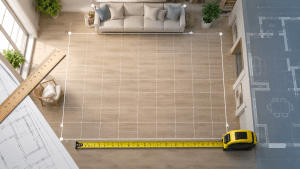
The quarter acre is the quiet workhorse of American real estate. It is the lot size that shows up on more suburban listings than any other, the parcel most first-time buyers end up on, and the number people reach for when they picture ‘a house with a yard.’ Yet ask how many square feet a quarter acre actually is and most people guess. Here is the exact figure, where it comes from, how it stacks up against the other fractional-acre sizes, and what you can really do with it.
Here is the answer up front, and it is a clean, fixed number. A quarter acre is 10,890 square feet. That comes straight from dividing the 43,560 square feet in a full acre by four, and because the acre is fixed by definition, the quarter acre is too. It does not change with the shape of the lot, the state you live in, or the way the listing is worded. A quarter-acre parcel that is a tidy square and one that is a long, skinny rectangle both contain exactly 10,890 square feet.
If you want to convert your own numbers while you read, keep the Square Feet Calculator open in another tab. It turns acres and fractions of an acre into square feet in one tap, and flips the other way just as fast, so you can check any figure on this page against your specific lot.
Drop your lot’s dimensions into the Square Feet Calculator and compare the result against 10,890 to see how close it is to a true quarter acre.
What this guide covers
The short answer, spelled out
A quarter acre is 10,890 square feet. That single number is worth committing to memory if you are house-hunting, because the quarter acre is the default residential lot across huge swaths of American suburbia. When a listing says a home sits on ‘a quarter-acre lot,’ it is telling you the parcel is right around 10,890 square feet, give or take the small variations that come from how a particular subdivision was platted.
The reason the quarter acre became the standard is partly practical and partly historical. It is large enough to hold a comfortable single-family house with a garage, a driveway, and usable yard space front and back, yet small enough to keep lot prices, property taxes, and maintenance within reach of a typical household. That balance is why developers have carved neighborhoods into quarter-acre lots for the better part of a century, and why the 10,890 figure is one of the most useful land numbers an ordinary buyer can know.
Because the quarter acre is simply the full acre split four ways, everything about it flows from that 43,560 base. Half of a quarter acre is an eighth of an acre at 5,445 square feet; double it and you are at a half acre of 21,780 square feet. Keeping the full acre in mind as the anchor makes all the fractional sizes easy to reason about without memorizing each one separately.
Where the number 10,890 comes from
The quarter acre inherits its oddness from the acre itself. A full acre is 43,560 square feet, a figure that traces back to medieval English farming rather than any decimal system, so when you divide it into quarters you get another number that looks strange but is perfectly exact. Forty-three thousand five hundred sixty divided by four is 10,890, with no remainder and no rounding.
1 acre = 43,560 square feet
43,560 ÷ 4 = 10,890 square feet = a quarter acre
It is worth understanding this relationship rather than just memorizing 10,890, because it lets you derive any fraction of an acre on the spot. Need an eighth? Halve 10,890 to get 5,445. Need three-quarters? Multiply 10,890 by three to get 32,670. Every fractional-acre figure is just the 43,560 base scaled by the fraction, so once the acre is locked in, the quarter acre and all its cousins fall out with simple arithmetic. For the full story of where the 43,560 comes from, our guide on how many square feet in an acre walks through the medieval furlong-and-chain origin in detail.
One thing the fixed number does not tell you is the shape. Just like the full acre, a quarter acre is a quantity of area, not a set of dimensions. The 10,890 square feet can be arranged as a square, a wide rectangle, a deep narrow strip, or an irregular polygon following a road or a creek. That freedom is why two quarter-acre lots can look and feel completely different even though they contain the identical area, a point that matters a great deal once you start thinking about what will fit.
How to actually picture a quarter acre
The cleanest mental image starts with the square version. If you shaped a quarter acre into a perfect square, each side would be about 104.4 feet, because the square root of 10,890 is roughly 104.36. So picture a square a bit longer than 100 feet on every side, and you have a quarter acre. For most people that is a little larger than they expect, which is a useful correction, since the quarter acre is often imagined as smaller than it really is.
Real lots are rarely square, though, so it helps to see the same 10,890 square feet in the rectangular shapes developers actually use. A common suburban quarter-acre lot might be about 90 feet of street frontage by 121 feet deep, or 75 feet wide by 145 feet deep, both of which multiply out to 10,890 square feet. Wider, shallower lots feel more spacious from the street; deeper, narrower lots give you a longer back yard. The area is identical; only the proportions change.
The square version
About 104.4 ft on each side. Slightly larger than a third of a football field’s length per side.
A typical lot
Around 90 ft of frontage by 121 ft deep, a proportion you will see across countless suburban streets.
Everyday comparison
Roughly the footprint of about four modest single-story homes, or close to four standard tennis courts laid together.
Comparisons to familiar spaces seal the intuition. A quarter acre is about four tennis courts placed side by side, since a tennis court is roughly 2,800 square feet. It is a little under a quarter of an American football field including the end zones, which run about 57,600 square feet. And it is roughly the combined footprint of three to four modest houses, which is exactly why a full acre feels like it can hold a small cluster of homes. Stacking a few of these pictures together turns 10,890 from an abstract figure into a size you can actually feel.
It also helps to walk it. If you pace out roughly 104 steps in one direction and 104 in another, assuming a step of about a foot, you have traced the boundary of a square quarter acre. Doing that on the ground, or on a satellite map with a measuring tool, tends to land the size more firmly than any number can, because you see how the 10,890 square feet relate to the buildings and streets around them. Many people come away realizing a quarter acre is larger than the tight image they carried, which is the whole point of pinning an abstract area to something physical.
Quarter acre versus half acre and third of an acre
The quarter acre rarely gets considered in isolation. Buyers usually weigh it against the neighboring fractional sizes, so it helps to see the whole ladder at once. Each step is just the 43,560-square-foot acre divided a different way, and the table below lays them out from smallest to largest so you can place any listing on the scale instantly.
| Fraction of an acre | Calculation | Square feet | Typical use |
|---|---|---|---|
| 1/16 acre | 43,560 ÷ 16 | 2,722.5 sq ft | Townhome / row-house parcel |
| 1/10 acre | 43,560 ÷ 10 | 4,356 sq ft | Small city lot |
| 1/8 acre | 43,560 ÷ 8 | 5,445 sq ft | Compact in-town lot |
| 1/5 acre | 43,560 ÷ 5 | 8,712 sq ft | Modest suburban lot |
| 1/4 acre | 43,560 ÷ 4 | 10,890 sq ft | Standard suburban lot |
| 1/3 acre | 43,560 ÷ 3 | ~14,520 sq ft | Roomy suburban lot |
| 1/2 acre | 43,560 ÷ 2 | 21,780 sq ft | Large residential lot |
| 3/4 acre | 43,560 × 0.75 | 32,670 sq ft | Semi-rural / estate lot |
Reading the ladder, a few things jump out. The half acre is exactly double the quarter acre, so stepping up from 10,890 to 21,780 square feet doubles your ground. The third of an acre, at 14,520 square feet, is only about a third larger than a quarter acre, which is why the two are often cross-shopped, the extra 3,630 square feet buying a noticeably deeper yard without a big jump in price or upkeep. And the eighth of an acre, at 5,445 square feet, is exactly half a quarter acre, the size you see in denser neighborhoods where lots are split to fit more homes. For a deep dive on the larger end of this ladder, our guide on how many square feet is 2 acres carries the same logic up into multi-acre territory.
What actually fits on a quarter acre
Knowing a quarter acre is 10,890 square feet is only half the story; the practical question is how much of that you can actually use. The answer depends on setbacks, the required buffers between your structures and the property lines that nearly every municipality enforces. A typical setup might require 20 to 30 feet in the front, 5 to 10 feet on each side, and 15 to 25 feet in the rear, and those strips come off the top of your 10,890 square feet before you can build anything.
Once you subtract setbacks, the buildable footprint on a quarter acre often lands somewhere around 5,000 to 7,000 square feet, depending on the lot’s shape and the local rules. That is still plenty for a comfortable single-family home. A two-story house with a 1,500-square-foot footprint fits easily, leaving room for a driveway, a two-car garage, and yard space front and back. Even a sprawling single-story home works on many quarter-acre lots, though it eats more of the yard. The lot’s proportions matter here as much as its area: a wide, shallow quarter acre favors a broad ranch-style house, while a deep, narrow one favors a compact two-story with a long back yard.
The house. A typical 1,200 to 2,000 square foot footprint sits comfortably, often as one or two stories, using roughly a third of the lot after setbacks.
Driveway and garage. Space for a two-car driveway and attached garage is standard on a quarter acre, usually along one side or across the front.
Yard. Enough for a real back yard, some landscaping, a patio or deck, and often a small garden. A pool is possible on many quarter-acre lots but starts to crowd the yard.
The limits. A quarter acre is tight for a large detached shop, an accessory dwelling plus a pool, or extensive gardens. Those uses push you toward a third or half acre.
It is worth stressing that the lot’s proportions decide the character of the home more than the raw area does. On a wide, shallow quarter acre a single-story home spreads comfortably across the frontage with a shallow but wide back yard, while on a deep, narrow quarter acre the same 10,890 square feet pushes you toward a two-story design with a long, private rear yard. Two buyers looking at lots of identical area can end up with completely different houses and outdoor lives depending on which shape they choose, which is why reading the dimensions matters as much as reading the acreage.
If you are planning what to plant or pave on that yard once the house is placed, the square footage is the number every materials estimate needs. Convert your usable area with the Square Feet Calculator, then let the Topsoil Calculator and Mulch Calculator turn it into bags and cubic yards. The whole Home Calculators collection is built to work from the square-foot figure a quarter acre gives you.
A quarter acre in other units
Square feet is the unit you will use most, but a quarter acre can be expressed several other ways, which is handy when a deed, a survey, or an international listing speaks a different language. All of these describe the same 10,890 square feet of ground.
| Unit | A quarter acre equals | Note |
|---|---|---|
| Square feet | 10,890 sq ft | The everyday US figure |
| Square yards | 1,210 sq yd | 10,890 ÷ 9, since a square yard is 9 sq ft |
| Square meters | ~1,011.7 m² | For metric documents and listings |
| Hectares | ~0.1012 ha | About a tenth of a hectare |
| Acres | 0.25 acre | By definition, one quarter of an acre |
The square-meter figure is the one most likely to trip you up, since a quarter acre is a bit over 1,000 square meters, which sounds larger than it feels. If you are converting between the metric and imperial systems regularly, our breakdown of how many square feet in a square meter covers the exact factor, and the Square Feet Calculator handles every one of these conversions without your having to remember a single multiplier.
How a quarter acre compares to other common lot sizes
Placing the quarter acre against the sizes just above and below it makes its trade-offs clear. Move down to an eighth of an acre and you save on price and upkeep but lose most of your usable yard; the house fills more of the lot and outdoor space gets tight. Move up to a third or half acre and you gain real breathing room, space for a bigger yard, a workshop, or a pool, at the cost of a higher price, more taxes, and more grass to mow.
The quarter acre sits at the sweet spot for most buyers precisely because it balances those pressures. It gives you a genuine yard without the maintenance burden of a half acre, keeps the lot affordable relative to larger parcels, and still fits comfortably within the walkable, close-neighbor feel that many suburban buyers want. That is why it has remained the default residential lot for so long, and why understanding the 10,890 figure helps you judge whether a given listing is offering you more or less than that baseline.
When you compare listings, the trick is to convert everything to square feet first, because agents mix units freely. A lot advertised as ‘0.28 acres’ is about 12,197 square feet, meaningfully larger than a true quarter acre, while one listed at ‘9,500 square feet’ is smaller. Running each through the same unit stops the marketing language from doing your thinking for you. Our companion guide on how many acres is 10000 square feet is the natural next read here, since so many in-town lots are quoted in square feet right around the quarter-acre mark.
There is a value angle to this comparison as well. Because a quarter acre is such a common baseline, agents and appraisers often reason in terms of how a lot deviates from it, describing a parcel as a little more or a little less than a quarter acre and pricing accordingly. If you carry the 10,890 benchmark in your head, you can immediately sense whether a listing is offering above-average or below-average land for its price, and you can spot when a slightly smaller lot is being marketed at a full quarter-acre premium. The number becomes a quick reality check that keeps the framing honest, whether you are the buyer or the one setting the price.
How to measure your own quarter acre
If you want to confirm whether a lot is really a quarter acre, or map out where 10,890 square feet falls on the ground, the method is straightforward. For a rectangular lot, measure the length and the width in feet and multiply them. If the product is close to 10,890, you have a quarter acre. A lot measuring 100 feet by 109 feet, for instance, comes to 10,900 square feet, essentially a quarter acre.
Walk each property line with a long tape or a measuring wheel, or pull the dimensions from your plat or survey. Keep every measurement in the same unit, feet, so the areas add up correctly.
For a simple rectangular lot, length times width gives the square footage directly. Compare it to 10,890 to see how close the lot is to a true quarter acre.
If the lot bends or angles, divide it into rectangles and triangles, find each area, and add them together. A triangle’s area is half its base times its height.
Enter your measurements into the Square Feet Calculator to total everything and convert to acres, so you can see the result as both 10,890 square feet and 0.25 acres.
This is the same core skill behind sizing any space, and it is worth getting comfortable with because it applies far beyond land. The full method, including how to handle circles, triangles, and awkward angles, lives in our guide on how to calculate square feet, which pairs naturally with this one when you move from the whole lot to the individual rooms and features on it.
Measure the sides, enter them in the Square Feet Calculator, and it will tell you the exact square footage and whether it rounds to a quarter acre, a third, or something in between.
Why the quarter acre became the American standard
The quarter acre did not become the default residential lot by accident. Its rise is tied to the post-war housing boom, when developers laying out new suburbs needed a lot size that squeezed the most homes onto a tract while still giving each family a yard to call their own. The quarter acre hit that balance almost perfectly, big enough to feel like real ownership, small enough to keep prices within reach of a working household and to fit efficiently onto a gridded subdivision.
There is a cultural thread here too. In several countries the phrase ‘quarter-acre block’ or ‘quarter-acre dream’ became shorthand for the aspiration of a detached house with a garden, a symbol of arriving in the middle class. That association stuck because the size genuinely delivers: 10,890 square feet is enough for a family home, a lawn where children can play, a spot for a barbecue, and a garden, without demanding the time and money that a larger acreage does. The number became a stand-in for a whole way of living.
Understanding that history helps explain why the quarter acre still dominates listings today even as lot sizes in some new developments shrink. Builders know buyers instinctively read ‘quarter-acre lot’ as the comfortable middle option, larger than the cramped infill parcels and smaller than the higher-maintenance estate lots. When you see the label, you are reading decades of development convention compressed into two words, and knowing it means 10,890 square feet lets you check whether a given lot truly lives up to the standard or falls a little short of it.
The real cost of a quarter acre: taxes, upkeep, and price per square foot
Beyond the purchase price, a quarter acre carries ongoing costs that scale with its size, and the 10,890-square-foot figure is the starting point for estimating all of them. Property taxes are often assessed with land area as one input, so a quarter acre generally sits between the low bills of an eighth-acre infill lot and the heavier bills of a half-acre parcel. When you compare two homes, dividing the price by the square footage of the land gives you a price-per-square-foot figure that cuts through differences in lot size and lets you judge value on equal terms.
Upkeep is the cost people underestimate most. A quarter-acre yard, once you subtract the house and driveway, leaves several thousand square feet of lawn and landscaping to maintain. That means regular mowing through the growing season, seasonal fertilizing and weed control, and watering, all of which are priced by the square foot of coverage. Knowing you have roughly 5,000 to 7,000 square feet of open ground tells you how much seed, fertilizer, and mulch each round will take, and whether a push mower will do or you want something faster.
This is exactly where converting the lot to square feet pays off in dollars. Take your open area, run it through the Square Feet Calculator, and feed the result into the Topsoil Calculator or Mulch Calculator to turn square feet into bags, cubic yards, and a shopping list. Estimating materials off the real square footage rather than a guess is how you avoid buying three pallets of sod for a job that needed two, and it is the practical reason the 10,890 number is worth knowing precisely rather than approximately.
Landscaping and gardening a quarter-acre yard
A quarter acre gives you genuine room to landscape, and planning it well starts with knowing how the 10,890 square feet break down once the house and hardscape are in. After a typical home footprint, driveway, and walkways, you might be working with 5,000 to 7,000 square feet of plantable ground split between front and back. That is enough for a proper lawn, foundation plantings, a few trees, a vegetable garden, and a patio, though not all at full scale at once, so a little planning goes a long way.
Thinking in zones helps. A front yard on a quarter acre is usually a modest lawn with foundation shrubs and perhaps a shade tree, occupying maybe 1,500 to 2,500 square feet. The back yard, where most of the usable space lives, can hold a lawn for recreation, a patio or deck, garden beds along the fence, and still leave room to move. Because each of these uses is measured in square feet, sketching them to scale against your total keeps you from over-committing the space, a common mistake that leaves a yard feeling cramped despite starting with a comfortable 10,890 square feet.
Trees deserve special thought on a quarter acre because they define the yard for decades. A large shade tree can spread 40 to 60 feet across at maturity, which is a big fraction of a roughly 100-foot-wide lot, so one or two well-placed trees are usually the right number rather than a small forest. Once you have your beds and lawn zones mapped, the square-foot totals feed straight into materials planning, and the wider Home Calculators collection can size soil, mulch, and more from those figures. For the underlying skill of measuring each zone accurately, the how to calculate square feet guide is the companion piece.
Why quarter-acre listings are rarely exactly 10,890
One thing that surprises buyers is how often a lot marketed as a quarter acre is not exactly 10,890 square feet. The label is almost always a rounded description rather than a precise measurement, because subdivisions are platted to fit roads, drainage, and irregular parcel boundaries rather than to hit a perfect fraction of an acre. A lot recorded at 10,450 square feet and one at 11,200 square feet will both get called ‘quarter-acre lots’ in casual listing language, even though they differ by several hundred square feet.
That rounding is why converting the stated dimensions to square feet yourself matters. When a listing gives real numbers, such as 82 feet of frontage by 132 feet of depth, you can multiply to get 10,824 square feet and see that it is a hair under a true quarter acre. When a listing only gives the word ‘quarter-acre,’ treat it as an approximation and ask for the recorded lot size before you assume you are getting the full 10,890. The difference rarely changes whether a house fits, but it can matter for how much yard, garden, or setback room you actually have.
Regional conventions add another wrinkle. In some markets, especially older cities, lots are quoted purely in square feet and the acre framing never appears, so a 9,800-square-foot lot is simply that, even though it is close to a quarter acre. In newer suburban and semi-rural developments, acreage framing is more common, and you will see quarter-, third-, and half-acre labels used loosely. Knowing that 10,890 is the true quarter-acre benchmark lets you translate between these conventions and compare a square-foot-quoted city lot against an acreage-quoted suburban one on equal footing, which is exactly what the square feet to acres guide is built to help with.
Mistakes people make with quarter-acre lots
The quarter acre is simple, but a few predictable misunderstandings still cost buyers and planners. Watch for these.
Assuming the whole 10,890 is buildable. Setbacks and easements shrink the usable footprint to roughly 5,000 to 7,000 square feet. Never plan a structure against the raw lot area.
Ignoring the lot shape. Two quarter-acre lots with the same 10,890 square feet can suit completely different houses depending on whether they are wide-and-shallow or deep-and-narrow.
Confusing a quarter acre with a quarter of a mile or a square that is 43,560 on a side. A quarter acre is an area of 10,890 square feet; a square version is only about 104 feet per side, not thousands.
Rounding the acre before dividing. Some people divide 44,000 by four and call it 11,000. The exact quarter acre is 10,890; use it for anything that matters, like a survey or a purchase.
Trusting the listing’s label over the numbers. ‘Quarter-acre lot’ is often approximate. Convert the stated dimensions to square feet yourself and compare to 10,890 before you assume.
Steer clear of those five and the quarter acre becomes one of the easiest sizes to work with, a single memorable number, 10,890, that anchors nearly every residential lot decision you will make.
Frequently asked questions
How many square feet are in a quarter acre?
A quarter acre is 10,890 square feet, which is the 43,560 square feet in a full acre divided by four. The figure is fixed, so a quarter-acre lot always holds 10,890 square feet regardless of its shape. You can confirm any lot against it with the Square Feet Calculator.
How big is a quarter acre in feet by feet?
A quarter acre has no single feet-by-feet size because it can be any shape. As a perfect square it would be about 104.4 feet per side, since the square root of 10,890 is roughly 104.36. A common suburban version is about 90 feet wide by 121 feet deep, which also equals 10,890 square feet.
How many square feet is a half acre versus a quarter acre?
A half acre is 21,780 square feet, exactly double the 10,890 square feet of a quarter acre. Stepping up from a quarter to a half acre doubles your ground, which usually translates into a considerably larger yard rather than a much bigger house.
Is a quarter acre big enough to build a house?
Yes. A quarter acre at 10,890 square feet is a very common size for a single-family home and comfortably holds a house, a driveway, a garage, and front and back yards once you account for setbacks. The buildable area is smaller than the full 10,890 because of those required buffers from the property lines.
How many square feet is a third of an acre?
A third of an acre is about 14,520 square feet, which is 43,560 divided by three. It sits between a quarter acre at 10,890 square feet and a half acre at 21,780 square feet, offering a roomier yard than a quarter acre without the full step up to a half.
How do I measure a quarter acre on my own property?
Measure the length and width in feet and multiply for a rectangular lot, then compare the result to 10,890. For an irregular lot, split it into rectangles and triangles, find each area, and add them up. The square footage method and a calculator handle the arithmetic.
How many square feet is an eighth of an acre?
An eighth of an acre is 5,445 square feet, which is 43,560 divided by eight, or exactly half a quarter acre. It is a compact lot size common in dense in-town neighborhoods and townhome developments where each home still has its own small parcel.
The quick version
A quarter acre is 10,890 square feet, the full 43,560-square-foot acre divided by four. As a square it is about 104 feet per side, though real lots take many shapes. A half acre is double it at 21,780 square feet, a third of an acre is 14,520, and an eighth is 5,445. After setbacks, roughly 5,000 to 7,000 square feet is usually buildable, which is plenty for a typical single-family home with a yard.
Use the Square Feet Calculator to check any lot against 10,890, read the full acre conversion guide for where the number comes from, and browse the Square Feet blog or the Home Calculators and the wider Waldev calculator library for the rest.
Accuracy note: Figures here use the standard US survey acre of 43,560 square feet and are for general informational and educational purposes. Confirm any specific lot against its recorded survey, plat, or deed, since legal boundaries, setbacks, and local rules affect both the exact area and how much of it is buildable. This is not legal, surveying, or real estate advice.
The US survey acre that the quarter acre derives from is maintained by the National Institute of Standards and Technology. NIST Office of Weights and Measures →
Setback and lot-coverage rules that determine buildable area are set locally; the American Planning Association explains the framework. American Planning Association →