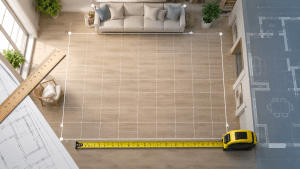
‘1000 square feet’ appears on apartment listings, floor plans, and project quotes, but the number is hard to feel without something to compare it to. So how big is 1000 square feet, really? It is about the size of a small two-bedroom apartment, a three-car garage, or a square roughly 31 feet 7 inches on each side. Here is exactly what 1000 square feet looks like, with real-world comparisons, common dimensions, what fits inside, and how it stacks up against other familiar spaces, plus the same approach for other sizes.
Here is the short answer. 1000 square feet is an area equal to a square about 31.6 feet on each side, roughly the size of a small two-bedroom apartment or a three-car garage. It is enough room for a living area, a kitchen, one or two bedrooms, and a bathroom, a comfortable compact home.
To see how any dimensions add up to 1000 square feet, keep the Square Feet Calculator open as you read. Enter a length and width and it shows the area, so you can find the many shapes that all equal 1000 square feet and compare them to your own space.
Enter any length and width into the Square Feet Calculator to see how they compare to 1000 square feet, and to find the dimensions that give any area you have in mind.
What this guide covers
The short answer: how big 1000 square feet is
1000 square feet is an amount of area, and the easiest way to grasp it is as a square. A square with an area of 1000 square feet has sides of about 31.6 feet each, since 31.6 times 31.6 is close to 1000. So picture a square room a little under 32 feet on every side, and that is 1000 square feet of floor.
Of course, real spaces are rarely perfect squares, so 1000 square feet takes many shapes: a rectangle 25 by 40 feet, one 20 by 50 feet, or one 10 by 100 feet all have exactly 1000 square feet of area, each enclosing the same floor. The floor space is the same in each; only the proportions differ, which our guide on room dimensions to square feet explains for any size you might meet. The area, not the shape, is what 1000 square feet fixes.
In everyday terms, 1000 square feet is a comfortable small home or a spacious apartment. It typically holds a living room, a kitchen, one or two bedrooms, and a bathroom, with hallways and closets, a complete if compact living space. Compared with the average new US single-family house, which is well over 2,000 square feet, 1000 square feet is roughly half that, the size of a starter home, a small bungalow, or an accessory dwelling unit.
The reason 1000 square feet is a useful benchmark is that it sits at a relatable scale, big enough to live in, small enough to picture. Many of the size questions people ask, from 500 to 2,000 square feet, are easiest to understand relative to this round thousand. The rest of this guide fills in that picture with concrete comparisons, dimensions, and what actually fits, so the number stops being abstract.
It helps at the outset to separate two things the number can describe. Sometimes 1000 square feet refers to a whole home or unit, the total living area, and sometimes it refers to a single surface, like 1000 square feet of flooring, patio, or lawn. The area is identical in both cases, but the context changes how you think about it: as a home it is divided among rooms, while as a surface it is one continuous expanse. Keeping that distinction in mind as you read prevents the confusion of picturing a whole apartment when someone means a single large deck, or vice versa. Both are 1000 square feet; they just arrange the same amount of surface differently.
The dimensions of 1000 square feet
Because 1000 square feet is an area, it can be arranged in countless dimensions, all multiplying to 1000. Seeing several makes the size tangible, since you can match whichever shape is closest to the space you are imagining.
| Dimensions | Area | Shape |
|---|---|---|
| 31.6 x 31.6 ft | 1,000 sq ft | A square |
| 25 x 40 ft | 1,000 sq ft | A common rectangle |
| 20 x 50 ft | 1,000 sq ft | A longer rectangle |
| 10 x 100 ft | 1,000 sq ft | A long, narrow strip |
| 33.3 x 30 ft | 1,000 sq ft | A near-square |
Each of these encloses exactly 1000 square feet, yet they feel very different: the square is balanced and roomy, while the 10-by-100 strip is a long corridor. This is why square footage alone does not tell you a space’s shape, only its area, a point our guide on room dimensions explores. For an apartment or home, 1000 square feet usually comes in a fairly compact overall footprint, closer to the square or the 25-by-40 rectangle than the narrow strip, and the Square Feet Calculator lets you test any dimensions.
To find the side of a square with a given area, you take the square root of the area, which is why a 1000-square-foot square is 31.6 feet per side, since 31.6 is roughly the square root of 1000. This is the reverse of the length-times-width calculation: instead of multiplying two sides to get the area, you find the one side that, squared, gives the area. It is a handy trick for turning any square footage into a picture, since the square root tells you how wide a square of that area would be. For 1000 square feet that is about 31.6 feet, for 2000 about 44.7, and for 500 about 22.4, each the square root of its area.
Enter dimensions into the Square Feet Calculator until they multiply to 1000, and you will see the many rectangles that all equal 1000 square feet.
Real-world comparisons for 1000 square feet
Nothing makes an area concrete like comparing it to familiar spaces. Here are several real-world equivalents that all come close to 1000 square feet, so you can anchor the number to something you know.
A three-car garage. A typical three-car garage is roughly 900 to 1,000 square feet, so 1000 square feet is about the footprint of three cars parked side by side with space around them.
Five to six parking spaces. A standard parking space is about 160 to 180 square feet, so 1000 square feet is roughly five to six of them, a small parking block.
A small two-bedroom apartment. Many two-bedroom apartments are around 900 to 1,100 square feet, making 1000 square feet a very typical apartment size.
About a third of a basketball court. A full basketball court is about 4,700 square feet, so 1000 square feet is a bit over a fifth of one, or roughly the area near one basket.
Four one-car garages. A single-car garage is roughly 250 square feet, so 1000 square feet is about four of them combined.
Any one of these gives you a handle on the size. If you can picture a three-car garage or six parked cars, you can picture 1000 square feet. These comparisons work because they translate an abstract area into objects and spaces you have physically experienced, which is the surest way to understand square footage, as our guide on what square feet is discusses.
It is worth choosing a comparison that matches the context you are thinking about. If you are picturing a home, the small-two-bedroom-apartment comparison is most useful, since it maps directly onto living space. If you are planning a patio or a parking area, the parking-space or garage comparison fits better, because it maps onto a single flat surface. The football field, at about 57,600 square feet including the end zones, is far too large to help picture 1000 square feet directly, but noting that 1000 square feet is only about one-fifty-seventh of a field can still convey how modest the area is on that scale. Matching the comparison to your purpose makes the mental picture sharper and more reliable.
1000 square feet as an apartment or home
Since so many people meet 1000 square feet on apartment listings, it helps to know what it means for living space. A 1000-square-foot apartment or home is a comfortable, functional size: on the larger end for a one-bedroom, typical for a two-bedroom, and workable as a small three-bedroom.
A common 1000-square-foot two-bedroom layout has a living room of around 250 square feet, a kitchen of 100 to 150, two bedrooms of roughly 120 to 150 each, a bathroom of about 50, and the remainder in hallways, closets, and perhaps a dining area. That distribution gives real living space in every room without anything feeling tight, which is why 1000 square feet is a popular and livable apartment size and a frequent target for efficient new construction.
Compared with tiny apartments of 400 to 600 square feet, 1000 square feet feels genuinely spacious, with room for full-size furniture and separate living and sleeping areas. Compared with large homes of 2,500-plus square feet, it is modest and efficient. For most singles, couples, and small families, 1000 square feet is enough to live comfortably, which is exactly why it recurs as a standard apartment and starter-home size. To size any specific room within it, our guide on square feet of a room helps.
How spacious a 1000-square-foot home feels also depends heavily on its layout and ceiling height, not just the floor area. An open-plan 1000 square feet with high ceilings and large windows can feel much larger than a chopped-up 1000 square feet divided into many small rooms with low ceilings. This is why two homes with identical square footage can feel completely different, and it is a reminder that square footage measures floor area, not the sense of volume or openness a space conveys. When evaluating a 1000-square-foot home, the number tells you the floor you have to work with, but the layout and vertical space determine how roomy it actually feels to live in.
What fits inside 1000 square feet
Understanding what actually fits in 1000 square feet makes the size real. At this area, you can furnish a complete home, and knowing the rough room count and furniture capacity helps you judge listings and plan spaces.
A 1000-square-foot home typically supports about four to five distinct rooms plus circulation space. That usually means a living room with a sofa, chairs, and a media unit; a kitchen with full appliances and counter space; one or two bedrooms each fitting a queen or king bed with dressers; and a full bathroom. There is room for a dining table, some storage, and comfortable walking paths throughout.
What you generally will not fit in 1000 square feet is a large number of big rooms at once, a formal dining room plus a family room plus an office plus three big bedrooms, for example. The area supports a compact, efficient layout rather than a sprawling one. Thinking in terms of how the 1000 square feet divides among rooms, using the room-size figures in our room dimensions guide, is the practical way to picture what a given 1000-square-foot space can hold.
A useful way to test whether a layout fits in 1000 square feet is to add up the rooms you want. If you list a 250-square-foot living room, a 150-square-foot kitchen, two 150-square-foot bedrooms, a 50-square-foot bathroom, and 100 square feet of hallways and closets, that totals 850 square feet, leaving room to spare within 1000. Push each room bigger, or add a third bedroom and an office, and the total quickly exceeds 1000, which tells you the plan needs a larger home. This adding-up exercise, room by room, is exactly how architects and buyers judge whether a wish list fits a given square footage, and it turns the abstract 1000 into a concrete budget of space to allocate.
1000 square feet compared to a house
Placing 1000 square feet against typical house sizes shows where it sits on the scale from tiny home to mansion. It is firmly in the small-house range, well below the current US average but a complete home nonetheless.
The average new single-family home in the United States is well over 2,000 square feet, so 1000 square feet is roughly half the size of a typical new build. It is comparable to a small starter home, a modest bungalow or cottage, an older post-war house, or an accessory dwelling unit built in a backyard. Many condos and townhomes also fall right around 1000 square feet.
This makes 1000 square feet a meaningful benchmark for downsizing, first-time buying, or building an efficient small home. It offers full living functionality in a footprint that is cheaper to buy, heat, cool, and maintain than a larger house. Our guide on figuring square feet of a house explains how whole-home square footage like this is measured, and the Square Feet blog compares many sizes.
It is also worth noting how home sizes have changed over time, which puts 1000 square feet in perspective. Decades ago, 1000 square feet was much closer to an average family home, and many mid-century houses were built right around that size. As average new-home sizes grew, 1000 square feet shifted from typical to compact, even though the space itself is unchanged and still perfectly livable. Understanding this trend helps explain why the same 1000 square feet can be described as cozy or generous depending on the era and the comparison, and why interest in efficient, smaller homes has brought renewed attention to what a well-designed 1000-square-foot house can offer.
1000 square feet as outdoor space
1000 square feet is just as useful a measure outdoors, for patios, decks, gardens, lawns, and other projects, and picturing it as land rounds out the sense of scale. As an outdoor area it is a generous patio, a small yard, or a substantial garden.
A 1000-square-foot patio, say 25 by 40 feet, is a large entertaining space, easily holding a big dining set, a lounge area, and a grill with room to move. A 1000-square-foot lawn is a modest but real yard, enough for a small play area or several garden beds with paths between them. For a paver or concrete project of this size, our guides on figuring square feet for materials and square feet to cubic feet help turn the area into a materials order.
Comparing outdoor 1000-square-foot spaces to sports areas helps too: it is a bit less than half a doubles tennis court (about 2,800 square feet) or roughly a fifth of a basketball court. Whether indoors or out, the 1000-square-foot area is the same amount of surface; only its use changes. That consistency is the whole point of measuring in square feet, as our guide on how to calculate square feet shows.
Outdoors, the shape of 1000 square feet matters as much as the area for how it functions. A square 1000-square-foot patio, about 31 feet on a side, makes a generous gathering space, while the same 1000 square feet stretched into a long 10-by-100-foot strip would be a walkway rather than a patio. For a lawn or garden, 1000 square feet spread across an irregular yard may not look like much once it winds around beds and paths, even though it is the same area as a compact square patio. This is why, for outdoor projects, it pays to think about both the total square footage, which sets your material order, and the shape, which determines how the space will actually be used and how much material waste the edges will create.
Other common sizes compared to 1000 square feet
Since people ask how big many different areas are, the table below places common square-foot figures next to 1000, with a relatable comparison for each. Use it to size up any of these areas by relating it to the 1000-square-foot anchor.
| Area | As a square | Rough comparison |
|---|---|---|
| 100 sq ft | 10 x 10 ft | A small bedroom |
| 200 sq ft | ~14 x 14 ft | A one-car garage |
| 500 sq ft | ~22 x 22 ft | A studio apartment |
| 1,000 sq ft | ~31.6 x 31.6 ft | A small two-bedroom |
| 1,500 sq ft | ~38.7 x 38.7 ft | A modest family home |
| 2,000 sq ft | ~44.7 x 44.7 ft | An average new home |
| 5,000 sq ft | ~70.7 x 70.7 ft | A large luxury home |
Reading down the table, notice that area grows much faster than the side length, because area squares the dimension: a 2,000-square-foot square is only about 40 percent wider per side than a 1,000-square-foot one, not twice as wide, even though it has twice the floor. This squaring effect, covered in our guide on room dimensions, is why doubling a home’s square footage does not double its width. Each of these sizes anchors to a familiar space, and the Square Feet Calculator converts any dimensions you like.
How big are other common square-foot sizes?
People search for the size of many specific areas, so here is a rundown of the sizes most often asked about, each anchored to something familiar. Using 1000 square feet as the reference point, you can place any of these on the scale.
How big is 100 square feet? About a 10-by-10 square, the size of a small bedroom or a large walk-in closet. It is a tenth of 1000 square feet.
How big is 200 square feet? Roughly 14 by 14 feet, about the size of a standard one-car garage or a small studio’s main room.
How big is 300 square feet? About 17 by 17 feet, the size of a small studio apartment or a large bedroom.
How big is 400 square feet? Around 20 by 20 feet, a compact studio apartment or a two-car garage.
How big is 500 square feet? About 22 by 22 feet, a comfortable studio or small one-bedroom apartment, half of 1000 square feet.
How big is 1500 square feet? Roughly 39 by 39 feet, a modest three-bedroom family home, half again as large as 1000 square feet.
How big is 2000 square feet? About 45 by 45 feet, close to the average new US single-family home, twice the size of 1000 square feet.
How big is 5000 square feet? Around 71 by 71 feet, a large luxury home, five times 1000 square feet.
Each of these follows the same logic as 1000 square feet: it is an area you can express as a square, a rectangle, or any shape that multiplies to the figure, and it is easiest to grasp against a familiar space you have actually stood in. Notice that the side length of the square grows slowly compared with the area, so a 2000-square-foot home is only about 45 feet per side against 32 for a 1000-square-foot one. For any of these, our guide on room dimensions shows how the numbers work, and the Square Feet Calculator gives exact dimensions.
1000 square feet in different contexts
The same 1000 square feet means slightly different things depending on what it is describing, and it is worth seeing the range. The area is fixed, but its significance shifts with the use.
As a home, 1000 square feet is a complete small residence. As commercial space, 1000 square feet is a small shop, office, or restaurant, enough for a modest storefront or a few workstations. As storage, a 1000-square-foot unit is large, easily holding the contents of a multi-bedroom house with room to move between stacks. As event space, 1000 square feet accommodates roughly 65 to 100 people standing, or 50 to 60 seated at tables, useful for planning gatherings, since venues are commonly rated by square feet per guest.
In construction and renovation, 1000 square feet is a common project scope, whether it is an addition, a finished basement, or a new floor of flooring or roofing. Knowing that 1000 square feet is a recognizable, mid-scale amount helps you interpret it wherever it appears, from a lease to a building permit. The unit stays constant; what changes is how many people, products, or purposes that fixed area serves, which is exactly why square feet is such a versatile measure, as our guide on what square feet is explains.
Commercial leasing is a context where the exact meaning of 1000 square feet deserves extra care, because leases sometimes quote gross square footage, which includes shared areas like hallways and lobbies, rather than the usable square footage a tenant actually occupies. So a 1000-square-foot office lease might give somewhat less than 1000 square feet of private space once common areas are apportioned. This mirrors the residential distinction between gross and finished area, and it is a reminder that the headline square-footage number always rewards a second look at what exactly it includes. For any space, knowing whether a figure is gross or usable is as important as the number itself.
How to visualize 1000 square feet yourself
Beyond comparisons, a couple of simple techniques let you picture 1000 square feet in your own surroundings. These turn the number into something you can see wherever you are.
The pacing method works well. An average adult step is about 2.5 feet, so a square of 1000 square feet is about 31.6 feet, or roughly 12 to 13 normal steps, on each side. Pace out 12 steps, turn 90 degrees, pace 12 more, and you have walked two sides of a 1000-square-foot square. Doing this in a parking lot or open room gives a direct physical sense of the area.
The room-multiplying method is another route. If you know a room’s size, you can count how many make 1000 square feet. About seven 12-by-12 bedrooms (144 square feet each) make roughly 1000 square feet, or about ten 10-by-10 rooms. Picturing several familiar rooms combined conveys the total. Our guides on the 12×12 room and measuring a room give the room sizes to build from, and the Square Feet Calculator handles the arithmetic.
There is also the object-tiling method for very concrete visualization. A queen mattress is about 33 square feet, so around 30 of them laid flat would cover 1000 square feet. A standard sheet of plywood is 32 square feet, so about 31 sheets tile 1000 square feet. A parking space is roughly 170 square feet, so about six of them make it. Mentally tiling the area with an object whose size you know well gives an immediate, tangible sense of scale, and different people find different objects most intuitive. Whichever method you use, the goal is the same: to translate the abstract 1000 into a picture your mind can actually hold.
Cost and materials for 1000 square feet
Because 1000 square feet is a common project size, it is useful to know how the area translates into materials and rough costs, though prices vary widely. The area is the starting point for estimating flooring, paint, and other materials for a space this size.
Flooring a 1000-square-foot space means buying about 1000 square feet of flooring plus a waste allowance, typically 10 percent, so around 1,100 square feet in total, then multiplying by the price per square foot. Painting the walls of a 1000-square-foot home involves considerably more than 1000 square feet of wall area, since walls are taller than the floor is wide; you calculate wall area from the perimeter and ceiling height as our guides describe. For bulk materials with depth, like mulch over a 1000-square-foot area, you multiply by the depth to get volume, covered in our cubic feet guide.
The key point is that 1000 square feet is the base figure that every material estimate for the space builds on. Whether it is flooring, paint, tile, or landscaping material, you start from the 1000-square-foot area, apply the product’s coverage, and add waste. Our guides on square feet for flooring and paint coverage walk through the specifics, and the Square Feet Calculator confirms the area.
Because 1000 is such a round number, it also makes a handy unit for rough cost estimates. If flooring runs, say, four dollars a square foot installed, then 1000 square feet is about 4,000 dollars before waste, and you can scale that up or down for other areas by simple proportion. The same logic applies to painting, tiling, or roofing: find the per-square-foot rate, multiply by the area, and you have a ballpark figure. Real quotes vary with material, labor, and region, but anchoring on a per-square-foot rate times 1000 gives a quick sense of what a project of this size might cost, which is one more reason the 1000-square-foot benchmark is so practical.
Getting the picture of 1000 square feet right
A few points help keep your mental picture of 1000 square feet accurate. Watch for these.
Remember it is area, not length. 1000 square feet is a surface, about 31.6 feet square, not a distance of 1000 feet. The two are very different.
Shape varies, area does not. A square, a long rectangle, and an L-shape can all be 1000 square feet. The area is fixed; the layout is not.
Compare to something known. Anchor 1000 square feet to a three-car garage or six parking spaces rather than trying to imagine the raw number.
Side length grows slowly. Doubling to 2,000 square feet only widens a square by about 40 percent per side, because area squares the dimension.
Usable space is less than the total. Walls, hallways, and fixtures take some of the 1000 square feet, so livable floor is a bit less than the gross figure.
Keep those in mind and your sense of 1000 square feet will be accurate. The most common mistake is confusing area with a linear distance, imagining 1000 feet in a line rather than a surface of 1000 one-foot squares, and the second most common is forgetting that layout and ceiling height shape how big the same area feels. The anchor to remember is that 1000 square feet is an area, roughly a 31.6-foot square, about the size of a small two-bedroom apartment or a three-car garage. Compare it to a space you know, and the number becomes concrete. For any area, the Square Feet Calculator and the wider Home Calculators help you size it up.
Frequently asked questions
How big is 1000 square feet?
1000 square feet is an area equal to a square about 31.6 feet on each side, or a rectangle like 25 by 40 feet. It is roughly the size of a small two-bedroom apartment, a three-car garage, or about half a doubles tennis court. The Square Feet Calculator shows any dimensions.
What does 1000 square feet look like?
Like a modest apartment or small home with a living room, kitchen, one or two bedrooms, and a bathroom. As a square it is about 31.6 by 31.6 feet. Picture a three-car garage or six parking spaces to visualize the area.
Is 1000 square feet big for an apartment?
It is a comfortable size, on the larger side for a one-bedroom and typical for a two-bedroom. It gives room for a full living area, kitchen, and one or two bedrooms without feeling cramped, though it is modest next to a large house.
How many rooms fit in 1000 square feet?
Usually about four to five rooms: a living room, kitchen, one or two bedrooms, and a bathroom, plus hallways. It comfortably supports a small two-bedroom, one-bath layout.
What are the dimensions of 1000 square feet?
Any dimensions that multiply to 1000, such as 25 by 40, 20 by 50, or about 31.6 by 31.6 feet for a square. The area is the same; only the proportions change.
How big is 1000 square feet compared to a house?
It is a small house or large apartment. The average new US home is well over 2,000 square feet, so 1000 square feet is roughly half that, like a compact starter home, a bungalow, or an accessory dwelling unit.
How does 1000 square feet compare to a parking space?
A standard parking space is about 160 to 180 square feet, so 1000 square feet is roughly five to six spaces. Picture about six cars parked in a block to visualize close to 1000 square feet.
The quick version
1000 square feet is an area, roughly a square 31.6 feet on each side, or a rectangle like 25 by 40 feet. It is about the size of a small two-bedroom apartment, a three-car garage, five to six parking spaces, or a bit less than half a doubles tennis court. It comfortably holds a living room, kitchen, one or two bedrooms, and a bathroom. It is roughly half the average new US home. Any dimensions multiplying to 1000 give the same area.
Use the Square Feet Calculator to size any area, and browse the Square Feet blog, the what is square feet guide, the room dimensions guide, the Home Calculators, or the wider Waldev calculator library for more.
Accuracy note: Comparisons are approximate; real apartments, garages, and courts vary in size. 1000 square feet is a measure of area, not length, and usable floor space is slightly less than the gross figure once walls and fixtures are counted. Figures are for general informational and educational purposes.
Average new US single-family home sizes are tracked by the US Census Bureau. US Census Bureau →
The square foot is the US customary unit of area, defined through the foot at 0.3048 meters. NIST Office of Weights and Measures →