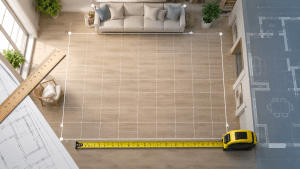
Before you buy paint, one number decides how many cans end up in your cart: how many square feet does a gallon of paint cover? One gallon of paint covers about 350 to 400 square feet with a single coat on a smooth, primed surface. This guide explains exactly where that figure comes from, how coverage changes with surface, coats, and paint type, how to calculate the paint you need for any room, and a full paint-by-room reference so you never over- or under-buy.
Here is the short answer. One gallon of paint covers about 350 to 400 square feet with one coat. That is the figure most manufacturers print on the label. Rough or unprimed surfaces drop it toward 250 to 300 square feet per gallon; very smooth, primed walls reach the top of the range. For two coats, a gallon covers only about 175 to 200 square feet.
To work out how much wall you have and how many gallons that means, keep the Square Feet Calculator open as you read. Enter your wall dimensions to get the area, then divide by the coverage rate below.
Enter each wall’s width and height into the Square Feet Calculator to get the total area, then divide by 350 to estimate gallons.
What this guide covers
How many square feet a gallon of paint covers
One gallon of paint covers about 350 to 400 square feet with a single coat, and that is the figure you will see on nearly every paint can. It represents the area a gallon can coat evenly, one time, on a typical smooth, primed interior wall. Since a standard wall is 8 feet tall, 350 to 400 square feet is roughly the wall area of a small-to-average room, which is why a single gallon is often enough for one coat in a modest space.
The reason the figure is a range, not a single number, is that real surfaces vary. On a very smooth, sealed, previously painted wall, a gallon can reach 400 square feet or a little more, because the paint sits on top rather than soaking in. On a rougher or more porous surface, the same gallon might cover only 300 or even 250 square feet, because the material drinks up paint. So 350 to 400 is the typical middle of that range, and it is a safe planning figure for smooth interior walls. Our guide on how to calculate square feet shows how to measure the wall area you are covering. When in doubt, plan with the lower end of the range, since it is far cheaper to have a little paint left over than to stop halfway through a wall and run to the store, where a remixed can may not match perfectly.
The single most important thing to understand is that this figure is for one coat. Most walls need two coats for full, even, durable color, especially when changing colors or painting over a patchy surface. Two coats means a gallon effectively covers only about half as much, roughly 175 to 200 square feet, so you should plan your paint quantity around the number of coats, not just the wall area. We cover this in detail below, because it is the most common reason people run short.
Finally, remember that coverage is about area, not volume. A gallon is a fixed volume of paint, and how far it stretches depends entirely on how thickly it is applied and how much the surface absorbs. Applied properly at the recommended thickness, a gallon reaches its rated 350 to 400 square feet; applied too thickly, or on a thirsty surface, it covers less. The Square Feet Calculator gives you the wall area; the coverage rate tells you how many gallons that area needs.
Where the 350 to 400 figure comes from
The 350-to-400-square-feet-per-gallon figure is not arbitrary; it comes from the physics of how paint spreads. Understanding it helps you judge when your real-world coverage will be higher or lower.
Paint is designed to be applied at a specific film thickness, usually a few thousandths of an inch when wet. A gallon of paint contains a fixed volume, so spreading it at that intended thickness over a surface yields a predictable area, which works out to about 350 to 400 square feet for typical interior wall paint. Manufacturers test this on standard smooth surfaces and print the result on the label. It is a spread rate: volume divided by thickness equals area.
Because the figure depends on thickness and absorption, anything that changes those changes the coverage. A thicker coat, common with heavy-bodied or cheaper paints, covers less area per gallon. A thinner or premium paint with good hide can cover more. A porous surface absorbs some of the paint into itself, effectively increasing the thickness consumed and reducing the area. This is why the same gallon can cover 250 square feet on bare drywall and 400 on a sealed, previously painted wall. Keeping the spread-rate idea in mind lets you adjust the 350-to-400 estimate up or down for your specific job, and the Square Feet Calculator handles the area side of the equation.
Divide your total wall square footage by 350 for a safe one-coat estimate, then multiply by your number of coats. The Square Feet Calculator gives you the area to start.
One coat versus two coats
The difference between one coat and two is the single biggest factor in how much paint you buy, and it trips up more people than any other. The label figure is always for one coat.
When you apply two coats, which most interior walls need for full, even color, you use roughly twice the paint. So a gallon that covers 350 to 400 square feet in one coat covers only about 175 to 200 square feet when you apply two coats. If you measure your walls at 700 square feet and see ‘400 square feet per gallon’ on the can, it is tempting to buy two gallons, but for two coats you actually need about four.
Two coats are usually necessary because a single coat rarely hides the previous color or surface completely, and it often dries unevenly, showing roller marks or thin spots. The second coat evens out the color, deepens it, and improves durability. Some premium ‘one-coat’ paints can cover in a single application under ideal conditions, similar color, smooth primed surface, but even then a second coat is often worth it for a professional finish. When planning, the safe rule is to assume two coats unless you are only refreshing the exact same color on a good surface. Our guide on the 12×12 room gives a worked example of wall area you can apply this to.
It also helps to know why the second coat uses roughly as much paint as the first, even though the surface is already colored. The second coat still lays down a full film of paint at the intended thickness; it is not merely touching up bare spots. That is why you cannot count on stretching one gallon across two coats of a large area, and why doubling the paint for two coats is the reliable rule rather than assuming the second coat is somehow thinner. Only in cases where the first coat already looks nearly perfect can a very light second coat use a bit less, and that is not something to bank on when buying.
| Coats | Coverage per gallon | Paint for 700 sq ft of wall |
|---|---|---|
| 1 coat | ~350-400 sq ft | ~2 gallons |
| 2 coats | ~175-200 sq ft | ~4 gallons |
| 3 coats | ~115-135 sq ft | ~6 gallons |
As the table shows, each additional coat multiplies the paint needed. Always decide your number of coats first, then calculate, and the Square Feet Calculator plus a division gives you the gallons.
How to calculate the paint you need
Working out how much paint to buy is a short, reliable calculation, and doing it yourself prevents both wasted paint and mid-project runs to the store. Here are the steps.
Measure each wall’s width and height, multiply for its area, and add the walls together. A room with four 12-foot walls, 8 feet tall, is 4 × (12 × 8) = 384 square feet.
Subtract about 20 square feet for each door and 15 for each window. One door and one window removes about 35 square feet.
Divide the net wall area by 350 square feet per gallon for a safe estimate. 384 minus 35 is 349, divided by 350 is about 1 gallon per coat.
Multiply by your coats. For two coats, 1 gallon becomes 2 gallons. Round up to the next whole gallon.
This method works for any room. The key steps are measuring accurately, accounting for openings, and multiplying by coats. Using 350 rather than 400 as the divisor builds in a small safety margin so you are not caught short. For the measuring step, our guide on working out square feet of a room and the Square Feet Calculator do the arithmetic. It is always wise to buy a little extra for touch-ups and to keep the exact color for future repairs.
How surface and texture change coverage
The surface you are painting has a large effect on how far a gallon goes, often more than any other factor. The rougher and more porous the surface, the less area a gallon covers.
A smooth, previously painted, sealed wall is the easiest surface, and a gallon can reach the top of its range, around 400 square feet, because the paint sits on the surface. Bare drywall, new plaster, and unprimed surfaces are porous and drink up the first coat, dropping coverage toward 250 to 300 square feet per gallon, which is a major reason priming first saves paint. Textured surfaces, popcorn ceilings, stucco, brick, concrete block, and rough wood, have far more surface area than their flat dimensions suggest, so a gallon may cover only 200 to 250 square feet or less because the paint must coat every bump and crevice.
This is why measuring the flat wall area is only the starting point. On a textured or porous surface, you should plan for lower coverage, buying extra paint or priming first to seal the surface. Brick and block in particular can consume paint at two or three times the rate of a smooth wall. When you know your surface, adjust the coverage figure accordingly: use 400 for smooth sealed walls, 350 for typical primed walls, and 250 or less for rough, porous, or textured surfaces. The Square Feet Calculator gives you the flat area; your surface tells you which coverage rate to divide by.
A useful way to picture the texture effect is to imagine unrolling all the bumps and crevices of a rough wall flat: the true surface area is far larger than the wall’s measured height times width. A heavily textured or knockdown wall might have 20 to 40 percent more actual surface than its flat dimensions suggest, and rough masonry far more, which is exactly the extra area the paint has to cover. That is why the flat measurement understates paint needs on texture, and why sealing rough surfaces with primer first, filling and smoothing that hidden area, is often the most paint-efficient approach on porous or bumpy walls.
Paint type, quality, and primer
Not all paint covers the same, and the type and quality you choose shift the coverage figure. Better paint and the right primer can meaningfully reduce how many gallons you need.
Premium paints generally have higher pigment and solids content, giving better ‘hide,’ so they cover more area per coat and often need fewer coats. Cheaper paints are thinner and lower in pigment, so they cover less and frequently require an extra coat, which can erase their price advantage. Paint sheen also plays a small role: flat and matte paints tend to cover slightly better in one coat than glossier finishes, though gloss is more durable and washable.
Primer is the other key factor. Priming a bare, patched, or dramatically different-colored surface seals it and gives the topcoat a uniform base, so the finish paint covers at its full rated rate rather than being absorbed. A gallon of primer covers a similar 200 to 400 square feet depending on the surface. Priming adds a step, but it usually saves finish paint and produces a better result, especially on new drywall or big color changes. So when estimating, factor in whether you will prime, and choose quality paint if you want to minimize coats. Our guide on figuring square feet for flooring covers a similar buy-the-right-amount logic for another material.
It is worth doing the arithmetic on quality versus price, because the cheaper can is not always the cheaper job. If a budget paint needs three coats where a premium paint needs two, you buy 50 percent more of the cheap paint, plus you spend the extra time and labor of a third coat. Once you factor in that a premium paint often covers more square feet per gallon at full hide, the price gap per gallon frequently disappears or reverses. For a job you want to last, the better paint usually wins on total cost as well as finish, which is why professionals rarely reach for the cheapest can on the shelf.
Quarts and 5-gallon buckets
Paint comes in sizes other than the gallon, and knowing their coverage helps you buy efficiently for projects large and small. The coverage scales directly with volume.
A quart is one-quarter of a gallon, so it covers about 85 to 100 square feet with one coat. Quarts are ideal for small jobs, trim, doors, an accent wall, furniture, or touch-ups, where a full gallon would be wasteful. A single interior door, for example, needs only a small fraction of a quart per coat. At the other end, a 5-gallon bucket covers about 1,750 to 2,000 square feet with one coat, enough for the walls of several rooms or roughly two average rooms with two coats. Buckets are the economical choice for whole-house or large projects, usually costing less per gallon than individual cans.
There is also a consistency benefit to buying the larger size when you need a lot of paint. Every can or batch of tinted paint can vary very slightly in shade, so painting an entire area from one 5-gallon bucket, or from cans ‘boxed’ together by pouring them into one container and mixing, guarantees a uniform color across all the walls. This matters most on large, continuous surfaces where a subtle shade difference between cans could show as a faint seam. For a single room from one or two gallons it rarely matters, but for a whole house, buying and mixing in bulk is both cheaper and more consistent.
| Container | Volume | Coverage (1 coat) |
|---|---|---|
| Quart | 0.25 gallon | ~85-100 sq ft |
| Gallon | 1 gallon | ~350-400 sq ft |
| 2 gallons | 2 gallons | ~700-800 sq ft |
| 5-gallon bucket | 5 gallons | ~1,750-2,000 sq ft |
Choose the container size that matches your project to avoid waste and save money. For a full room or house, gallons and buckets make sense; for trim and small areas, quarts do. The Square Feet Calculator gives you the area so you can pick the right size.
Paint needed by room size
To make planning concrete, here is roughly how much paint typical rooms need for their walls, assuming two coats on smooth primed surfaces. Use it as a quick reference, then confirm with your own measurements.
| Room | Approx. wall area | Paint for 2 coats |
|---|---|---|
| Small bedroom (10×10) | ~320 sq ft | ~2 gallons |
| Average bedroom (12×12) | ~384 sq ft | ~2 gallons |
| Large bedroom (14×16) | ~480 sq ft | ~3 gallons |
| Living room (16×20) | ~576 sq ft | ~3-4 gallons |
| Bathroom (5×8) | ~208 sq ft | ~1-2 gallons |
These figures assume 8-foot ceilings and subtract a little for doors and windows. Taller ceilings, more openings, or textured walls change the numbers, so always measure your own space. As a rule of thumb, most average bedrooms take about two gallons for two coats, and larger living spaces three to four. Our guides on the 12×12 room and square feet of a room help you measure precisely, and the Square Feet Calculator turns your dimensions into gallons.
How color changes affect coverage
The color you are painting over and the color you are applying both influence how many coats, and therefore how much paint, you need. Big contrasts demand more.
Painting a light color over a similar light color is the easiest case, often achievable in one or two coats at full rated coverage. Painting a light color over a dark one, white over navy, for instance, is the hardest: the dark base shows through, and you may need three coats or a tinted primer to fully hide it, sharply increasing paint use. Painting dark over light is somewhat easier but can still need two coats for even, deep color, since dark and vivid pigments sometimes have weaker hide.
The practical takeaway is to factor color change into your estimate. For a dramatic light-over-dark change, plan for an extra coat or a primer, which effectively adds 50 to 100 percent more paint than a same-color refresh. Using a gray or tinted primer matched to your topcoat can cut the number of finish coats needed and save paint overall. So when you calculate gallons, adjust the number of coats up for high-contrast changes, then divide the wall area by 350 as before. The Square Feet Calculator handles the area; your color change tells you the coats.
Certain pigments are notorious for needing extra coats regardless of the base color. Deep reds, bright yellows, and some oranges have relatively weak hide because of how their pigments work, and they can need three or even four coats to reach a solid, even color, sometimes over a specially tinted primer. If you are painting one of these vivid colors, do not use the standard two-coat assumption; ask the paint store about the recommended coats and primer for that specific color, and buy accordingly. Underestimating paint on a hard-to-cover color is one of the most common ways a project stalls halfway.
Exterior paint and ceilings
Coverage figures shift for exterior surfaces and ceilings, so it is worth noting how they differ from smooth interior walls. Both tend to consume more paint.
Exterior surfaces, siding, stucco, brick, and rough wood, are usually more textured and weathered than interior walls, so a gallon of exterior paint often covers less, around 250 to 350 square feet, and sometimes far less on rough masonry. Exterior projects also almost always need two coats for durability against the weather, so plan generously. Ceilings are typically smooth and can take paint at the standard 350 to 400 square feet per gallon, but textured ceilings, like popcorn finishes, drink up paint and may cover only 200 to 250 square feet per gallon.
For any exterior or textured job, lean toward the lower end of the coverage range and buy a little extra, since running short partway through a coat can leave visible lap marks. Measuring exterior walls follows the same width-times-height method as interior, minus doors and windows, so our guide on how to calculate square feet and the Square Feet Calculator apply just as well outdoors. Just remember to use a lower coverage figure for rough or weathered surfaces.
Weather and timing add their own wrinkles to exterior coverage. Bare or sun-faded wood and old chalky paint absorb far more than fresh, sound siding, so an exterior that has not been painted in many years may drink up the first coat well below the rated rate. Priming or using a self-priming exterior paint helps, but the honest planning move is to measure the area, use a conservative coverage figure like 300 square feet per gallon or lower for rough siding, and buy enough for two full coats. Exteriors are also less forgiving of running short mid-wall, because a visible lap line on the front of a house is hard to hide, so erring generous is worth the small extra cost.
A full worked example, start to finish
Putting all the steps together on a real room makes the process clear. Say you are painting an average 12 by 14 foot bedroom with 8-foot ceilings, changing from a light beige to a medium blue, on smooth previously painted walls, and you want two coats.
Start with the wall area. The room has two 12-foot walls and two 14-foot walls, all 8 feet tall. The 12-foot walls are 12 × 8 = 96 square feet each, or 192 for the pair. The 14-foot walls are 14 × 8 = 112 square feet each, or 224 for the pair. Together that is 192 + 224 = 416 square feet of gross wall area. Now subtract the openings: one door at about 20 square feet and two windows at about 15 each, so 20 + 30 = 50 square feet comes off, leaving 366 square feet of net wall area to paint.
Next, apply the coverage rate. At 350 square feet per gallon, one coat needs 366 divided by 350, which is about 1.05 gallons. Because you want two coats, double it to about 2.1 gallons. Round up to the next whole gallon and add a little for touch-ups, and you land on 3 gallons, or more economically, two gallons plus a quart, which gives you 2.25 gallons of usable paint with a small margin. Since the surface is smooth and previously painted, and the color change from beige to medium blue is moderate, two coats at the standard rate is realistic, so 2 to 3 gallons is the right buy.
Notice how each factor entered the calculation: the wall dimensions set the area, the openings reduced it, the coverage rate converted area to gallons, and the two-coat plan doubled it. Change any one, taller ceilings, a bigger color jump, a textured wall, and the result shifts, which is why the method matters more than any single number. Run your own room through the same four steps with the Square Feet Calculator handling the area, and you will get an accurate gallon count every time. Our guide on working out square feet of a room covers the measuring step in more depth.
How rollers, brushes, and sprayers affect coverage
The tool you use to apply paint also changes how far a gallon goes, which is worth knowing when you estimate. Different application methods lay down paint at different thicknesses and with different amounts of waste.
A roller, the most common tool for walls, applies paint efficiently and close to the rated coverage, so the 350-to-400-square-feet-per-gallon figure assumes roller application on flat walls. A brush, used for trim, edges, and cutting in, applies paint a bit more thickly and slowly, so brushed areas consume slightly more paint per square foot, though the areas involved are usually small. A paint sprayer covers quickly and gives a smooth finish, but it produces overspray and wastes a meaningful fraction of the paint into the air and onto masking, so spraying can reduce effective coverage by 20 to 30 percent, meaning you need more paint than a roller for the same area.
The practical implication is to nudge your estimate based on method. For roller-and-brush interior work, the standard figures hold. For spraying, especially exteriors or cabinets, buy extra to account for overspray. The nap thickness of a roller matters too: a thick nap for textured surfaces holds and releases more paint, lowering coverage, while a thin nap for smooth walls is more economical. None of this changes the wall area, which the Square Feet Calculator gives you, but it does change which coverage rate is realistic for your setup, so match the rate to your tool.
Buying the right amount without waste
The goal is to buy enough paint to finish the job with a little to spare, but not so much that cans sit unused. A few habits get you there.
First, always round up to the next whole gallon or quart, since running out mid-coat is far more costly in time and finish quality than a little leftover. Second, buy a small surplus, roughly 10 percent extra, for touch-ups, second-coat needs, and future repairs, and keep the exact color and finish noted or the can label saved. Third, if you are close to a size threshold, compare costs: five gallons in a bucket is usually cheaper per gallon than five individual cans, so for larger jobs the bucket saves money.
Leftover paint, stored properly in a sealed can in a cool, dry place, lasts for years and is invaluable for touch-ups when the wall gets scuffed. So a modest surplus is not waste; it is insurance. The one thing to avoid is badly underestimating and having to buy a second batch that may not perfectly match if the color is remixed. Careful measuring with the Square Feet Calculator, a realistic coverage figure for your surface, and the right number of coats give you an accurate, low-waste estimate. Our Home Calculators include more project-planning tools.
Getting the paint numbers right
A few points keep your paint estimate accurate. Watch for these.
350-400 square feet per gallon is for one coat. For two coats, a gallon covers only about 175-200 square feet.
Always plan your coats first. Most walls need two; high-contrast color changes may need three or a primer.
Rough and porous surfaces cover less. Bare drywall, brick, stucco, and texture can drop coverage to 200-250 square feet or lower.
Subtract doors and windows. About 20 square feet per door and 15 per window comes off the wall area.
Round up and buy a little extra. Running short mid-coat costs more than a small surplus for touch-ups.
Keep those straight and buying paint is simple. The most common mistake is using the one-coat figure but applying two coats, which leaves you half a job short. The anchor to remember is that a gallon covers about 350 to 400 square feet per coat, so measure your wall area, subtract openings, divide by 350, and multiply by your number of coats. To size the walls and run the numbers, the Square Feet Calculator and the wider Home Calculators are there.
Frequently asked questions
How many square feet does a gallon of paint cover?
About 350 to 400 square feet with one coat on a smooth, primed surface, the figure most makers print on the label. Rough or unprimed surfaces drop it to 250 to 300 square feet per gallon. The Square Feet Calculator helps you size your walls.
How much paint do I need for a 12×12 room?
A 12×12 room has about 384 square feet of wall (8-foot ceilings). At 350 square feet per gallon that is about one gallon per coat, so plan on two gallons for two coats.
Does a gallon cover 400 square feet with two coats?
No. The 350 to 400 figure is for one coat. For two coats a gallon covers only about 175 to 200 square feet, so double your paint compared to a single-coat estimate.
How many square feet does a quart of paint cover?
About 85 to 100 square feet with one coat, since a quart is a quarter of a gallon. Quarts suit trim, doors, accent walls, and touch-ups.
How much does 5 gallons of paint cover?
About 1,750 to 2,000 square feet with one coat, enough for several rooms’ walls with one coat or roughly two average rooms with two coats.
Why does my paint cover less than the label says?
Rough, textured, porous, or unprimed surfaces absorb more paint. Dark-to-light color changes, thin cheap paint, and heavy application also reduce coverage. The label figure assumes a smooth, primed, similar-colored surface.
How do you calculate how much paint you need?
Add up the wall areas (width times height), subtract about 20 square feet per door and 15 per window, divide by 350 square feet per gallon, and multiply by the number of coats. Round up to the next gallon.
The quick version
One gallon of paint covers about 350 to 400 square feet with one coat on a smooth, primed surface, or about 175 to 200 square feet for two coats. A quart covers 85 to 100 square feet, and a 5-gallon bucket about 1,750 to 2,000. Rough, porous, or textured surfaces cover less; premium paint and priming cover more. To estimate: measure the walls, subtract doors and windows, divide by 350, and multiply by your coats, then round up and add about 10 percent for touch-ups.
Use the Square Feet Calculator to size your walls, and browse the Square Feet blog, the square feet for flooring guide, the square feet of a room guide, the Home Calculators, or the wider Waldev calculator library for more.
Accuracy note: Paint coverage varies by brand, product, surface, and application, so always check the specific figure on your paint can and adjust for your surface and coats. The 350-to-400-square-feet-per-gallon figure is a typical average for smooth interior walls. Figures are for general informational and planning purposes.
Coverage rates come from paint manufacturers’ published spread rates, printed on each product’s label and technical data sheet. American Coatings Association →
Area is width times height in feet; the foot is defined as 0.3048 meters and the gallon as 3.785 liters. NIST Office of Weights and Measures →