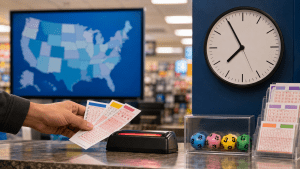
Where you cash a winning ticket depends almost entirely on how much it is worth. Here is the honest, state-by-state logic behind retailer payouts, claim centers, and mail-in claims — plus what to bring, what gets withheld, and what to do before you hand the ticket over.
You just checked your numbers and one of them actually won. The excitement lasts about ten seconds before the practical question takes over: where do you actually go to get the money? The honest answer is that it depends almost entirely on the size of the prize. A $20 scratch-off winner and a six-figure jackpot winner do not walk through the same door, and trying to cash a big ticket at the wrong counter just wastes a trip.
This guide walks through every tier — the corner store, the grocery chain, the state claim center, and the mail-in option — so you know exactly where to go before you get there. It also covers the specific questions people search most: cashing tickets over $600, whether big retailers like Walmart pay out winners, and how claim rules differ from state to state. Once you know what a prize is actually worth after taxes, the free Lottery Calculator can show you the real take-home number before you plan your next step.
Before you drive to a claim center, run the prize through the Waldev Lottery Calculator to see the after-tax amount you should expect. It takes federal withholding and typical state tax into account so there are no surprises at the counter.
What this guide covers
The quick answer
For the vast majority of winning tickets, which are small prizes, you cash them at any licensed lottery retailer — the same kind of store where lottery tickets are sold. Bring the ticket, sign the back first, and the clerk scans it and pays you in cash or store credit up to the retailer’s limit, which is typically a few hundred dollars and set by the state. No appointment, no paperwork, no waiting.
Above that retailer limit, the process shifts to a state lottery claim center or district office, where an employee verifies the ticket, processes any required tax withholding, and issues the payment by check. The very largest prizes, including jackpots, are usually claimed at lottery headquarters, sometimes with an appointment, and often allow mail-in claims as an alternative to an in-person visit. The exact dollar lines shift by state, which is why the sections below break the process down by prize size rather than by a single number.
Cashing small prizes at any retailer
Every licensed lottery retailer — gas stations, convenience stores, many grocery stores, and dedicated lottery counters — can pay out smaller prizes on the spot. The clerk runs the ticket through the same terminal used to sell tickets, the system confirms it is a winner and has not already been paid, and you get your money right away. This covers the overwhelming majority of winning tickets, since most wins are $50, $100, or a few hundred dollars rather than anything life-changing.
Retailers are not obligated to carry unlimited cash, so most states cap what an individual store can pay out in a single transaction, often somewhere in the low hundreds of dollars. If your prize is below that cap, any retailer that sells tickets for your state’s lottery should be able to pay you without sending you anywhere else. If it is above the cap, the clerk will typically tell you to take it to a claim center instead of trying to force a payout the store cannot cover.
The $600 rule and why it matters
The number that shapes almost every state’s claim process is $600. Under federal tax rules, lottery winnings of $600 or more generally trigger a Form W-2G, the document that reports gambling winnings to the IRS. Because retailers are not set up to handle that paperwork at the counter, most states route prizes at or above roughly this level away from ordinary stores and into a claim center or a mail-in process where the paperwork can be completed correctly.
This is why so many people search variations of “where can I cash my lottery ticket over $600” — the answer is almost never “the same store where you bought it.” Expect to visit a state lottery claim office, a regional lottery district office, or in some states an authorized bank partner, and expect to fill out a claim form and show identification. The lottery tax guide explains exactly what gets withheld once your prize crosses that line, and the calculator can estimate the after-tax number in advance.
| Prize size (approximate) | Typical place to cash it | What to expect |
|---|---|---|
| Under a few hundred dollars | Any licensed lottery retailer | Instant cash or store credit, no paperwork, no ID needed for very small amounts |
| Roughly $600 – a few thousand | State lottery claim center, district office, or mail-in claim | Claim form, photo ID, signed ticket, W-2G issued, possible tax withholding |
| Tens of thousands and up | State lottery headquarters, sometimes by appointment | In-depth verification, mandatory federal and state withholding, longer processing time |
| Jackpot-tier prizes | State lottery headquarters, often with a financial and legal team in tow | Formal claim process, choice of lump sum or annuity, media/anonymity rules apply |
State lottery claim centers and district offices
Every US lottery operates dedicated claim locations for prizes above the retailer limit. These might be called a claim center, a district office, a lottery headquarters, or a customer service center depending on the state, but they all do the same job: verify the ticket is genuine and unpaid, confirm your identity, process any required withholding, and cut you a check rather than handing over cash. Larger states often have several regional offices so you are not forced to drive to the capital for a mid-size prize.
Hours at these offices generally follow normal weekday business hours rather than a store’s extended hours, and many require or strongly recommend scheduling an appointment for higher-value claims so a staff member is ready for you. Before you drive anywhere, check your state lottery’s official website for the specific address, hours, and whether an appointment is required — this is the single step that saves the most wasted trips.
Claiming by mail
Almost every state lottery also accepts claims by mail, which is a good option if the nearest claim center is far away or you simply prefer not to carry a valuable ticket around in person. The general process is the same everywhere in spirit: sign the back of the ticket, make a photocopy for your own records before you send anything, fill out the official claim form from your state lottery’s website, and mail the original ticket along with the form and a copy of your ID using a trackable, insured mail service.
Never mail an unsigned or uncopied ticket. Sign the back the moment you confirm a win, keep a clear photo or photocopy of both sides, and use a mail service with tracking and delivery confirmation. A lost, unsigned winning ticket in the mail is one of the few mistakes with no fix.
Mail-in claims typically take longer than an in-person visit because of processing and mailing time in both directions, so most people use this route for prizes they are comfortable waiting a few weeks on, not for anything they need cash from immediately. Some states cap the prize size eligible for mail claims and require in-person verification above a certain amount, so check your specific lottery’s rules before you drop a large ticket in the mailbox.
What to bring when you cash a ticket
The signed original ticket. Sign the back as soon as you confirm a win. An unsigned ticket is effectively a bearer instrument — whoever holds it can claim it — so signing it protects you the moment you know it is a winner.
A government-issued photo ID. A driver’s license, state ID, or passport is standard for anything above a small retailer payout, and mandatory at every claim center.
Your Social Security number. Needed for any prize that requires a W-2G, since the lottery reports the win to the IRS under your SSN.
A completed claim form. Most state lotteries post the form online so you can fill it out before you arrive, which speeds up an in-person visit considerably.
A copy of the ticket for your records. Photograph or photocopy both sides before you hand over the original, especially for anything you are mailing in.
Do grocery stores and chains like Walmart cash tickets?
This is one of the most common searches on the topic, and the honest answer is “it depends on the store, not the brand.” Lottery sales and cashing are handled at the individual retail-location level through a state licensing agreement, not as a blanket corporate policy across an entire chain. Many grocery stores and pharmacy chains are licensed lottery retailers in some states and locations, and where they are licensed, they can typically sell tickets and cash winners up to the standard retailer limit, just like a convenience store.
Large national big-box retailers are a different story in most states: many do not participate in lottery sales at all, so if a store does not sell tickets, it almost certainly will not cash them either. Do not assume a store cashes lottery winners just because it is large or because you have seen a lottery display near the register at a similar location elsewhere — the safest move is to call ahead or check your state lottery’s retailer locator, which usually lists exactly which stores in your area are licensed to sell and redeem tickets.
Pharmacy chains and smaller regional grocery banners tend to follow the same location-by-location pattern: a store in one town might be a licensed lottery retailer while the same chain’s store two towns over is not, simply because the franchise owner or store manager applied for a license and the other did not. If you are new to an area or traveling, the fastest way to find a store that both sells and cashes tickets is your state lottery’s official “find a retailer” tool, which is kept current far more reliably than word of mouth or a quick search.
Gas stations vs. bigger retailers: does it matter where you cash it?
For a small prize, it genuinely does not matter whether you cash it at a gas station, a convenience store, or a grocery store counter — any licensed retailer’s terminal validates the ticket the same way and pays out to the same state-set limit. The convenience of gas stations is simply that they are everywhere and usually open long hours, which is why so many small prizes get cashed at the same place people buy their next ticket.
Where it can matter is cash on hand. A small convenience store may occasionally be reluctant to pay out its full allowed limit in cash if it has had a slow day at the register, though it is still obligated to pay valid winners. A larger grocery store or a dedicated lottery counter at a bigger location may simply have more cash available. If a smaller store hesitates, you are entitled to be paid up to the legal retailer limit, and trying a second nearby retailer or the district claim office resolves it quickly.
Cashing a ticket over $1,000: a worked example
Take a common scenario — you scan a scratch-off or draw-game ticket worth around $1,000 in a state like Florida. That prize is well above the typical small-retailer limit, so a normal store visit will not resolve it; the clerk will scan it, see that it exceeds the local payout ceiling, and direct you to the state lottery’s claim process instead. In practice that means visiting one of the lottery’s district offices in person with your signed ticket and ID, or in some states submitting a mail-in claim.
The specific dollar threshold that separates a retailer payout from a claim-office visit differs by state and can change, so treat any number you read online, including the example above, as a general guide rather than the exact current rule. Before you drive anywhere with a four-figure ticket, check your own state lottery’s official claims page for the current threshold, required documents, and office locations — five minutes online saves a wasted trip with a valuable ticket in your pocket.
What time can you cash a ticket?
Retailer cashing generally follows the store’s own hours. If a gas station or convenience store is open and its lottery terminal is running, it can typically pay out a winning ticket within the retailer’s limit any time during business hours, seven days a week in most areas. There is no special “lottery cashing window” separate from the store simply being open, so an early-morning or late-night winner at a 24-hour store can usually get paid immediately.
Claim centers and district offices are different: they run on standard government-style business hours, typically weekdays during the day, and are closed on weekends and state holidays. This applies in Texas as much as any other state — a retailer can pay a small prize at any hour it is open, but a claim office visit for a larger prize needs to happen during posted business hours, and some locations require an appointment. Always check the specific office’s current hours on your state lottery’s website before you go, since hours and locations do shift over time.
Can you cash an out-of-state lottery ticket?
Generally, no — you must claim a ticket in the state where it was sold. Each state lottery is a separate legal entity that only pays out prizes on tickets it issued, even for multi-state games like Powerball and Mega Millions. A Powerball ticket bought in one state has to be claimed through that state’s lottery, not through the lottery of the state you happen to live in or are currently visiting, even though the drawing itself is shared across all participating states.
This matters most for people who buy a ticket while traveling and then head home before checking the numbers. If that ticket wins, plan on returning to the state of purchase, or using that state’s mail-in claim option if it offers one, rather than assuming your home state’s lottery office can process it. It is a common and understandable point of confusion, but the rule is consistent everywhere: the issuing state is the only one that can pay the prize.
Verify the ticket before you try to cash it
Before you drive to a claim center or even a nearby store, confirm the ticket is actually a winner and for how much, using an official channel rather than trusting your own read of the numbers. A lottery’s official app or website, an in-store terminal scan, or the numbers published directly by the lottery are all reliable; comparing numbers by eye against a printed list is where honest mistakes happen, especially with games that have multiple prize tiers or a bonus number.
This step matters even more for anything approaching the $600 line, because it determines which of the paths above you should take. Scanning the ticket at any retailer terminal is free and instant and will tell you both whether it won and roughly how much, without committing you to cashing it there. For the full process of confirming a win correctly, see how to check and scan a lottery ticket and how to read a lottery ticket, which explains the numbers, codes, and barcode that a scan is actually checking.
How long you have to cash a winning ticket
Winning tickets do not stay valid forever. Every state lottery sets a claim deadline, commonly somewhere between 90 days and one year from the draw date depending on the state and the type of game, and once that window closes, an unclaimed prize is typically forfeited for good. There is no universal grace period, and lotteries are generally strict about the cutoff because the deadline is written into state law or regulation, not just internal policy.
The safest habit is to check any ticket promptly and claim it as soon as you have confirmed a win, rather than tossing it in a drawer “for later.” If you already have a stash of old tickets you never checked, verify them now rather than assuming they are worthless. The full state-by-state deadline rules, along with what happens to money that is never claimed, are covered in do lottery tickets expire.
Cashing a jackpot: what’s different
Jackpot claims are the one category where the process genuinely departs from ordinary prizes. Verification is more rigorous, the payout requires a formal choice between a lump sum and an annuity, and federal withholding of 24% is only the starting point — the final tax bill can reach the top marginal rate of 37% once the full amount is reported. The step-by-step version of everything that happens after a jackpot hit, in order, is laid out in what to do if you win the lottery, and the full claim mechanics are in how to claim lottery winnings.
Staying private on a big prize
Where you cash a jackpot-size ticket can also affect how much privacy you get to keep. Some states allow winners to claim through a trust or legal entity rather than their own name, which is one of the main tools people use to reduce public exposure, while other states require the winner’s name to be part of the public record regardless of how the claim is filed. This is decided entirely by state law, so it is worth knowing your state’s rule before you claim, not after reporters have already called.
If anonymity matters to you, this is exactly the kind of decision to fold into the “build a team first” step above, since setting up a trust correctly before you claim is far easier than trying to add privacy protections afterward. The state-by-state rules on what can and cannot stay private are covered in full in how to stay anonymous after winning the lottery.
Taxes withheld when you cash a ticket
Whatever office ultimately pays your prize, taxes are usually handled at the same moment the money changes hands rather than left entirely to your next tax return. For prizes large enough to require a W-2G, the lottery generally withholds 24% for federal taxes automatically before you receive the check, and many states apply their own withholding on top of that. Because 24% is only the mandatory withholding rate and not necessarily your final bill, a big enough total win can push your effective federal rate up to the top bracket of 37% once you file, meaning many winners owe more at tax time rather than getting a refund.
| Claim method | Speed | Best for |
|---|---|---|
| Retailer payout | Instant | Small prizes under the state’s retailer limit |
| In-person claim center | Same day to a few weeks | Mid-size to large prizes, and anything needing a W-2G |
| Mail-in claim | Several weeks | Winners far from an office, or who prefer not to travel with a valuable ticket |
| Headquarters / jackpot claim | By appointment, weeks to plan lump sum vs. annuity | Life-changing prizes needing a full advisory team |
State income tax on top of the federal share varies enormously — some states take a meaningful cut, others take none at all — and that difference alone can be worth a substantial amount of money on a large prize. The complete federal and state breakdown is in how much are lottery winnings taxed and lottery winnings tax by state, and the Lottery Calculator turns those rules into an actual dollar estimate for your specific prize.
Mistakes that delay or cost you money
Not signing the ticket right away. An unsigned winning ticket can be claimed by whoever holds it. Sign the back the moment you confirm a win, before you do anything else.
Assuming any big store cashes tickets. Licensing is per location, not per brand. Check your state lottery’s retailer locator instead of guessing.
Trying to cash a large prize at a small retailer. Stores have payout limits for a reason; a $5,000 ticket is not going to clear a convenience-store register.
Waiting too long to claim. Claim deadlines are real and typically not extended. A forgotten ticket in a drawer can quietly expire.
Announcing a big win before claiming it. Word travels fast, and it is much easier to plan privacy and finances quietly before the claim than to undo publicity after.
Lost, damaged, or unsigned tickets
A damaged ticket — torn, faded, run through the wash, or partially printed — is not automatically worthless, but it does require extra steps. Most state lotteries have a damaged-ticket claim process where you submit the remains of the ticket along with an affidavit, and staff attempt to verify the numbers and validation codes against their records. It is not guaranteed to work if the critical barcode or serial number is destroyed, which is exactly why keeping tickets flat, dry, and out of pockets that go through the laundry matters more than it sounds.
A genuinely lost ticket is a much harder problem, because most lotteries cannot pay a prize without the physical ticket in hand, and there is generally no way to prove you held a specific winning combination without it. This is the strongest practical argument for photographing every ticket you buy and checking results promptly: if a ticket is ever lost before you get to claim it, a photo at least documents that you had it, even though it may not substitute for the physical item in every state’s process. Treat every ticket as if it were cash the moment you buy it, because in every way that matters to a claims office, it is.
A simple step-by-step checklist
The quick version
Small prizes get cashed instantly at any licensed lottery retailer, regardless of the brand, as long as the store is licensed for your state’s lottery. Prizes at or above roughly $600 — the federal reporting threshold that triggers a W-2G — generally move to a state lottery claim center, district office, or mail-in claim, where you will need a signed ticket, photo ID, and often a claim form. Jackpot-tier prizes are claimed at lottery headquarters, usually by appointment, with a lump sum vs. annuity decision, tax withholding starting at 24% federal, and state-specific anonymity rules all handled at once. You can only claim a ticket in the state where it was sold, claim deadlines are real, and a signed, photographed ticket protects you if anything goes wrong.
Before you claim anything, run the number through the Lottery Calculator to see the realistic after-tax payout, and use the calculator again once you know your exact state and prize size. Go deeper with how to claim lottery winnings, lottery tax by state, do lottery tickets expire, and what to do if you win the lottery. Browse more in the lottery blog, the finance calculators section, or the full calculator library from the homepage. However big or small the prize, the right claim location is simply a matter of matching the amount to the venue built to handle it — and using the Lottery Calculator so the number in your head matches the number on the check.
Where to cash lottery tickets: frequently asked questions
Where can I cash a lottery ticket?
Small prizes, usually a few hundred dollars or less, can be cashed instantly at any licensed lottery retailer, which is the same type of store where tickets are sold, such as convenience stores, gas stations, and some grocery stores. Prizes at or above roughly $600 generally need to be claimed at a state lottery claim center, district office, or through a mail-in claim rather than at a retailer counter, since those amounts require tax paperwork the store cannot process. Always confirm your state’s exact rule before assuming which route applies to your ticket.
Where can I cash my lottery ticket over $600?
Prizes at or above roughly $600 generally cannot be cashed at an ordinary retailer because they require a Form W-2G for tax reporting, which stores are not set up to issue. Instead, you typically visit your state lottery’s claim center or district office in person with a signed ticket, photo ID, and a completed claim form, or submit a mail-in claim if your state offers one. The exact threshold and required documents vary by state, so check your state lottery’s official claims page before you go.
Do Walmart and other big retailers cash lottery tickets?
It depends on the specific store location, not the brand as a whole, because lottery licensing is granted per retail location under a state agreement. Many large chains do not sell lottery tickets at all in some states, and if a store does not sell tickets, it will not cash them either. Rather than assuming, check your state lottery’s official retailer locator or call the specific store to confirm it is a licensed lottery retailer before making a trip to cash a winning ticket there.
How do I cash a lottery ticket step by step?
First, sign the back of the ticket immediately and verify the prize amount using an official scan or the lottery’s app. Photograph or photocopy both sides for your records. For a small prize, take it to any licensed retailer for instant payment. For anything near or above $600, bring the signed ticket, a government-issued photo ID, your Social Security number, and a completed claim form to your state lottery’s claim center, or mail it in if that option is available. Claim before your state’s deadline expires.
Can I cash a lottery ticket in a different state than where I bought it?
Generally no. Each state lottery only pays out prizes on tickets it issued, even for multi-state games like Powerball and Mega Millions that share the same drawing across many states. A ticket must be claimed through the lottery of the state where it was purchased, not the state where you live or happen to be. If you bought a ticket while traveling, plan to claim it in that state or use its mail-in option if it offers one.
What time can you cash in a lottery ticket?
Retailer payouts follow the store’s own hours, so a store open at any hour, including many 24-hour convenience stores, can typically pay a small prize immediately during that time. Claim centers and district offices generally operate on standard weekday business hours and are closed on weekends and state holidays, and some require an appointment for larger prizes. Always check your state lottery’s website for the specific office’s current hours before making the trip, since hours and appointment requirements vary and can change.
What do I need to bring to cash a winning lottery ticket?
For a small prize at a retailer, you typically just need the signed ticket itself. For anything requiring a claim center visit, bring the signed original ticket, a government-issued photo ID, your Social Security number for tax reporting, and a completed claim form, which most states let you fill out online in advance. Keep a photograph or photocopy of the ticket for your own records before you hand over the original, especially if you are mailing a claim rather than delivering it in person.
What happens if my winning ticket is lost or damaged?
A damaged ticket, such as one that is torn or faded, is not automatically worthless; most lotteries have a damaged-ticket claim process using an affidavit and whatever remains of the ticket, verified against internal records where possible. A genuinely lost ticket is a much harder problem, since most lotteries require the physical ticket to pay a prize and there is generally no way to prove ownership without it. Photographing every ticket you buy is the best protection against this outcome.
Disclaimer: This article is general informational content about claiming lottery prizes, not tax, legal, or financial advice, and rules vary by state and change over time. Always confirm current claim locations, thresholds, and hours with your state lottery’s official website before you travel to cash a ticket. If gambling ever stops feeling like entertainment, confidential help is available through the resources noted below.
The IRS requires a W-2G for most lottery winnings of $600 or more, which shapes where and how prizes get paid out. IRS: About Form W-2G →
Every US lottery publishes its own claim locations, thresholds, and deadlines — always confirm with the issuing state. NASPL: State lottery directory →