
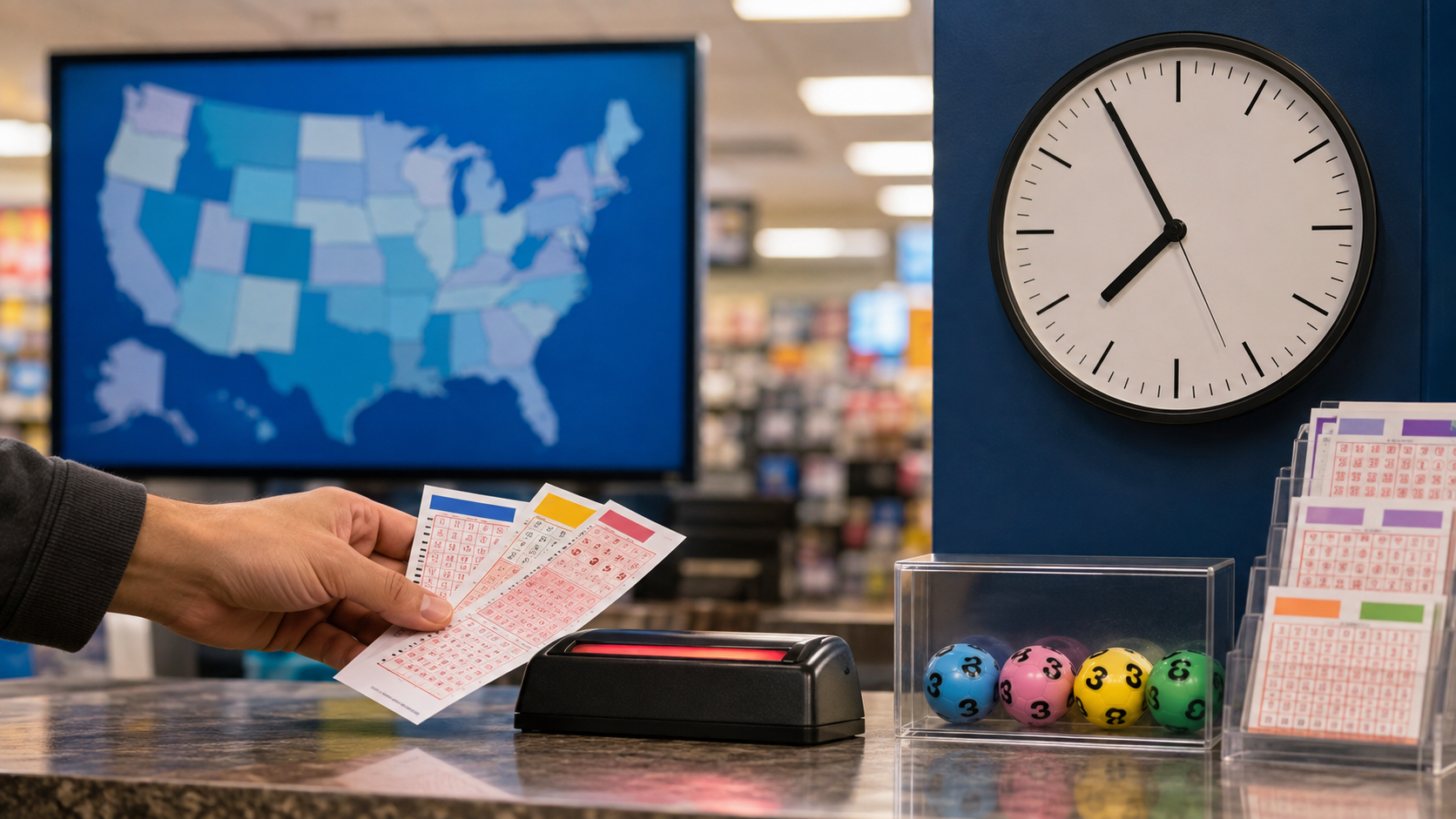
There is no single national cutoff — every state lottery sets its own sales-stop time, usually somewhere between an hour and just a few minutes before the drawing. Here is exactly how cutoff times work and how to find yours.
You are standing in line, the drawing is in twenty minutes, and you are not sure whether the clerk can still sell you a ticket. It is one of the most common last-minute questions in lottery play: what time do they stop selling lottery tickets? The honest answer is that it depends entirely on which state and which game you are playing, because every state lottery sets its own cutoff time, and that time is almost never the same as the drawing time itself.
This guide walks through how cutoff times actually work, why Powerball and Mega Millions cutoffs differ by state even though the draws happen at the same national moment, what the typical windows look like, and how to find the exact time for your state so you are never the person turned away at the counter. Once you know when your window closes, you can also use the Lottery Calculator to see what any prize you win would actually be worth after taxes and the cash-value cut, so the planning does not stop at the purchase.
Cutoff times decide whether you get a ticket in at all — the Waldev Lottery Calculator tells you what winning would actually be worth once you do. Run any jackpot through it while you wait for the next drawing.
What this guide covers
Why lottery sales have a cutoff at all
Every drawing needs a finalized, locked-in pool of tickets before the machine draws the numbers, so lotteries set a sales cutoff to give themselves a buffer between the last ticket sold and the moment the balls actually drop. That buffer covers the technical work of closing out sales terminals across thousands of retailers, reconciling the total number of entries, and transmitting that data to the drawing system, all of which has to happen cleanly before the draw for the results to be valid and auditable.
The cutoff also protects fairness. If sales stayed open until the literal second of the draw, there would be no clean way to guarantee that every ticket sold anywhere in the state was actually included in the pool, or that no one could exploit a delay to buy after seeing early information. A fixed cutoff, enforced simultaneously at every terminal in the state, closes that gap and gives every retailer and every player the same clean deadline.
None of this is arbitrary or punitive — it is simply logistics at scale. Thousands of terminals need to stop selling, upload their totals, and hand off to the drawing system in a matter of minutes, and the cutoff is the mechanism that makes that possible. Understanding that helps explain why the buffer exists at all, and why it is measured in a specific number of minutes before the draw rather than being flexible.
There is no single national cutoff time
Because Powerball and Mega Millions are played across dozens of participating states and jurisdictions, and each of those runs its own lottery commission, there is no single cutoff time that applies everywhere. The drawing itself happens at one national moment, broadcast live, but the moment each state’s sales close leading up to that draw is set independently by that state’s lottery, and can differ from its neighbors by anywhere from a few minutes to close to an hour.
This surprises a lot of players who assume that because the draw is national, the sales rules must be too. In practice, a state on the East Coast might stop selling Powerball tickets a full hour before the draw, while a state further west, in a different time zone, might have a cutoff that falls closer to the draw in local time simply because of how the schedule maps onto that zone. The safest assumption is always to check your own state, not to assume a neighboring state’s rule applies to you.
This is also why generic answers you find online, including a lot of what circulates informally, tend to be wrong or outdated for your specific state. The only reliable source is your state lottery’s own website or official app, which is exactly where the US state lottery guide points you for every state’s specific rules and contact information.
Powerball cutoff times, explained
Powerball drawings happen three nights a week at a fixed national time, and most participating states close ticket sales somewhere in the range of fifty-nine minutes to about an hour before that draw, though the exact figure is set independently by each lottery. A smaller number of states and jurisdictions cut off sales a bit earlier, and a few cut it closer to the draw, so the honest range you will see quoted is roughly forty-five minutes to just under two hours beforehand, depending entirely on where you are.
What is consistent across virtually every state is that the cutoff always falls before the draw, never at or after it, and that the gap exists specifically so the state can close out and validate every ticket sold. If you want to play Powerball on a given night, the safest habit is to buy your ticket well before the evening of the draw rather than racing the clock, since the exact minute the window closes in your state may not match what you remember from a different state or a different year. For everything else about how the game works, see how to play Powerball, including the rules, odds, and prize tiers.
Mega Millions cutoff times, explained
Mega Millions follows the same basic pattern as Powerball: a fixed national drawing night and time, with each participating state setting its own sales cutoff ahead of that moment, independently of its neighbors. As with Powerball, most states close sales somewhere in the neighborhood of an hour before the draw, though you will find some variation, with a handful of states cutting off sales earlier in the evening and others allowing purchases a little closer to draw time.
Because Mega Millions and Powerball are sold through the same retailer terminals in most states, the cutoff times for the two games are often identical or very close within a given state, even though the games themselves have different draw nights. That said, “often” is not “always,” so if you are buying both games on the same visit, it is still worth confirming that your state has not set a slightly different cutoff for one versus the other. The how to play Mega Millions guide covers the rules, Megaplier, and prize structure if you want the full picture beyond timing.
Typical cutoff windows you will actually see
Rather than a single number, think of cutoff times as falling into a few common bands. The table below shows the general pattern reported across most states for the major multi-state games; treat it as a starting orientation, not a substitute for checking your specific state.
| Typical cutoff window | How common it is | What it usually means for you |
|---|---|---|
| About 45–60 minutes before the draw | Most common pattern nationally | You generally need to buy on draw night before the early evening cutoff, not right up to broadcast time. |
| 30–45 minutes before the draw | Reported in a number of states | A slightly tighter window; do not assume you have a full hour. |
| Less than 30 minutes before the draw | Less common but does exist | Cutting it close is genuinely risky here; buy earlier in the day if possible. |
| Cutoff also applies to online/app purchases | Standard where online sales exist | Online sales close at the same or an earlier time than in-store retail sales, not later. |
These bands describe the general shape of cutoff schedules across states and are not a guarantee for any one jurisdiction. Your state lottery’s website is the only source that gives you the exact minute for tonight’s draw.
Why the cutoff always comes before the draw, never at it
A question that trips up newer players is why the cutoff cannot simply be the moment the drawing starts. The answer comes back to the logistics described earlier: closing thousands of retail terminals, confirming that every sale has been recorded, and transmitting a finalized entry pool to the drawing system all take real time, and that work has to be finished before the draw, not happening simultaneously with it.
There is also a fairness dimension. If sales stayed open until the draw itself, there would be a real risk of tickets being sold in the final seconds without being properly included in the pool, or of some retailers processing sales fractionally later than others due to network delays. The buffer removes that ambiguity entirely: by the time the draw happens, every eligible ticket has already been locked in, verified, and accounted for, and no purchase made after the cutoff can influence or be included in that night’s result.
How each state actually sets its cutoff
State lotteries generally set their own cutoff time based on a combination of their retailer network size, their internal processing requirements, and simple operational preference, which is exactly why the number varies from state to state rather than being dictated by Powerball or Mega Millions as multi-state games. A state with a larger retailer footprint may need slightly more buffer time to close out every terminal cleanly, while a smaller state might be comfortable with a tighter window.
| Factor | How it can affect the cutoff time |
|---|---|
| Size of the retailer network | More terminals to close out generally means the state builds in a bit more buffer before the draw. |
| In-house processing systems | Each state lottery’s own technology determines how quickly it can finalize and transmit its sales totals. |
| Whether online sales are offered | States with online or app-based sales must synchronize an additional sales channel, which can affect the cutoff. |
| Local operational policy | Some lotteries simply choose a rounder, more customer-friendly cutoff time (for example, on the hour) rather than the tightest possible window. |
None of this is something a player needs to calculate themselves — it explains why the number differs, not something you have to verify. The practical takeaway is simply that your state’s cutoff is a fixed, published number you can look up, and it will not necessarily match what you have heard from someone who plays in a different state. Once your ticket is safely in before the deadline, the more useful number to think about is what a win would actually pay, which the Lottery Calculator can show you in after-tax terms for either payout option.
Do online sales have a different cutoff than in-store sales?
In states where online or app-based lottery ticket sales exist, the online cutoff is typically the same as, or sometimes earlier than, the in-store cutoff — it is essentially never later. Online systems still need time to process and finalize purchases before the state can lock in its full sales pool, so do not assume that buying digitally gives you extra minutes over walking into a retail store.
If your state offers online purchasing, its official site or app will state the online cutoff explicitly, and it is worth checking that number separately from the in-store one, since they are not always identical. See can you buy lottery tickets online for the state-by-state rundown of where online and app-based sales are actually available, since a meaningful number of states still require you to buy in person.
Time zones and buying near a state border
Because the national draw happens at one fixed moment in a reference time zone, and each state’s cutoff is set relative to its own local drawing time, players who live near a state line or who travel across time zones can genuinely confuse themselves about how much time is left. A cutoff quoted as “9:59 p.m.” means something different depending on which time zone that state actually observes, and a state one zone over may effectively have “more” or “less” clock time remaining even with an identical cutoff rule.
The safe habit if you are buying in a state near a time-zone boundary, or buying while traveling, is to check the cutoff in the local time of the state where you are actually purchasing the ticket, not the time zone you are used to at home. Lottery rules and eligible ticket purchases are governed by the state where the ticket is sold, a distinction that also matters for claiming a prize later, as covered in where to buy lottery tickets.
This matters in practice for anyone who commutes across a state line for work, or who lives in a metro area that straddles two states, since it is easy to glance at your phone’s clock, which usually follows your home time zone automatically, and misjudge how much time is actually left before the store you are standing in closes its terminal. When in doubt, ask the clerk what time zone the store’s system runs on, or simply check the official schedule for that specific state rather than doing the math in your head under pressure.
What happens if you show up after the cutoff?
Once the cutoff passes, retailer terminals in that state simply stop being able to process new lottery ticket sales for that drawing, whether you are buying in person or trying through an app. There is no exception process, no manual override, and no way for an individual retailer to sell you a ticket for that draw after the state-wide system has closed. Any ticket purchased is only valid for the next scheduled drawing once the current one has locked.
This is worth knowing in advance because it removes any temptation to argue with a clerk or assume a particular store might make an exception. The cutoff is enforced at the system level across every retailer simultaneously, not at each store’s discretion, so if the terminal will not sell you a ticket, it genuinely cannot, and your best move is simply to plan to buy earlier next time.
Retailer terminal shutdown vs. the official state cutoff
It is worth distinguishing between the official published cutoff time and how an individual retailer actually behaves as that time approaches. Some stores may effectively stop selling tickets a few minutes ahead of the true system cutoff simply because a clerk is finishing another transaction, closing the register for the night, or dealing with a line, even though the terminal itself would technically still process a sale.
This means the official cutoff time should be treated as the latest possible moment, not a guarantee that any given store will still be willing or able to sell you a ticket right up until that second. If you are buying close to the published cutoff, do not assume every retailer will process your sale at the very last minute; busy stores, especially near a big jackpot, tend to have informal buffers of their own layered on top of the official one.
Cutoff times on holidays and special drawings
Regular scheduled drawings generally keep their normal cutoff time even on holidays, since Powerball and Mega Millions draws happen on their usual nights regardless of the calendar date. Where you should be more careful is around special or one-off promotional drawings, second-chance drawings, or any state-specific bonus game, since these can sometimes carry their own separate entry deadlines that are not the same as the regular ticket-sales cutoff.
If a state lottery announces a special holiday drawing or a limited-time promotion, always check that specific announcement for its own cutoff or entry deadline rather than assuming the standard draw-night cutoff applies. The mechanics of entering non-winning tickets into bonus drawings are covered separately in how second-chance lotteries work, including how those deadlines typically differ from a normal sales cutoff.
Multi-draw and advance-play tickets around the cutoff
Many players buy tickets that cover several upcoming drawings at once, sometimes called multi-draw or advance play, which sidesteps the cutoff question entirely for future draws since the purchase is already locked in ahead of time. If you buy a five-drawing advance ticket today, none of those future draws require you to race a cutoff again, because your entry for each of them was finalized at the moment of purchase.
The cutoff only matters for the single, next upcoming drawing you are trying to enter right now. If you already know you want to play several draws in a row, buying in advance removes the timing pressure completely and is one of the simplest ways to make sure you never miss a drawing because you were running late. Check when lottery drawings actually happen for the specific days and times you would be covering with a multi-draw ticket.
Scratch-off tickets have no drawing cutoff at all
It is worth clarifying that everything above applies specifically to draw-based games like Powerball, Mega Millions, and state Pick games, which are tied to a scheduled live drawing. Scratch-off (instant) tickets work completely differently: there is no drawing to schedule around, because the winning outcome is already determined and printed on the ticket at the time of manufacture. You can buy a scratch-off ticket any time a retailer is open and selling, with no cutoff whatsoever tied to a draw clock.
The only timing consideration with scratch-offs is store operating hours and, separately, the claim deadline for redeeming a winning ticket once you have scratched it, which is an entirely different kind of deadline than a sales cutoff. See the scratch-off lottery guide for how instant games work and how their odds compare to draw games, and do lottery tickets expire for how long you actually have to claim a prize after the fact.
How to find your exact state’s cutoff time
Because the cutoff genuinely varies by state and can change over time as lotteries update their systems, the only reliable way to know your exact number is to check an official source directly rather than relying on general guidance like this article for the precise minute.
Every US lottery publishes its own site with a drawing schedule page; search “[your state] lottery drawing schedule” or “[your state] lottery cutoff time” to find it directly.
Both national games’ official sites link out to each participating state lottery, which is the fastest way to jump straight to your state’s specific rules.
Where an official app exists, it typically shows a live or near-live countdown to the sales cutoff for tonight’s drawing, which is the most current source you can check on your phone.
Clerks who regularly sell lottery tickets usually know their store’s practical cutoff for the night, even if they cannot quote the official system time to the minute.
Cutoff times can be adjusted by a state lottery over time, so if you have not confirmed the number in a while, do a quick check rather than relying on a memory from a year or more ago.
Common mistakes people make with cutoff times
Assuming your state’s cutoff matches a neighboring state’s. Each state lottery sets its own time independently; do not borrow a number from a friend who plays somewhere else.
Confusing the draw time with the cutoff time. The cutoff is always before the draw, often by 45 minutes to an hour, never at the moment the draw itself happens.
Assuming online sales close later than in-store sales. Where both exist, online cutoffs are typically the same as or earlier than in-store cutoffs, never later.
Not accounting for time zones near a state line. Always use the local time of the state where you are actually buying the ticket, not your home time zone.
Expecting a retailer to make a manual exception. Once the state-wide system closes, no individual store can process a sale for that drawing, no matter how the request is made.
Waiting until draw night to check the schedule at all. Confirm the cutoff earlier in the day so you are not looking it up under time pressure right before the deadline.
Why cutting it close is a bad habit, even if you make it
Even if you have successfully bought a ticket five minutes before your state’s cutoff before, treating that as a reliable routine sets you up to eventually miss a drawing entirely. Lines get longer on big-jackpot nights, a store’s own informal buffer might be earlier than the official system cutoff, and any small delay — a slow transaction ahead of you, a printer jam, a system hiccup — can turn a comfortable five-minute margin into a missed window with no way to fix it.
The safer and, frankly, less stressful approach is to simply build your ticket-buying into your day earlier, rather than treating the cutoff as a countdown to beat. Nothing about your odds changes whether you buy at noon or nine minutes before the cutoff; the only thing at risk by waiting is whether you get a ticket in at all. There is no upside to cutting it close, and a real downside if you do not make it.
It also helps to remember that the drawing itself is broadcast and reported well after the sales window closes, so there is genuinely no advantage to buying as late as possible — you are not getting fresher information or a better shot at the numbers by waiting. The only thing “cutting it close” accomplishes is added stress and a real chance of missing the window entirely on the one night it actually matters to you, like a big jackpot draw when lines are longest and margins are tightest.
Sales cutoff vs. second-chance entry deadlines
It is worth being clear that a lottery ticket sales cutoff and a second-chance drawing entry deadline are two entirely different clocks. The sales cutoff governs when you can still buy or enter a ticket for the next live drawing. A second-chance deadline, by contrast, governs when you can still submit an already-purchased, non-winning ticket into a separate promotional drawing, and that deadline can be days or weeks after the original ticket was sold, with its own published schedule entirely independent of any draw-night cutoff.
Do not confuse the two when you are trying to figure out how much time you have left. If you are trying to buy a new ticket for tonight’s drawing, you need the sales cutoff. If you are trying to submit an old losing ticket into a bonus drawing, you need that specific promotion’s entry deadline, which is detailed on your state lottery’s second-chance program page rather than its regular drawing schedule.
A simple rule of thumb if you cannot check right now
If you genuinely cannot look up your exact state cutoff in the moment, a reasonably safe rule of thumb is to assume you need to buy at least an hour before the scheduled drawing time in your local time zone. That is on the conservative end of the typical range most states use, so treating it as your personal deadline means you are very unlikely to be caught out by a state with a slightly earlier cutoff than you expected.
This rule of thumb is a fallback, not a substitute for actually checking. It exists so that if you are, say, traveling and cannot easily pull up your home state’s exact schedule, you have a safe buffer to work from rather than guessing at the last minute. As soon as you can, confirm the real number for wherever you are buying, since an hour is a safe overestimate in most states but not a guarantee in every one.
Planning ahead instead of racing the clock
The simplest fix for all of this is to stop treating ticket-buying as a last-minute errand tied to the draw clock at all. Many regular players build a habit of buying earlier in the day, on their way to or from work, or as part of another errand, precisely so the cutoff time becomes irrelevant to their routine. If your ticket is already bought by mid-afternoon, it genuinely does not matter what the exact cutoff is that night.
This habit also pairs naturally with using a multi-draw ticket for games you play regularly, so you are not even making the decision fresh each drawing night. Between buying early and covering several draws at once, the cutoff time stops being something you need to think about under pressure, and becomes just a piece of trivia about how the system works behind the scenes. Whatever routine you land on, the goal is the same: never let a countdown clock decide whether you got to play at all — save the real decision-making for after a draw, when a quick pass through the Lottery Calculator tells you what any prize tier is actually worth.
The quick version
There is no single national answer to “what time do they stop selling lottery tickets” — every state sets its own cutoff, typically somewhere between about forty-five minutes and an hour before the scheduled drawing, and that cutoff is always before the draw, never at it. Powerball and Mega Millions follow the same general pattern, online sales cutoffs are the same as or earlier than in-store cutoffs, and once the system-wide cutoff passes, no retailer can make an exception. The only reliable way to know your exact number is to check your state lottery’s official website or app directly, and the safest habit is to buy earlier in the day rather than racing a countdown you cannot control.
Once your ticket is in, see when lottery drawings actually happen, brush up on the rules in how to play Powerball and how to play Mega Millions, and check where to buy lottery tickets or can you buy lottery tickets online for the full purchasing picture. Then run any prize through the Lottery Calculator to see what a win would really pay out after taxes, browse the wider lottery blog and finance calculators, or head back to the homepage for the full library of free tools.
Lottery ticket cutoff times: frequently asked questions
What time do they stop selling lottery tickets?
It depends on your state, since every state lottery sets its own sales cutoff independently rather than following one national rule. Most states close ticket sales somewhere between about forty-five minutes and an hour before the scheduled drawing, though the exact number varies. The cutoff is always before the draw itself, never at the same moment. The only way to know your exact time is to check your own state lottery’s official website or app, since neighboring states can have different cutoffs even for the same national game.
How late can you buy a Powerball ticket?
Most states stop selling Powerball tickets roughly an hour before the scheduled national drawing, though the specific cutoff is set independently by each participating state and can be somewhat earlier or later. There is no single answer that applies everywhere. Check your own state lottery’s official site or app for the exact time on a given draw night, and treat about an hour before the draw as a safe general assumption if you cannot look up the specific number in the moment.
What time does the lottery close for Mega Millions?
Like Powerball, Mega Millions cutoff times are set individually by each participating state, and most fall in a similar range of roughly forty-five minutes to an hour before the scheduled national drawing. Because many states sell Powerball and Mega Millions through the same retailer terminals, the cutoff times for both games are often identical within a given state, but that is not guaranteed everywhere, so it is worth confirming with your official state lottery source if you are buying close to the deadline.
Do online lottery ticket sales have a different cutoff than in-store sales?
In states that offer online or app-based ticket sales, the online cutoff is typically the same as, or sometimes slightly earlier than, the in-store cutoff. It is essentially never later, since online purchases still need processing time before the state finalizes its sales pool for the draw. If your state offers online sales, check that specific cutoff separately, since it is not always identical to the retail in-store time even though it is usually close.
Can a retailer sell me a ticket after the official cutoff time?
No. Once a state’s sales cutoff passes, the terminal system stops processing new ticket sales for that drawing across every retailer simultaneously, and there is no manual override an individual store can use. Any purchase attempted after the cutoff will not go through for that draw, though the terminal will typically still be available for the next scheduled drawing once the current one has locked. This rule is enforced at the system level, not at each retailer’s discretion.
Is the cutoff time the same in every US state?
No. Each state lottery sets its own sales cutoff independently, based on its own retailer network and processing systems, so cutoff times genuinely differ from state to state even for the same multi-state game like Powerball or Mega Millions. A neighboring state’s cutoff time is not a reliable guide to your own state’s rule. Always check your specific state lottery’s official website or app rather than assuming a time you heard for a different state applies to you.
Does the sales cutoff apply to scratch-off tickets too?
No. Scratch-off, or instant, tickets have no drawing to schedule around, since their outcome is already determined and printed at the time of manufacture rather than decided by a live draw. You can buy a scratch-off ticket any time a retailer is open, with no draw-night cutoff involved at all. The only relevant deadlines for scratch-offs are the store’s operating hours and, separately, the claim deadline for redeeming a winning ticket after you have scratched it.
What is the safest rule of thumb if I cannot check my state’s exact cutoff?
If you cannot look up your state’s exact number in the moment, a reasonably safe assumption is to buy at least an hour before the scheduled drawing time in your local time zone, since that sits on the conservative end of the typical range most states use. This is a fallback for when you are in a hurry, not a substitute for checking; confirm the real cutoff for your state as soon as you can, since some states do allow purchases closer to the draw than that hour-long buffer.
Disclaimer: This article is general informational content about lottery sales and drawing schedules, not official rules for any specific state lottery. Cutoff times, drawing schedules, and retailer hours change and vary by jurisdiction, so always confirm the exact time with your state lottery’s official website or app before relying on it. If lottery spending ever feels out of control, confidential help is available through the resources noted below.
Powerball publishes its national drawing schedule and general sales-cutoff guidance. Powerball game info →
Mega Millions lists its drawing days, times, and links to every participating state lottery. Mega Millions official site →
