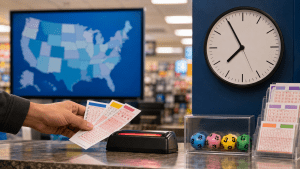
Lottery tickets are sold almost everywhere you already shop — gas stations, grocery stores, pharmacies, convenience stores — but the payment rules, age limits, and hours vary more than most players expect. Here is exactly where to look, what to bring, and what to know before you get to the register.
The honest answer to “where can I buy a lottery ticket” is almost always: wherever you already stop for gas, coffee, or milk. In every state that runs a lottery, tickets are sold through a network of licensed retailers — gas stations, convenience stores, grocery chains, pharmacies, and dedicated lottery or liquor stores — rather than through the lottery itself. There is no single “lottery store” you have to hunt down; there is a huge, ordinary retail network that most people pass a dozen times a week without noticing the little lottery sign in the window.
What trips people up is not finding a retailer but knowing the details: which payment methods actually work at the register, how old you need to be, whether the gas station at the airport counts, and what to have ready so the transaction takes ten seconds instead of an awkward back-and-forth with the cashier. This guide covers all of that, store by store and question by question. And once you have picked your numbers, the free Lottery Calculator shows you what any prize would actually be worth after the cash-value cut and taxes — worth a look before you decide how many lines to buy.
Buying the ticket is the easy part. Before you get too attached to a jackpot number, run it through the Waldev Lottery Calculator to see the realistic lump-sum and after-tax take-home — it keeps the whole errand in perspective.
What this guide covers
Where lottery tickets are actually sold
Every US state that runs a lottery licenses independent retailers to sell tickets on its behalf, rather than operating its own storefronts. That means the ticket you buy comes from the exact same register as your gum and your gas, rung up on a lottery terminal built into the point-of-sale system. Licensing requirements differ by state, but they generally involve a background check, a bond, and a commission agreement, which is why you tend to see lottery signage at established, long-standing businesses rather than pop-up shops.
In practical terms, this means the lottery is sold almost everywhere ordinary retail happens: fuel and convenience chains, supermarkets, pharmacy chains, drug stores, liquor stores, smoke shops, and plenty of independent corner stores. Some states also allow ticket sales at bars, bowling alleys, and other licensed venues. The common thread is foot traffic and a cash register, not any special “lottery store” format, so the fastest way to find one is usually to think about which of your regular stops already has a lottery terminal — you have probably walked past several this week.
A smaller number of outlets are worth knowing about too: some states allow ticket vending machines in approved locations, separate from the staffed counter, and a growing number allow purchases through an official state lottery app or website (covered later in this guide). But the overwhelming majority of tickets nationwide are still bought the traditional way, at a counter, from a person.
Finding a retailer near you
If you are searching “lottery tickets near me” hoping for a definitive list, the most reliable source is your own state lottery’s official website, which typically includes a retailer locator you can search by ZIP code or address. These locators pull from the same licensing database the state uses to authorize sellers, so they are more accurate than a general map search, which can show closed businesses or stores that stopped selling tickets.
That said, for everyday purposes most people do not need a locator at all — the fastest method is simply to check the front window or register area of stores you already pass. Lottery signage is required at point of sale in most states, so a quick glance as you walk in tells you instantly whether a given gas station, pharmacy, or grocery store sells tickets. If you are new to an area or traveling, a locator becomes genuinely useful, and it also tells you whether a specific retailer sells scratch-offs, draw games, or both, since not every licensed retailer carries every game.
Rule of thumb: any large chain gas station, most major supermarket chains, and most standalone pharmacies in a lottery state sell tickets. Small, brand-new, or very rural stores are the ones where you cannot assume — check the window or ask.
Gas stations & convenience stores
Gas stations and convenience store chains are, by a wide margin, the most common place people buy lottery tickets, and it is easy to see why: high foot traffic, long hours, and a register that is already handling cash and card transactions for fuel and snacks. Major fuel and convenience chains across the country — Circle K, QuikTrip, Speedway, Sheetz, RaceTrac, Casey’s, and many regional chains — sell lottery tickets in the states where they operate and the lottery is legal.
Convenience stores that are not attached to a gas station follow the same pattern: 7-Eleven locations in lottery states are a classic example, often selling both scratch-offs and draw-game tickets around the clock or close to it. The appeal for a quick purchase is obvious — you are usually already stopping for gas or a drink, and grabbing a ticket adds seconds to a trip you were making anyway. This convenience is also part of why lottery spending can add up without feeling deliberate; if you want a sense of what regular small purchases actually total over a year, see how much a lottery ticket really costs.
Grocery stores & pharmacies
Beyond gas stations, most major supermarket chains sell lottery tickets in states where the game operates, usually at a dedicated terminal near the customer service desk or the front registers rather than at every checkout lane. This is convenient if you are already doing a weekly grocery run and want to pick up a ticket without a separate errand, though lines at the customer service counter can sometimes be longer than at a convenience store.
Pharmacy and drugstore chains follow a similar model: many locations of the major national drugstore chains sell lottery tickets alongside prescriptions and everyday goods, typically at the main register. As with grocery stores, not every single location carries every game, and some smaller-format pharmacy locations may not sell tickets at all, so the window signage or a quick locator search is the fastest way to confirm before making a special trip.
Does Wawa sell lottery tickets?
Wawa is a frequent search because the chain is enormously popular along the East Coast, and the honest answer is: it depends on the location and state. Wawa operates in several states, and whether a given Wawa sells lottery tickets depends on that state’s lottery program, local licensing, and sometimes the individual store’s setup. Rather than assuming yes or no, the fastest way to confirm is to look at the counter area on your next visit or check your state lottery’s retailer locator for that address, since Wawa’s lottery participation is not uniform chain-wide.
The same logic applies to almost any regional convenience or gas chain readers search by name — the brand does not guarantee lottery availability everywhere it operates, because licensing happens at the state and store level, not at the corporate level nationwide. If a particular location matters to you (say, the Wawa you pass every morning), the two-second check at the counter beats guessing based on the brand alone.
Dedicated lottery, liquor & smoke shops
Alongside the big chains, plenty of smaller, independent stores exist mainly to sell lottery products, tobacco, and sometimes liquor, and these can be excellent options if you specifically want a large scratch-off selection or a knowledgeable clerk who deals with claims and second-chance entries regularly. Liquor stores in many states are licensed lottery retailers, and their staff often handle high-value scratch-off tickets and small prize redemptions daily, which can make them a smoother experience than a busy convenience store register.
Smoke shops and standalone lottery kiosks fill a similar niche in some areas, particularly for scratch-off variety, since these dedicated retailers sometimes stock a wider range of price points and games than a general convenience store has shelf space for. If you are specifically hunting for a particular scratch-off game, a dedicated lottery or liquor retailer is often a better bet than a gas station, which typically carries a smaller, higher-turnover selection. For a full rundown of how scratch-offs work and which price tiers to expect, see the scratch-off lottery guide.
How to buy a ticket, step by step
Buying a lottery ticket in person is simple, but it goes faster if you know the sequence, especially for draw games like Powerball or Mega Millions where you are choosing numbers rather than just grabbing a scratch-off card off a display.
The whole process usually takes under a minute for a simple purchase, and slightly longer if you are filling out play slips for several draw games at once. If you are unfamiliar with how the numbers and codes on the printed ticket relate to your slip, how to read a lottery ticket walks through exactly what each line and barcode means. It is also worth a minute before you buy multiple lines to run the numbers through the Lottery Calculator, so your sense of the prize stays grounded in the real, after-tax figure rather than the advertised headline.
Payment methods at the register
Payment rules for lottery tickets are set at the state level, and sometimes further restricted by individual retailers, so there is real variation across the country. Cash is universally accepted everywhere lottery tickets are sold and remains the simplest, no-questions-asked option. Beyond cash, the picture gets more specific, and it is worth understanding before you are standing at a register with the wrong card out.
| Payment method | Typical acceptance | What to know |
|---|---|---|
| Cash | Accepted everywhere | Universally the simplest and most reliable option; no restrictions apply. |
| Debit card (PIN-based) | Accepted in many states | Common where state law allows it; some states or individual retailers still decline card payment for lottery specifically. |
| Credit card | Restricted or prohibited in many states | A number of states bar lottery purchases on credit specifically, even where the same card works for other items in the store. |
| Mobile wallet / tap-to-pay | Varies by retailer terminal | Generally follows whatever underlying card type (debit or credit) is linked to the wallet. |
| SNAP/EBT | Not allowed | Federal rules bar the use of food assistance benefits for lottery tickets nationwide. |
Because these rules genuinely differ by state and even by individual store policy, the safest habit is to carry a little cash for lottery purchases specifically, even if you normally pay for everything by card. That way a declined card at the lottery terminal is a minor inconvenience rather than a wasted trip.
Can you buy lottery tickets with a debit card?
In many states, yes — debit cards, especially when run as a PIN-based transaction, are a commonly accepted lottery payment method, since a debit transaction pulls directly from funds you already have rather than extending credit. Retailers that accept debit for everything else in the store often extend the same acceptance to lottery terminals, though this is set by state regulation first and store policy second, so it is not universal.
Where debit is restricted, it is usually part of a broader rule limiting lottery payment to cash only, rather than a rule that singles out debit specifically while allowing credit. If you are unsure whether a specific store accepts debit for lottery purchases, the fastest way to find out is simply to ask before the clerk rings up the ticket, since return or refund policies on lottery tickets are essentially nonexistent once printed.
Can you buy lottery tickets with a credit card?
This is where the rules tighten the most. A number of states specifically prohibit using a credit card to buy lottery tickets, even though the same card works fine for gas, groceries, or anything else in the same store. The reasoning behind these restrictions is consumer protection: regulators in those states have decided that borrowing money, even briefly on a credit line, to fund lottery play, carries enough risk that it should not be facilitated at the point of sale.
Where credit is allowed, it typically works exactly like any other credit purchase at that retailer. Because the rule varies so much by state, and because a declined transaction at the register is an awkward moment for everyone involved, the practical advice is the same as with debit: default to cash for lottery specifically if you are unsure, and treat any card acceptance as a convenience rather than something to count on, especially when traveling to a state you do not normally play in.
How old do you have to be to buy lottery tickets?
The minimum age to buy a lottery ticket is set individually by each state, and while 18 is the most common threshold nationwide, several states set the bar higher, requiring players to be 19 or 21. There is no single national age, which matters if you are buying near a state border or traveling, because a ticket that is perfectly legal for you to buy at home might not be if the store sits in a state with a higher minimum age.
Retailers are required to check ID for anyone who appears to be near the cutoff, and selling to an underage buyer can put the store’s lottery license at risk, so a clerk asking for ID is following the rules rather than being difficult. If you want the full state-by-state age breakdown along with related legal questions like whether you can play across state lines, see playing the lottery: age limits, legality and out-of-state rules, which covers this in detail.
ID and verification at the register
For a routine ticket purchase, you generally do not need to show ID unless the clerk has reason to check your age, which typically happens when a buyer looks close to the state’s minimum. Standard government-issued photo ID — a driver’s license, state ID, or passport — satisfies this everywhere it is required, and there is nothing unusual about being carded for a lottery ticket the same way you might be for alcohol or tobacco at the same counter.
ID becomes far more relevant later, at the claiming stage, where winners of anything beyond a small prize typically must present identification and complete paperwork to be paid, whether at the retailer for a modest win or at a state lottery claims center for a large one. Keeping a valid photo ID handy is a good habit generally, but it is genuinely required, not just polite, once you are collecting a prize rather than just buying a ticket.
Can you buy lottery tickets at the airport?
Yes, in many airports located within states that run a lottery, you can find a newsstand, convenience shop, or gift store inside the terminal that is a licensed lottery retailer, just like any other store in that state. Whether a specific airport sells tickets depends on the state’s lottery program and which concessionaires operate inside that terminal, so it is not guaranteed everywhere, but it is common enough that a bored traveler with a layover often has the option.
One detail worth knowing: an airport retailer sells tickets under the rules of the state the airport is physically located in, not the state you departed from or are flying to. If you are hoping to buy a ticket for your home state’s specific game while passing through an airport in a different state, that generally is not possible — you can only buy tickets valid for the games sold in the state you are physically standing in. For more on this distinction, the section below on buying across state lines covers it in more depth.
Buying while traveling or out of state
Multi-state games like Powerball and Mega Millions are sold in most states that participate, so if you are traveling through a participating state, you can typically buy a ticket there for that shared drawing just as easily as a local resident can. What you generally cannot do is buy a ticket for a game that is not sold in the state you are physically in — lottery retailers sell what their state’s lottery offers, not tickets from other states’ game menus.
This matters for two common situations: road trips through multiple states, where each stop only sells that state’s available games, and residents of non-lottery states who need to cross into a neighboring state to buy a ticket at all, since a handful of states do not run a lottery. In both cases, the ticket itself is only valid for the drawing it was printed for, in the state where it was sold, and prizes generally must be claimed in that same state. The full legal picture, including which states have no lottery at all, is covered in age limits, legality and out-of-state rules.
Buying online instead of in person
A growing number of states now allow ticket purchases directly through an official state lottery website or app, letting you buy draw-game tickets from your phone rather than a physical counter. Where this option exists, it typically requires creating an account, verifying your identity and location, and linking a payment method, after which you can buy tickets for eligible games without a store visit at all.
Online buying is not universal, though, and where it is not offered, the only legitimate way to buy a ticket remains an in-person, licensed retailer. Be cautious of third-party apps or websites that claim to buy or “courier” tickets on your behalf in states without official online sales — the safest, always-legitimate option is your own state lottery’s official online system if one exists, or a licensed physical retailer if it does not. For the complete state-by-state picture of where online purchasing is available, see can you buy lottery tickets online.
What to bring: a quick checklist
A lottery purchase rarely fails because of anything complicated, but a little preparation avoids the small hiccups that turn a ten-second errand into a longer one.
Cash, just in case. Even if you normally pay by card everywhere, carry some cash specifically for lottery purchases in case the terminal or state restricts card payment.
A valid photo ID. You may not need it for a routine purchase, but you will if you look close to the state’s minimum age, and you will definitely need it to claim any real prize later.
Your numbers written down. If you play specific numbers rather than a Quick Pick, bring them on paper or on your phone rather than trying to recall them at the counter.
A decision on add-ons. Know in advance whether you want Power Play, Megaplier, or multiple draws, since it is faster to tell the clerk up front than to change your mind after the ticket prints.
A pen, for the moment you get home. Sign the back of any real-value ticket as soon as you can, ideally before you even leave the parking lot.
Play slip vs. Quick Pick
For draw games, you have two ways to choose numbers: fill out a paper play slip by hand, marking your chosen numbers on a printed grid, or simply ask the clerk for a Quick Pick, which generates random numbers by computer. Both produce an equally valid ticket with identical odds — the method of selection has zero effect on your chances, since every combination is equally likely regardless of who or what picked it.
Play slips are worth using if you have specific numbers you want to play consistently, such as meaningful dates, while Quick Pick is faster if you have no particular numbers in mind or you are buying on the way out the door. Many regular players use a mix of both: a few play-slip lines with chosen numbers and additional Quick Pick lines to fill out the rest of their budget. For guidance on choosing numbers thoughtfully rather than just grabbing whatever comes to mind, see how to pick lottery numbers.
Store hours and sales cutoffs
A store being open does not always mean lottery sales are open. Every draw game has a sales cutoff time before each drawing, typically ranging from under an hour to a couple of hours prior, after which the lottery terminal simply will not print a ticket for that drawing, even if the store itself stays open all night. Buying at 11:50 pm at a 24-hour gas station does not guarantee you make a drawing scheduled for that evening if the cutoff has already passed.
This trips up more players than you would expect, especially the “I’ll grab it right before the drawing” crowd. If a specific drawing matters to you, it is worth buying well ahead of the deadline rather than cutting it close, since a missed cutoff simply rolls your purchase to the next scheduled drawing instead. For the exact cutoff windows by game and how they vary, see what time do lottery sales stop.
Mistakes people make buying tickets
A handful of avoidable errors show up again and again at the counter, and most of them are easy to sidestep once you know to watch for them.
Assuming a card will work. Showing up with only a credit card in a state that restricts credit-card lottery purchases means an awkward moment and a wasted trip if you have no cash backup.
Missing the sales cutoff. Buying too close to a drawing’s deadline can push your ticket to the next scheduled drawing without you realizing it happened.
Not checking the printed ticket. Numbers, draw date, and add-ons should all be confirmed at the counter, since mistakes on a play slip or a mis-communicated request are far easier to fix before you leave.
Leaving a ticket unsigned. An unsigned ticket can generally be claimed by whoever physically holds it, so this is the single most important habit to build immediately after buying.
Buying at a store that does not carry the game you want. Not every licensed retailer sells every game, so double-check before assuming a store carries a specific multi-state or specialty game.
After you buy: protecting the ticket
Once the ticket is in your hand, the most valuable thing you can do costs nothing: sign the back, right away, before you forget or lose it. A signed ticket establishes your ownership if it is ever lost or stolen, which matters far more than most people realize until it is too late. Treat any real-value ticket the way you would a check made out to cash — something to secure, not something to leave loose in a cupholder.
Beyond signing, it helps to know how you would check the numbers and where you would go to claim a prize before you actually need to. Checking is straightforward through official apps, websites, or the retailer’s terminal, covered in how to check and scan a lottery ticket, while cashing in a win, whether it is a small prize at the store counter or a larger one requiring a claims center, is covered fully in where to cash lottery tickets. Knowing both steps in advance means a real win never catches you unprepared about what to do next.
The quick version
Lottery tickets are sold through licensed retailers in every participating state — gas stations, convenience stores, grocery chains, pharmacies, and dedicated lottery or liquor stores — not through any special “lottery store.” Cash works everywhere; debit and credit acceptance varies by state and retailer, with several states restricting credit-card lottery purchases specifically. Most states set the minimum age at 18, though some require 19 or 21, and you can generally buy at an airport or while traveling, but only for games sold in the state you are physically in. Watch your state’s sales cutoff before each drawing, sign any real-value ticket immediately, and bring cash and ID just in case.
Before you decide how many lines to buy, check the honest after-tax number in the Lottery Calculator. Then go deeper with buying tickets online, age and legality rules, sales cutoff times, how to read a ticket, and the US state lottery guide. Browse more in the lottery blog, the finance calculators, or from the homepage — and once your ticket is bought and signed, the calculator is exactly where to check what a win would really be worth.
Where to buy lottery tickets: frequently asked questions
Where can I buy lottery tickets near me?
Lottery tickets are sold at licensed retailers in every state that runs a lottery, most commonly gas stations, convenience stores, grocery stores, pharmacies, and dedicated lottery or liquor stores. There is no separate lottery-only storefront; instead, look for a lottery terminal or window signage at stores you already visit. Your state lottery’s official website typically includes a retailer locator you can search by ZIP code, which is the most reliable way to confirm a specific address sells tickets before making a special trip.
Can you buy lottery tickets with a debit card?
In many states, yes, especially as a PIN-based transaction, since debit pulls directly from money you already have rather than extending credit. Acceptance is set by state regulation first and individual retailer policy second, so it is not guaranteed everywhere. Because rules vary, it is smart to carry some cash for lottery purchases specifically, even if you normally pay by card for everything else, so a declined debit transaction does not turn into a wasted trip to the store.
Can you buy lottery tickets with a credit card?
It depends on the state. A number of states specifically prohibit using a credit card to buy lottery tickets, even though the same card works for other purchases in the same store, largely for consumer-protection reasons around borrowing to gamble. Where it is allowed, it works like any other credit transaction. Since the rule differs by state and even by retailer, defaulting to cash for lottery purchases is the safest habit, especially when traveling somewhere you do not normally play.
How old do you have to be to buy lottery tickets?
Most states set the minimum age at 18, but several states require players to be 19 or 21 instead, so there is no single national age. Retailers check ID when a buyer appears close to the cutoff, since selling to someone underage can jeopardize the store’s lottery license. If you are near a state border or traveling, it is worth confirming the local minimum age rather than assuming your home state’s rule applies, since age limits are set state by state, not nationally.
Can you buy lottery tickets at the airport?
Yes, many airports in lottery-running states have a newsstand, convenience shop, or gift store that is a licensed lottery retailer, the same as any other store in that state. The tickets sold follow the rules of the state the airport physically sits in, not the state you flew from or are headed to, so you can only buy tickets for games offered in that airport’s home state. Whether a specific airport has a lottery retailer depends on its concessionaires, so it is not guaranteed everywhere.
Does Wawa sell lottery tickets?
It depends on the specific location and state, since Wawa’s lottery participation is not uniform across every store the chain operates. Lottery licensing happens at the state and individual-store level, not company-wide, so some Wawa locations sell tickets and others may not, even within states where the lottery is legal. The fastest way to confirm is to check the counter area on your next visit or search your state lottery’s official retailer locator for that specific address.
How do you buy a lottery ticket for the first time?
Pick a game and know the price, then either fill out a paper play slip marking your chosen numbers or simply ask the clerk for a Quick Pick to get computer-generated numbers. Tell the clerk before the ticket prints if you want add-ons like Power Play or Megaplier, or multiple consecutive drawings. Pay with an accepted method, glance at the printed numbers and date to confirm they match what you asked for, and sign the back of the ticket right away.
Can I buy a lottery ticket in a state I am just visiting?
Yes, as long as that state runs a lottery and the retailer is licensed there, you can buy a ticket for the games that state sells, regardless of where you live or where you are headed. What you cannot do is buy a ticket for a different state’s specific game while standing in a store that does not sell it. Prizes generally must be claimed in the state where the winning ticket was purchased, so keep that in mind if you win somewhere other than home.
Disclaimer: This article is general informational content about buying lottery tickets in the United States, not legal or financial advice. Rules on age, payment methods, and retailer locations vary by state and by individual store policy, so confirm details with your state lottery or the retailer directly. Lottery tickets are a form of gambling with a negative expected value; only spend money you can comfortably afford to lose, and if gambling ever feels compulsive, confidential help is available through the resource below.
State lotteries maintain licensed-retailer locators and general game information. Powerball official site →
If buying tickets ever stops feeling like harmless fun, free and confidential help is available. National Council on Problem Gambling →