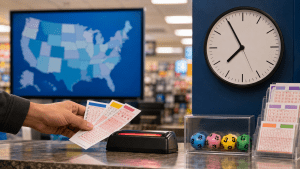
Scratch-offs look simple — pick a card, scratch it, see what happens — but the games hide real differences in price, odds, and remaining prizes. Here is how to actually find the best lottery scratch off tickets to buy, and how the whole system works underneath.
Scratch-off tickets — also called scratchers, instant games, or scratch cards — are the best-selling product in most state lotteries, and for good reason: they are cheap, instant, and come in dozens of price points and themes. But “which one should I buy” is a genuinely answerable question, because unlike draw games such as Powerball, scratch-off odds and remaining prizes are public information that changes as a game sells through. Once you know where to look, picking a smarter card takes about thirty seconds.
This guide covers the full picture: what the best lottery scratch off tickets to buy actually look like on paper, what a single ticket or a full roll costs, how many tickets come in a roll, whether you have to scratch off every panel, when new games are released, and what time retailers stop cashing scratch-offs each day. Once you have the mechanics down, the free Lottery Calculator is the fastest way to see what any prize — scratch-off or draw game — is actually worth after taxes.
Scratch-off top prizes are taxed the same way as draw-game wins. Run any prize amount through the Waldev Lottery Calculator to see the realistic after-tax number before you get your hopes up.
What this guide covers
What a scratch-off ticket actually is
A scratch-off is a preprinted lottery ticket with a hidden play area covered by a removable latex coating. Every card in a print run already has its outcome determined at the printing press — there is no live draw involved the way there is with Powerball or Mega Millions. The lottery commission knows in advance exactly how many winning tickets exist at each prize level within a given game, and those tickets are shuffled and distributed randomly across the print run so that no one, including the retailer, can predict which physical card in a roll is a winner.
Each scratch-off “game” is really a themed product with its own name, price, prize structure, and print run, and a state lottery typically runs dozens of games at once, from $1 cards with small prizes up to $50 tickets with jackpot-sized top prizes. Games are retired once the print run sells out or reaches its end date, and new games rotate in continuously, which is why the shelf at your local store looks different every few months. Understanding that a scratch-off is a finite, already-determined batch of cards — not a fresh random draw each time — is the key to everything else in this guide, especially the idea that odds genuinely improve as a game sells through and top prizes get claimed.
How scratch-off games are built
Behind every scratch-off is a prize structure the state lottery designs before a single ticket is printed. The lottery decides the total number of tickets in the game, how many of those tickets will win at each prize tier (from a free-ticket “match” up to the game’s top prize), and the ticket price needed to fund those prizes plus the state’s take. That structure is baked into the print run permanently: if a $5 game says “1 in 4.2 overall odds,” that ratio describes the entire print run from day one, not a probability that resets with each purchase.
Because winning tickets are distributed randomly through the print run rather than evenly spaced, buying tickets in sequence from a roll does not guarantee a pattern of wins and losses. What does change over the life of a game is the pool of remaining tickets: every ticket sold and every prize claimed shrinks what is left, and states publish updated remaining-prize reports so players can see, at any point, roughly how many top prizes are still unclaimed in a given game. That single piece of public information is the closest thing to a real edge a scratch-off player has, and it is covered in detail below.
It is also worth knowing that scratch-off revenue funds the same things draw-game revenue does — prizes, retailer commissions, lottery operations, and a share that goes to state programs such as education or general funds, the same pattern covered in how the lottery works. Scratch-offs are simply a different delivery mechanism for the same basic exchange: you pay for a small chance at a prize, and the game is structured so the state keeps a portion of every dollar wagered.
How much does a scratch-off ticket cost?
Scratch-off prices are set per game and typically range from $1 to $50, with most state lotteries offering a spread across that range at any given time. As a rough rule, higher price points come with better overall odds and bigger top prizes, because the lottery can build a richer prize structure into a more expensive ticket. A $1 ticket might have overall odds around 1 in 4 to 1 in 5 of winning any prize (often a small one, or a free ticket), while a $50 ticket might have overall odds closer to 1 in 2.5 to 1 in 3, with a top prize in the hundreds of thousands or more.
The exact price tiers and what each one buys vary by state, but the general lineup looks similar everywhere: budget tickets around $1–$2 for casual, frequent small plays; mid-range tickets around $3–$10 that balance affordability with a real shot at a four- or five-figure prize; and premium tickets from $20 to $50 aimed at players chasing the largest instant-game jackpots, which can run into six or seven figures depending on the game and state. For a full breakdown of what draw-game tickets and add-ons cost by comparison, see how much a lottery ticket costs.
| Typical price point | Common overall odds range* | Typical top prize range* |
|---|---|---|
| $1 – $2 | ~1 in 4 to 1 in 5 | $500 – $10,000 |
| $3 – $5 | ~1 in 3.7 to 1 in 4.3 | $10,000 – $100,000 |
| $10 | ~1 in 3.3 to 1 in 4 | $100,000 – $500,000 |
| $20 – $30 | ~1 in 2.8 to 1 in 3.5 | $500,000 – $2 million |
| $50 | ~1 in 2.5 to 1 in 3 | $1 million – $10+ million |
*Ranges are general and illustrative only. Every state and every individual game sets its own odds and prize structure — always check the specific game’s back panel or your state lottery’s website for the real numbers.
What makes a scratch-off “the best” to buy?
There is no single scratch-off that is objectively best everywhere, because prize structures differ by state and by game, and every game’s pool of prizes shrinks as it sells. But “best” has a consistent, checkable definition: the game with the best combination of favorable overall odds and the most top prizes still remaining relative to how many tickets are left to sell. That is a factual, publicly available comparison, not a guess or a superstition.
Practically, that means the best ticket to buy today is rarely the newest, flashiest game on the rack. Brand-new games have their full original odds, but so does every other unclaimed prize spread across the entire print run — nothing has been won yet, and nothing tells you where the winners are. A game that has been on shelves for months, by contrast, may have already had a chunk of its lower-tier prizes claimed while several top prizes remain, effectively improving the remaining odds for anyone buying now. The two questions worth asking before buying are simple: what are this game’s overall printed odds, and how many top prizes does the state’s website show as still unclaimed for this specific game?
Higher price points also tend to offer better overall odds as a general pattern, so if your budget allows it, a $10 or $20 ticket usually has meaningfully better odds of winning something than a $1 ticket, even though the $1 ticket is more affordable per play. Neither approach is “wrong” — it depends on whether you want more frequent small wins or better odds per individual ticket — but knowing the trade-off is what separates an informed purchase from a random one.
Reading the overall odds and remaining prizes
Every legally sold scratch-off ticket in the US is required to display its “overall odds” on the back panel, usually phrased as “Overall odds of winning are 1 in X.” That number covers every prize tier combined, from the smallest payout up to the jackpot, so it tells you your chance of winning anything, not specifically the top prize. A separate, much longer odds figure applies to the top prize alone, and serious buyers should look at both.
Price point vs. odds: the honest trade-off
It helps to be honest about what “better odds” really buys you. A $50 ticket with 1-in-2.8 overall odds sounds dramatically better than a $2 ticket at 1-in-4.5, but most of that improved likelihood is still concentrated in small prizes — often literally a free ticket or a few dollars back. The odds of hitting the actual top prize on any scratch-off, at any price point, remain long, typically ranging from roughly 1 in a few hundred thousand to 1 in several million depending on the game and price.
What genuinely shifts with price is the ceiling: spend more per ticket and the top prize you are chasing gets bigger, and the overall odds of winning something back generally improve modestly too. What does not shift is the underlying math — every scratch-off, like every lottery game, has a built-in house edge, and no price point turns the game into a good financial bet. Choosing a price point is really about choosing what kind of experience you want (frequent small wins vs. a rarer shot at a big prize) within a budget you have already decided you can afford to lose, and the Lottery Calculator can help you picture what any of these top prizes would actually pay out after taxes.
How many tickets are in a roll?
Scratch-off tickets are printed and shipped to retailers in continuous rolls rather than individual sheets, and the number of tickets per roll depends entirely on the ticket’s price, not on the state. As a general pattern across most US lotteries, cheaper tickets are packaged in larger rolls and more expensive tickets in smaller rolls, because the total dollar value per roll is kept in a manageable range for retailers.
Typical roll sizes run something like 300 tickets for a $1 game, 150 for a $2 game, 75 to 100 for a $5 game, 60 for a $10 game, and 30 or fewer for $20 and $30 games, though exact counts vary by state and by specific game. If you are asking how many tickets are in a roll for a particular game, the fastest accurate answer is to ask the retailer or check your state lottery’s retailer resources, since the packaging convention can shift slightly between states and even between different print runs of the same price point.
| Ticket price | Typical roll size* | Approx. roll face value |
|---|---|---|
| $1 | ~300 tickets | ~$300 |
| $2 | ~150 tickets | ~$300 |
| $5 | ~75–100 tickets | ~$375–$500 |
| $10 | ~60 tickets | ~$600 |
| $20 | ~30 tickets | ~$600 |
| $30 – $50 | ~20–30 tickets | ~$600–$1,500 |
*Roll sizes are common industry patterns, not a guarantee. States and individual games can package rolls differently, so treat these as a general guide rather than an exact count for any specific ticket.
How much does a roll of lottery tickets cost?
A full roll simply costs the ticket price multiplied by the number of tickets in the roll, so the face value scales with the price point rather than staying fixed. A roll of $1 tickets with 300 tickets costs about $300; a roll of $5 tickets with 75 to 100 tickets costs roughly $375 to $500; a roll of $10 tickets with around 60 tickets runs about $600. Higher-priced games with smaller roll counts often land in a similar total-value range, which is a deliberate packaging choice by lottery commissions to keep roll costs manageable for retailers and bulk buyers alike.
Buying a whole roll does not change your per-ticket odds at all — you are simply purchasing many individual chances at once, exactly like buying the same number of tickets one at a time from the same physical box. The appeal of a full roll is convenience (for group buys, gifts, or office pools) and, in some cases, guaranteed variety, since a full roll typically contains a representative mix of winners and non-winners consistent with the game’s overall odds, though the exact placement of winning tickets within the roll is random and unknown even to the retailer.
Buying a roll in Georgia (and other states)
Georgia is one of several states where players specifically ask about roll pricing, likely because Georgia’s lottery, like most, sells a wide range of scratch-off price points and packages them in rolls at retailers statewide. As with every state, the cost of a roll in Georgia follows the same math as anywhere else: ticket price times tickets per roll, and both figures vary by the specific game rather than being fixed statewide. A Georgia Lottery retailer can tell you the exact roll count for any game currently on the shelf, and the Georgia Lottery’s own website lists active games with their prices and odds.
The same logic applies whether you are buying a roll in Georgia, Florida, Texas, or any other state: check the specific game’s packaging at the store or the state lottery’s official site rather than assuming a number, because roll sizes are set per game and per price point, not per state. If you are comparing options across state lines — for example while traveling — remember that scratch-off tickets, unlike some draw games, generally must be purchased and redeemed within the state that issued them; see lottery age and legal rules for more on state-specific purchase and residency rules, and the US state lottery guide for how offerings differ state by state.
Do you have to scratch off everything on a lottery ticket?
No — you only need to scratch off the play areas required to determine and validate your result, not every printed panel on the card. Most scratch-off tickets have one or more numbered “play” zones (where your numbers or symbols are revealed) and, in many games, a validation code area near the barcode that must remain intact and unscratched for the retailer’s terminal to scan and confirm the ticket. Scratching off the validation code, or scratching the barcode itself, can make a ticket difficult or impossible to validate at some terminals, even if you can visually tell it won.
The safest approach is to read the “how to play” instructions printed directly on the ticket, which specify exactly which boxes or panels to scratch to reveal your result, and to leave everything else — especially the barcode and any area marked “do not scratch” — untouched. Some players scratch decorative or bonus areas out of curiosity, which is generally harmless as long as the barcode and validation number stay legible, but when in doubt, scratch only what the instructions tell you to and bring the ticket to a retailer or lottery office if you are ever unsure whether it is a winner.
How to scratch a ticket properly
Use a coin, not a key or fingernail. A coin edge removes the latex coating evenly without gouging the paper underneath, which can obscure or damage the printed numbers.
Scratch gently and evenly. Light, even pressure across the whole play area avoids tearing through the ticket, which some retailers will refuse to validate if it is damaged.
Read the instructions first. Every game has a slightly different play format printed on the card; know what you are looking for (matching numbers, symbols, or a target amount) before you start.
Leave the barcode and validation number untouched. These are required for the retailer’s scanner to confirm a win; damaging them can complicate or delay claiming a prize.
Check your ticket in good light. Latex residue can obscure numbers; a soft brush or cloth (not scraping) can clear leftover dust after scratching.
When do new scratch-off games come out?
Most state lotteries release new scratch-off games on a rolling schedule throughout the year rather than on one fixed annual date, typically introducing several new games per month as older ones sell through or reach their end-of-sale date. Florida’s lottery, like many large state lotteries, regularly rotates in new scratch games and publishes an official calendar or “new games” page listing upcoming releases along with their price, top prize, and odds, so players who want to know exactly when a specific game launches should check that state’s official site rather than relying on a fixed date, since release schedules shift.
New games tend to launch with the most favorable overall odds and the fullest set of unclaimed top prizes, since nothing has been sold from that print run yet, which is why some players specifically watch for launch announcements. The trade-off, as covered earlier, is that a brand-new game gives you no information about where in the print run the winning tickets are, whereas a game that has been out for a while lets you check how many top prizes remain relative to sales. Neither timing is inherently better — a new game offers a fresh full prize pool, while an established game offers visibility into what is left.
What time do they stop cashing scratch-off tickets?
There is no single national cutoff time for cashing scratch-off tickets, because redemption hours depend on the retailer’s own operating hours and, for prizes above a state’s retailer-payable limit, the hours of the lottery’s claim centers or district offices. Small prizes (commonly up to $600, though the exact retailer limit varies by state) can typically be cashed at any licensed lottery retailer during that store’s normal business hours, so a 24-hour convenience store can pay a small scratch-off win any time it is open, while a store that closes at 9 p.m. cannot pay it after that.
Larger prizes generally must be claimed at a state lottery office or authorized claim center, which keep standard business hours (commonly weekdays, roughly 8 or 9 a.m. to 4 or 5 p.m.) and are closed on weekends and state holidays. Some retailers also pause ticket sales and prize validation briefly around system maintenance windows or shift changes, so if a machine says it cannot validate a ticket, that is often temporary rather than a hard daily cutoff. For the full breakdown of retailer limits, claim-center hours, and sales cutoff windows by state, see lottery ticket cutoff times.
Where and how to cash a winning scratcher
Cashing a scratch-off win follows a simple tiered system in nearly every state. Small prizes, often up to a few hundred dollars, can be paid directly by any licensed retailer that sells lottery tickets, right at the register, once the ticket scans as a winner. Mid-tier prizes, frequently in the low thousands of dollars, may need to go through a larger retailer, a lottery district office, or a designated high-tier claim center, depending on the state’s specific rules. Top prizes, especially anything reaching six or seven figures, almost always require an in-person or mailed claim directly with the state lottery, along with identification and a completed claim form.
Before heading anywhere, sign the back of the ticket immediately — an unsigned winning ticket can, in principle, be claimed by whoever holds it — and keep it somewhere safe and dry, since a torn, faded, or water-damaged barcode can complicate validation. If you are unsure where a specific prize amount needs to be claimed, most state lottery websites list the exact thresholds, and the step-by-step process, required documents, and processing timelines are covered fully in how to claim lottery winnings, while general redemption locations for any lottery prize are covered in where to cash lottery tickets.
Scratch-offs vs. draw games: how the odds compare
Scratch-offs and draw games like Powerball or Mega Millions sit at opposite ends of the odds spectrum, and understanding the contrast helps you choose the right game for what you actually want. Draw games offer astronomically long odds on a massive jackpot — roughly 1 in 300 million for the very top prize — with the appeal being a truly life-changing sum. Scratch-offs offer far shorter overall odds of winning something, frequently in the single digits, but with top prizes that, while still meaningful, are typically smaller than a multi-state jackpot.
| Feature | Scratch-off tickets | Draw games (Powerball/Mega Millions) |
|---|---|---|
| Overall odds of any win | Roughly 1 in 3 to 1 in 5 | Roughly 1 in 24 to 1 in 32 |
| Top prize odds | Roughly 1 in hundreds of thousands to millions | Roughly 1 in 300 million |
| Typical top prize | $10,000 to low eight figures | Can reach hundreds of millions or more |
| Result timing | Instant | Scheduled drawing days |
| Price range | $1 to $50 | $2 to $5 (plus optional add-ons) |
Neither format is objectively “better” — they simply serve different appetites. If frequent small wins and instant results matter more to you, scratch-offs deliver that experience far more often than a jackpot game ever will. If the appeal is the outside chance at a truly enormous, headline-making sum, only the big multi-state draw games offer that scale of prize, as covered in the odds of winning the lottery and how to play Powerball.
Mistakes to avoid when buying scratch-offs
The most common mistake is buying based on packaging or theme alone — a shiny, colorful card with a catchy name has exactly the odds printed on its back panel, nothing more, and nothing about the artwork changes the math. A closely related mistake is assuming a brand-new game is automatically the “best” choice; it has full original odds, but so does an established game with a healthy number of top prizes still remaining, and the established game at least lets you check that fact before buying.
Another frequent error is buying a large quantity of the same game at once expecting a pattern — since winning tickets are randomly distributed through the print run, buying five tickets in a row from one roll carries no better or worse odds than buying five tickets from five different rolls of the same game. Finally, many players overlook the overall odds and remaining-prizes information entirely and simply grab whatever is at the register; those two pieces of public data take under a minute to check and are the single most useful filter available before spending any money.
Validation codes and security features
Every scratch-off ticket carries several layers of security designed to prevent counterfeiting and confirm a legitimate win. The most important is the validation number, a unique code printed under the latex or in a separate scratch panel that the retailer’s terminal reads (often via barcode scan) to confirm the ticket against the lottery’s central database. This is the definitive check — visually matching numbers on the play panel tells you a ticket looks like a winner, but the validation scan is what officially confirms it, since it cross-references the actual database of issued winning tickets.
Additional features vary by state and game but commonly include microprinting, UV-reactive ink, and unique manufacturing marks that are difficult to replicate, all aimed at preventing altered or counterfeit tickets from being cashed. This is also why damaging the barcode or validation area when scratching can cause real problems: without a scannable code, a retailer’s system may be unable to confirm the win electronically, requiring a manual review at a lottery office instead of an instant payout. Treating the validation area as off-limits when you scratch is the simplest way to avoid that entirely.
Budgeting for scratch-off play
Because scratch-offs deliver results instantly, they can be easy to overspend on compared with a once- or twice-weekly draw game — there is no natural pause between plays, since you can buy, scratch, and buy again in seconds. Setting a firm dollar limit before you walk into a store, and treating that limit as the whole entertainment budget for the visit rather than a starting point, is the single most effective guardrail against overspending on instant games specifically.
A useful habit is deciding in advance which price point fits your budget and sticking to it, rather than trading up mid-session after a small win in the hope of “using house money” to try a pricier ticket — a well-documented pattern that leads to spending far more than originally planned. If scratch-off buying starts happening more often than intended, or money meant for other things is being redirected to tickets, that is worth taking seriously; free, confidential support is available any time through the National Council on Problem Gambling. Played within a set budget, scratch-offs are simply a fast, inexpensive form of entertainment with an honest, checkable set of odds, and the Lottery Calculator is a useful reality check before any purchase, big or small.
The quick version
The best lottery scratch off tickets to buy are the ones with favorable overall odds printed on the back panel and a healthy number of top prizes still unclaimed according to your state lottery’s remaining-prizes report — both are public information that take about a minute to check. Prices generally run $1 to $50, with higher price points offering somewhat better overall odds and bigger top prizes. Rolls scale with price (bigger rolls for cheaper tickets, smaller rolls for pricier ones), and a roll simply costs price times quantity, whether you are buying in Georgia or any other state. You only need to scratch the play panels the instructions specify, never the barcode or validation area, and small prizes can be cashed at any open retailer while bigger ones need a claim center during business hours.
Whatever you win, run the amount through the Lottery Calculator to see the real after-tax figure. For more on the buying side, see how much a lottery ticket costs, where to buy lottery tickets, and lottery ticket cutoff times; on the winning side, see how to claim lottery winnings and second-chance lottery entries for a losing ticket’s extra shot. Browse the wider lottery blog, the finance calculators category, or the full calculator library for more free tools like this one.
Scratch-off lottery tickets: frequently asked questions
What are the best lottery scratch off tickets to buy?
The best scratch-off tickets to buy are the ones with favorable overall odds printed on the back panel combined with the most top prizes still unclaimed, which your state lottery’s website publishes as a remaining-prizes report. Higher price points generally offer somewhat better overall odds and bigger top prizes than $1 or $2 tickets, but the single most useful check for any price point is comparing the printed overall odds against how many top prizes remain relative to how much of the print run has sold. Neither theme nor packaging affects your odds at all.
How much is a scratch off lottery ticket?
Scratch-off prices typically range from $1 to $50 depending on the specific game, with most state lotteries offering several price points at once. As a general pattern, cheaper tickets ($1 to $2) have somewhat worse overall odds and smaller top prizes, while pricier tickets ($20 to $50) offer better overall odds and top prizes that can reach into the millions. Exact prices, odds, and top prizes vary by state and by individual game, so check the back of the ticket or your state lottery’s website for the current lineup.
How many tickets are in a roll of lottery tickets?
Roll size depends on the ticket’s price, not the state, and generally follows an inverse pattern: cheaper tickets come in bigger rolls and pricier tickets in smaller ones. Typical patterns are around 300 tickets for a $1 game, 150 for a $2 game, 75 to 100 for a $5 game, roughly 60 for a $10 game, and 20 to 30 for $20 to $50 games, though exact counts vary by state and by specific print run. Ask your retailer or check your state lottery’s site for the precise count on any given game.
How much is a roll of lottery tickets, including in Georgia?
A roll’s cost is simply the ticket price multiplied by how many tickets are in that roll, so it scales with the price point rather than being a fixed amount. A roll of $1 tickets with around 300 tickets costs about $300; a $5 roll with 75 to 100 tickets runs roughly $375 to $500; a $10 roll of about 60 tickets costs around $600. This math is the same in Georgia as in any other state, since roll size and price are set per game, not per state, so check the specific game’s packaging at a Georgia Lottery retailer for the exact figure.
Do you have to scratch off everything on a lottery ticket?
No. You only need to scratch the numbered play panels specified in the ticket’s printed instructions to reveal and confirm your result. The barcode and validation code area should be left untouched, since damaging them can make it difficult for a retailer’s terminal to scan and validate the ticket electronically, even if it visually appears to be a winner. Read the how-to-play text on the specific card before scratching, since play formats differ between games.
When do new scratch-off games come out?
New scratch-off games are released on a rolling basis throughout the year rather than on one fixed date, with most state lotteries introducing several new games per month as older ones sell through or reach their end-of-sale date. States like Florida publish an official calendar or new-games page listing upcoming releases with price, odds, and top prize information, so check your specific state lottery’s website for the current and upcoming lineup rather than expecting a set annual schedule.
What time do they stop cashing scratch off lottery tickets?
There is no single national cutoff; it depends on the retailer’s operating hours and, for larger prizes, the hours of the state’s lottery claim centers. Small prizes, commonly up to a few hundred dollars depending on the state, can usually be cashed at any licensed retailer while that store is open, including 24-hour stores at any time. Bigger prizes generally require a claim center or lottery district office, which keep standard weekday business hours and are closed on weekends and state holidays.
Are scratch-offs better odds than Powerball or Mega Millions?
For winning something, yes: scratch-off overall odds are typically in the single digits (often around 1 in 3 to 1 in 5), far better than a draw game’s roughly 1 in 24 to 1 in 32 odds of any prize. But for winning life-changing jackpot money, draw games offer a much bigger, if far rarer, prize; scratch-off top prizes are usually smaller than a major multi-state jackpot, with odds of hitting that top prize still running into the hundreds of thousands or millions to one.
Disclaimer: This article is general informational content about scratch-off lottery games, not financial or gambling advice, and rules, prices, and available games vary by state and change over time; always confirm current details with your state lottery’s official website or retailer. The lottery has a negative expected value and should only be played with money you can afford to lose. If gambling stops feeling fun, confidential help is available through the resources below.
Individual states publish live odds, prices, and remaining top prizes for every active scratch game. Florida Lottery scratch-off games →
If scratch-off spending ever feels compulsive, free and confidential help is available. National Council on Problem Gambling →