If you have a floating-rate loan, or you’re about to get one, a lender may require you to buy an interest rate cap before they fund. This guide explains exactly what a cap is, how it works, who pays for it, and what drives its cost, in plain language with real examples.
In This Guide
Jump to any section below.
What Is an Interest Rate Cap?
An interest rate cap is a financial derivative, specifically, a type of option, that sets a maximum limit on the floating interest rate a borrower will ever actually pay on a loan. The borrower purchases the cap by paying a one-time upfront premium, and in return, a financial institution (the cap seller) agrees to compensate the borrower for any portion of the floating rate that exceeds a pre-agreed level called the strike rate.
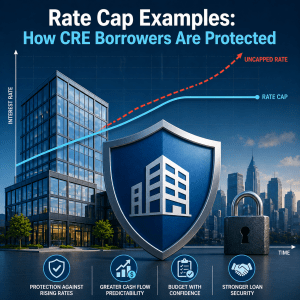
Think of it this way: you have a loan tied to a floating market rate that moves up and down with economic conditions. Without a cap, there is no ceiling, if rates spike to 10%, your loan costs 10%. With a cap at, say, 5%, the cap seller will pay you the difference between whatever the floating rate actually is and your 5% ceiling, so your effective borrowing cost never goes above that level.
The concept is closely analogous to insurance. You pay a premium today. If the event you’re insuring against (rates rising above the strike) doesn’t happen, the premium is simply the cost of peace of mind. If rates do rise above the strike, the protection kicks in and the cap seller’s payments offset your increased borrowing expense. Unlike insurance, however, a rate cap is a structured financial instrument governed by an ISDA Master Agreement, the standard legal framework for derivatives transactions, and is sold by banks and specialist derivatives dealers.
💡 Quick definition: An interest rate cap = a pre-paid option that pays the holder the difference between the floating reference rate and the strike rate, for each period during the cap term when the reference rate is above the strike.
Where are rate caps used?
Interest rate caps are most common in:
Commercial real estate (CRE) bridge loans. Bridge loans are short-term, floating-rate loans used for value-add apartment deals, office repositioning, hotel renovations, and other transitional assets. Lenders almost universally require caps on bridge loans because the loan term coincides with the highest volatility period for the asset.
Construction loans. Construction financing is drawn over time, carries floating-rate interest, and has an inherently long timeline, making rate uncertainty a serious risk. Caps are frequently mandated as a condition to funding.
Leveraged corporate loans and credit facilities. Large businesses with syndicated floating-rate bank debt sometimes purchase caps to protect earnings projections and satisfy board or investor risk management requirements.
Multifamily agency debt. Certain Freddie Mac and Fannie Mae loan programs with floating-rate structures include cap requirements as a property of the loan terms.
How a Rate Cap Actually Works
Understanding how a cap works requires understanding the relationship between three key elements: the reference rate, the strike rate, and the settlement payment. Here’s how those interact over the life of a floating-rate loan.
The reference rate
The reference rate is the floating market benchmark to which your loan is tied. Since 2023, this is almost always the Secured Overnight Financing Rate (SOFR), specifically Term SOFR, published daily by the CME Group. SOFR replaced LIBOR as the standard benchmark for U.S. dollar floating-rate lending. Your loan documents will specify which variant of SOFR applies: 1-Month Term SOFR and 3-Month Term SOFR are the most common.
The strike rate
The strike rate is the threshold level agreed to at the time you purchase the cap. If the reference rate stays below the strike, the cap provides no payment and effectively sits dormant. Once the reference rate exceeds the strike, the cap becomes active and payments begin. Your lender will often specify a maximum allowed strike rate in the loan commitment, meaning you cannot simply choose a very high strike to reduce your premium cost without limit.
How settlement payments work
At the end of each interest accrual period (monthly, quarterly, or semiannually, matching your loan’s reset frequency), the cap provider compares the reference rate to your strike rate. If the reference rate is above the strike, a cash payment is calculated and made to you, or, more commonly, directly applied to offset your loan interest expense. The formula is straightforward:
        Settlement Payment = Notional Amount × Max(Reference Rate − Strike Rate, 0) × Accrual Fraction


        Example: $10M notional, 6.00% reference rate, 4.50% strike, quarterly accrual (0.25 year)

        Payment = $10,000,000 × (0.0600 − 0.0450) × 0.25 = $10,000,000 × 0.0150 × 0.25 = $37,500
That $37,500 for the quarter effectively reduces what you owe on your floating-rate loan for that period, capping your net interest expense at your strike rate. Over a two or three-year loan term, these quarterly settlements can accumulate into a very significant amount of protection if rates are elevated.
Before your next meeting with a lender or broker, get a fast premium estimate using the Waldev interest rate cap calculator. Enter your loan amount, term, strike, and current forward rate to see an estimated cap cost in seconds.
Estimate My Cap Premium →Caplets: The Building Blocks of a Rate Cap
This is one of the most important concepts to understand, and it’s one most borrowers never encounter until they start digging into how their cap is actually priced. A rate cap is not a single option. It is a portfolio of individual options called caplets, one for each interest reset period over the life of the cap.
If you have a 3-year cap with quarterly resets, you actually own 12 separate caplets. Each caplet is an independent option on the 3-month SOFR rate for one specific quarter. Caplet 1 covers Q1. Caplet 2 covers Q2. And so on through Caplet 12. The total premium you pay upfront is the sum of the present values of all 12 caplets, each priced separately using a pricing model (discussed in the next section).
Why this matters for pricing
Each caplet is priced based on the forward rate for its specific period, not today’s spot rate. Near-term caplets are typically priced based on rates that are close to where we are today. Longer-dated caplets are priced based on where the market expects rates to be in the future, as implied by the SOFR futures and swap markets.
Why this matters for payouts
Each caplet settles independently. If rates are elevated in Year 1 but fall in Year 2, only the Year 1 caplets produce payments, the Year 2 caplets expire worthless. The cap as a whole protects you continuously, but the economics of each period are assessed individually.
How caplets build into a total premium
| Caplet # | Period | Forward Rate (Example) | Strike Rate | In/Out of Money | Caplet Value (Illustrative) |
|---|---|---|---|---|---|
| 1 | Q1 Year 1 | 4.80% | 5.00% | Out of money | $8,400 |
| 2 | Q2 Year 1 | 4.95% | 5.00% | Near at money | $12,100 |
| 3 | Q3 Year 1 | 5.10% | 5.00% | In the money | $19,200 |
| 4 | Q4 Year 1 | 5.20% | 5.00% | In the money | $22,500 |
| 5–8 | Year 2 | 5.10–5.30% | 5.00% | In the money | $74,800 combined |
| 9–12 | Year 3 | 4.90–5.05% | 5.00% | Near/at money | $41,600 combined |
Illustrative figures only. Actual caplet values depend on live market inputs including the full SOFR forward curve, implied volatility surface, and discount rates at each settlement date.
Who Needs an Interest Rate Cap?
Not every borrower needs, or is required to have, an interest rate cap. Understanding which situations call for a cap helps you evaluate whether you’re in a position where this product is essential versus optional.
When a cap is typically required
The most common reason borrowers buy caps is that their lender requires it as a closing condition. Most institutional bridge lenders and debt funds that provide transitional commercial real estate financing mandate a rate cap with a strike rate no higher than a specified level, typically 200–300 basis points above the forward rate, to ensure their DSCR covenant holds even in a rising rate environment.
Construction lenders face multi-year exposure on projects where the loan is drawn over 18 to 36 months. A rate cap is frequently a condition to construction loan funding, protecting both the lender’s return analysis and the borrower’s ability to service interest during the construction period.
Real estate equity funds, joint venture partners, and institutional co-investors sometimes require borrowers to purchase rate caps as a condition of their equity investment, particularly in value-add strategies where the business plan assumes a defined cost of debt that cannot deviate materially without impairing the projected return.
Even when not required, sophisticated borrowers sometimes voluntarily purchase caps because the premium is an acceptable cost relative to the protection it provides. If your deal underwriting is sensitive to interest rate assumptions and you cannot tolerate the scenario where rates rise 200bps, a cap converts that open-ended risk into a bounded, known cost.
When a cap may not be necessary
If you have a fixed-rate loan, a very short-term floating-rate facility (under 6 months) where rate movement is unlikely to be material, or a floating-rate loan with natural hedges built into the deal structure, a cap may be unnecessary cost. Borrowers who have already converted their floating-rate obligation to a fixed rate via an interest rate swap generally do not also need a cap, the swap has already eliminated the floating rate risk from both directions.
Key Terms Every Borrower Should Know
The language around interest rate caps can feel opaque at first. Here is a plain-language glossary of the terms that come up most in cap purchases and negotiations.
| Term | Plain-Language Definition |
|---|---|
| Notional Amount | The loan balance the cap is written on. This is not the amount you risk losing. It is simply the reference balance used to calculate settlement payments. A $15M cap is written on a $15M notional. |
| Strike Rate | The interest rate ceiling. When the reference rate exceeds the strike, the cap pays the difference. A lower strike provides stronger protection but costs more. |
| Reference Rate | The floating benchmark the cap monitors, almost always Term SOFR (1-month or 3-month) for U.S. dollar transactions today. |
| Cap Term | The length of time the cap is in force. The cap term should match the loan term or extension options; if the loan extends and the cap has expired, you face unhedged floating-rate exposure. |
| Premium | The one-time upfront cost of the cap, paid at inception. This is your total out-of-pocket cost. There are no ongoing payments unless the cap is structured with a deferred premium (uncommon). |
| Caplet | An individual option within the cap, covering one interest period. The sum of all caplet values equals the total cap premium. |
| Implied Volatility | A market-derived measure of expected future rate uncertainty. Higher implied volatility → higher cap premium. It is one of the most important drivers of cap pricing. |
| Forward Rate | The market’s current expectation for where SOFR will be at a future date. Forward rates are derived from SOFR futures and swap markets and form the “baseline” against which the strike is evaluated. |
| Discount Rate | The rate used to calculate the present value of future settlement payments. Affects the total cap premium, particularly for longer-dated caps. |
| Black-76 Model | The standard mathematical pricing model for interest rate caps. A variant of the Black-Scholes option pricing framework adapted for fixed-income derivatives, treating each caplet as a call option on a forward interest rate. |
| ISDA Master Agreement | The legal framework governing the cap transaction between you and the dealer bank. Establishes default, termination, and settlement terms. |
| Notional Schedule | Many loans have principal amortization or a specific draw schedule, the cap’s notional amount can be structured to decline over time to match the outstanding loan balance. |
What Determines the Cost of an Interest Rate Cap?
Cap premium is not arbitrary. It reflects the market’s rational estimate of the present value of expected future protection payments. Five variables are the primary drivers of any cap’s cost. Understanding each gives you the ability to anticipate how cost changes as your deal parameters change.
1. Notional Amount
Larger loan → larger settlement payments when the cap is in the money → higher premium. Cost scales approximately linearly with notional. A $20M cap costs roughly twice as much as a $10M cap on the same terms.
2. Strike Rate
Lower strike = stronger protection = higher premium. If current forward rates are 5.00%, a 4.50% strike cap is already partially in-the-money and will cost significantly more than a 6.00% strike that is deeply out-of-the-money.
3. Cap Term
Longer terms mean more caplets and therefore more cumulative protection. A 3-year cap costs considerably more than a 1-year cap on the same notional and strike, all else equal.
4. Implied Volatility
When the market expects high rate uncertainty (measured by swaption implied volatility), the option component of each caplet is worth more. Caps purchased during high-volatility environments cost substantially more than those purchased during calm markets.
5. Forward Rate Level
The shape and level of the SOFR forward curve determines where current market expectations sit relative to the strike. If the forward curve is already above the strike, the cap is in-the-money from inception and carries significant intrinsic value on top of time value.
6. Discount Rate
Future settlement payments must be discounted to present value. A higher discount rate reduces the present value of those future cash flows, reducing the premium. A lower discount rate increases it.
The Chatham-style rate cap calculator at Waldev lets you adjust notional, strike, term, volatility, and forward rate independently so you can see exactly how each variable moves the estimated premium. It’s the fastest way to build intuition for cap pricing without needing a Bloomberg terminal.
SOFR and the Interest Rate Cap: What Changed and Why It Matters
For decades, floating-rate lending and interest rate caps in U.S. dollar markets were written against LIBOR, the London Interbank Offered Rate. LIBOR was phased out permanently at the end of June 2023, replaced by SOFR as the standard benchmark. If you are buying a cap today, it will almost certainly be a SOFR cap, not a LIBOR cap, and there are a few important differences to understand.
What is SOFR?
The Secured Overnight Financing Rate is a daily benchmark rate published by the Federal Reserve Bank of New York, calculated based on transactions in the U.S. Treasury repurchase agreement (repo) market. It is considered more robust than LIBOR because it reflects actual transactions rather than bank estimates. For cap purposes, two variants of SOFR are commonly used:
Term SOFR
Published daily by the CME Group based on SOFR futures market expectations. Available for 1-month, 3-month, 6-month, and 12-month tenors. This is what most commercial loan agreements reference, because it is known at the start of each interest period, making it easier to plan and model cash flows.
Compounded SOFR in Arrears
Calculated by compounding the daily overnight SOFR rate over the interest period, known only at the end of the period. Less common in commercial real estate lending because it cannot be known in advance, making payment planning harder.
Does the LIBOR-to-SOFR transition matter if I’m buying a new cap today?
Not directly, if your loan is a new origination written against Term SOFR, your cap will be written against the same rate with no legacy conversion issues. Where the transition matters is for existing LIBOR-based loans that were amended to reference SOFR. If you have an existing cap written against LIBOR that was converted to SOFR under the ARRC or ISDA fallback protocols, your cap should now be settling against a SOFR-based rate with the appropriate spread adjustment (typically +26 basis points for 3-month LIBOR). Confirm with your derivatives advisor or lender that your existing cap documentation was properly updated during the transition.
⚠️ Note: Some older commercial loans extended through the LIBOR transition period may have cap documentation that does not fully align with the amended loan documents. Always verify that your cap reference rate matches your loan’s reference rate precisely before loan extension or closing.
The Life Cycle of an Interest Rate Cap
A rate cap has a defined journey from purchase through expiration. Understanding each stage helps you plan properly and avoid gaps in protection.
Your lender issues a loan commitment letter specifying the maximum allowed strike rate for the required cap. This letter is typically issued weeks before closing. You should start pricing caps as soon as you receive this specification, because cap premiums change daily with market conditions.
You select a cap provider, typically a bank or a derivative intermediary. Most lenders allow you to purchase from any approved counterparty. Soliciting multiple quotes is recommended, as pricing can vary. The cap is executed by signing an ISDA confirmation document specifying all economic terms: notional, strike, term, reference rate, payment frequency, and the agreed premium.
You pay the full cap premium upfront at or near loan closing. The cap provider delivers a confirmation and, for loans that require it, an Assignment Agreement or Consent and Acknowledgment from the cap provider confirming the lender’s interest in the cap. The lender typically takes a security interest in the cap as part of the loan collateral package.
The cap is now live. Each interest reset period, the reference rate is observed. If it exceeds the strike, a settlement payment is automatically calculated and paid to you (or directly to the lender as a loan payment offset). If the reference rate is below the strike, nothing happens that period, the cap simply waits.
If your loan has extension options, common in bridge lending, you may need to purchase a new or extended cap to maintain coverage for the extension period. This is called a cap extension or replacement cap. Extension cap pricing reflects current market conditions at the time of purchase, not the original premium.
When the loan is repaid (at maturity, refinance, or sale), the cap can either expire naturally if it reaches its scheduled end date, or be sold/terminated early. If rates have risen substantially, the cap may have significant residual market value that can be recovered upon termination, partially offsetting the original premium cost.
A Worked Example: Following One Cap Through Its Life
Let’s trace a real scenario, hypothetical but realistic, to see how a cap functions in practice from deal inception through settlement.
The scenario
Bridge loan on a 96-unit apartment complex in Austin, TX
Loan term with one 1-year extension option
Strike rate required by lender (max allowed)
The loan is indexed to 1-Month Term SOFR. At closing, 1-Month Term SOFR is sitting at 4.60%. The cap seller quotes a premium of approximately $218,000 for a 2-year cap on $12M notional at a 5.00% strike. The borrower pays that premium at closing and the cap becomes active.
Year 1, rates rise
Over the first 12 months, SOFR rises from 4.60% to 5.80% as the Federal Reserve tightens monetary policy in response to persistent inflation. During the months when SOFR is above 5.00%, the cap pays the difference. Let’s look at three specific months:
| Month | 1M Term SOFR | Strike Rate | Cap Payment (on $12M) | Borrower’s Net Rate |
|---|---|---|---|---|
| Month 7 | 5.10% | 5.00% | $1,000 | 5.00% effective |
| Month 9 | 5.45% | 5.00% | $4,500 | 5.00% effective |
| Month 12 | 5.80% | 5.00% | $8,000 | 5.00% effective |
By end of Year 1, cumulative cap settlement payments total approximately $52,000, representing real cash returned to the borrower (or offset against their loan payments) as a direct result of owning the cap.
Year 2, rates remain elevated
SOFR stabilises around 5.60% for most of Year 2. The cap continues generating monthly settlements of approximately $6,000–$8,000 per month. By the end of the 2-year term, total settlement payments have reached approximately $124,000.
The outcome
💰 The borrower paid $218,000 at closing. Over 2 years, they received $124,000 in cap settlements that directly reduced their interest expense. Net cost of protection: approximately $94,000, equivalent to roughly 78 basis points per year on the $12M loan. Without the cap, their interest expense would have exceeded their original underwriting by an amount far greater during the high-rate period.
Additionally, at loan maturity, the remaining cap (which still has months of coverage if they exercise the extension option) can be sold at market value. With SOFR elevated, the remaining cap may be worth $80,000–$110,000, further reducing the effective net cost of the hedge.
Before making a decision, run the numbers with the Waldev cap premium calculator. You can test different notional amounts, strike rates, and terms to understand the range of costs for your specific deal structure.
Cap vs. Swap: The Key Difference for Beginners
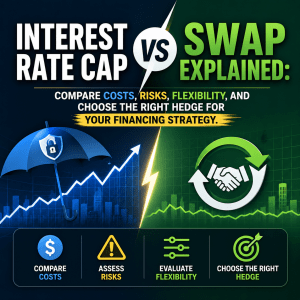
The two most common interest rate hedging instruments are the rate cap and the interest rate swap. Many borrowers encounter both options and are unsure how to choose. Here is the most important conceptual distinction:
Interest Rate Cap
Upfront premium, no obligation. You pay once. If rates rise, you are protected above your strike. If rates fall, you benefit from the lower floating rate, the cap simply sits dormant. Your downside is capped; your upside is preserved. Think of it as buying an option.
Interest Rate Swap
No upfront premium, two-way commitment. You agree to pay a fixed rate to the dealer and receive the floating rate. If rates rise, the dealer pays you the difference. If rates fall, you pay the dealer the difference. Your rate is fixed, but if you want out early, you face potentially large termination costs. Think of it as locking in a fixed rate contractually.
For bridge loans and transitional real estate, where the borrower hopes to sell or refinance within 2–3 years, a cap is almost always preferred because it avoids the exit cost problem. If you sell the property 18 months into a 3-year swap, the swap termination payment can be a six-figure negative surprise. With a cap, you simply let it expire or sell the remaining coverage at market value.
⚠️ Don’t confuse them at closing: Lenders who require a cap will not accept a swap as a substitute without prior discussion, the two instruments serve different risk management purposes and have materially different legal documentation requirements.
Frequently Asked Questions
What is an interest rate cap in simple terms?
An interest rate cap is a financial agreement where a bank or institution pays you whenever a floating interest rate exceeds a set ceiling (the strike rate). You pay a one-time premium upfront in exchange for that protection, similar to buying insurance on your borrowing costs. If rates stay below the strike, the premium is simply the cost of protection that was available but not needed. If rates rise above the strike, the cap generates payments that offset your increased loan interest expense.
Who typically needs to buy an interest rate cap?
Borrowers with floating-rate commercial loans, especially bridge loans, construction loans, and SOFR-based credit facilities, most commonly need caps. Institutional lenders often require them as a loan closing condition to protect their Debt Service Coverage Ratio covenant under rising rate scenarios. The requirement is almost universal for bridge lending on transitional commercial real estate assets, where lenders want assurance that rising rates will not push the property into technical default.
How much does an interest rate cap cost?
Cap premiums are highly variable. They depend on notional amount, strike rate, cap term, current implied volatility, and the shape of the SOFR forward curve. On a $10 million loan, a 2-year cap at a rate 150 basis points above current forward rates might cost anywhere from $30,000 to $180,000+ depending on the rate environment. When implied volatility is high (as it was during 2022–2023), premiums can be three to five times what they would be in a low-volatility environment. Use the Waldev cap calculator to estimate your specific premium based on current inputs.
What is a caplet?
A caplet is an individual option within the larger cap structure, covering one specific interest period (month, quarter, or semiannual period). If you have a 2-year cap with monthly resets, you own 24 caplets. Each caplet independently assesses whether the reference rate exceeded the strike during its period and pays out accordingly. The total cap premium is the sum of the present values of all caplets in the strip, each priced using the Black-76 options model.
What happens when my cap expires?
When your rate cap expires, your floating-rate exposure becomes unhedged. If your loan is still outstanding and rates remain elevated, you either need to purchase a new cap (a replacement or extension cap priced at current market conditions) or accept the full floating-rate risk for the remaining loan period. Most institutional lenders require the cap to cover the full loan term including any extension options, so be sure your cap term matches your loan term including extensions. If you are approaching cap expiration while still in the loan, engage your derivatives advisor well in advance.
Can I sell my interest rate cap?
Yes. Interest rate caps can be sold back to the dealer bank (at the dealer’s bid price) or assigned to a new counterparty in many circumstances. If market rates have risen significantly since you purchased the cap, the remaining coverage will have market value that could be substantial. When you sell a property or refinance and repay the loan, checking the market value of your cap and pursuing a sale or assignment is an often-overlooked step that can return meaningful proceeds. The cap does not simply vanish at loan payoff. It remains a financial asset until it expires or is terminated.
What is the difference between an interest rate cap and a floor?
An interest rate cap protects against rates rising above a ceiling. An interest rate floor does the opposite. It guarantees a minimum rate. Floors are typically purchased by investors who receive floating-rate cash flows (like lenders) and want protection against rates falling too low. Borrowers generally have no need for floors. A combination of a cap and a floor on the same notional is called a “collar”, the premium you receive from selling the floor partially offsets the cost of the cap.
Ready to Estimate Your Cap Premium?
Now that you understand how interest rate caps work, the strike rate, the caplet structure, the Black-76 pricing model, and the variables that drive cost, the logical next step is to run the numbers for your specific deal.
The Chatham-style interest rate cap calculator at Waldev is built on the same Black-76 framework used by professional derivatives advisors. Enter your loan’s notional amount, term, strike rate, implied volatility, and current forward rate to get an estimated cap premium in seconds, no account required, completely free.
Use it to:
Budget for the cap cost before loan closing
Test how different strike rates affect the premium
Compare cap costs across different loan terms
Shadow-price a bank quote to assess whether it’s in the market
Also useful for commercial real estate financial planning: the full finance tools category at Waldev includes calculators for loan analysis, interest-only structures, and real estate deal underwriting.
Disclaimer: This article is for educational and informational purposes only. It does not constitute financial, legal, or derivatives advisory advice. Interest rate cap pricing is complex and depends on live market data including the SOFR forward curve, implied volatility surfaces, and dealer spreads, none of which are captured in a simplified calculator. All examples in this article are hypothetical and illustrative. Always consult a qualified derivatives advisor, your lender, or a licensed financial professional before purchasing or structuring any interest rate hedging instrument. Past market conditions are not indicative of future performance or pricing.