From multifamily to industrial, office to hospitality — if you borrow floating-rate capital in commercial real estate, you will encounter the rate cap requirement. This complete guide brings together every dimension of the topic in one place: what caps are, how they are priced, what lenders require across all asset types, how to manage them through the deal lifecycle, and what to do when the loan is repaid.
In This Complete Guide
A comprehensive reference covering every CRE rate cap topic in one article.
What a CRE Rate Cap Is — and Why Every Floating-Rate Borrower Needs to Understand It
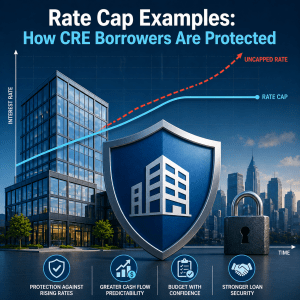
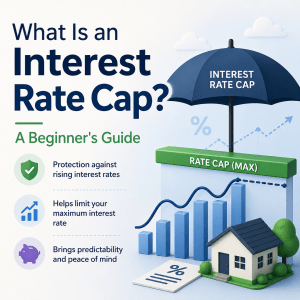
An interest rate cap is a financial derivative that sets a maximum effective floating interest rate on a commercial loan. The borrower pays a one-time upfront premium to a dealer bank and receives, in return, a contractual right to payments whenever SOFR exceeds the agreed strike rate. Those payments directly offset the higher interest expense — so the borrower’s effective rate never exceeds the strike rate for the duration of the cap.
In the commercial real estate market, the cap is almost never optional. Bridge lenders — the debt funds, bank bridge programs, and agency bridge products that finance the majority of transitional and value-add CRE transactions — require caps as a standard closing condition on virtually every floating-rate loan above a threshold size. The cap is as fundamental to a bridge loan closing as the appraisal, the environmental report, or the title policy.
What makes the cap unusual compared to those other closing items is that it has a meaningful and highly variable cost. A title policy costs what it costs. A cap on a $20M loan in a high-volatility rate environment can cost $400,000 or more — a line item that rivals the equity investment in many smaller deals and that can shift significantly between the time a deal is underwritten and the time it closes. Understanding caps is not optional knowledge for CRE professionals — it is essential to deal underwriting, closing management, and portfolio asset management.
Approximate loan size threshold above which institutional bridge lenders almost universally require a rate cap
Typical premium range on a mid-size CRE bridge loan depending on market conditions
Multiple by which cap premiums varied between low-vol and peak-vol environments in recent cycles
Why CRE Lenders Require Rate Caps: The Credit Logic
The cap requirement is not a formality — it is a credit risk management tool that lenders use to protect the loan’s debt service coverage ratio under adverse rate scenarios. Understanding this logic from the lender’s perspective explains every dimension of how the requirement is structured.
The open-ended DSCR problem
When a lender underwrites a floating-rate bridge loan, they project the property’s Net Operating Income (NOI) and the loan’s debt service at current and stressed rate levels. For a fixed-rate loan, the stress test is straightforward — the interest expense is known. For a floating-rate loan without a cap, there is no upper bound on interest expense. SOFR could double. The lender cannot definitively assess whether the property can service its debt under a severe rate spike scenario without knowing there is a ceiling.
The cap solves this problem by converting the floating-rate loan into one with a defined maximum effective rate. The lender now knows that DSCR will never fall below the level implied by (Cap Strike + Credit Spread) × Loan Balance ÷ NOI — no matter what SOFR does. This transformative certainty is worth the premium cost from the lender’s perspective, even if the premium is ultimately borne by the borrower.
Three functions the cap serves for the lender
DSCR floor protection
The cap sets a maximum rate that enters the debt service calculation. The lender’s stress testing can now produce a defined worst-case DSCR rather than an unbounded adverse scenario. This is critical for portfolio risk management and regulatory capital treatment of the loan.
Cash flow assurance
Through the Assignment Agreement, cap settlements flow directly to the lender’s lockbox when SOFR is elevated. The lender receives the cap payments before the borrower — ensuring that rate protection translates into actual debt service coverage rather than potentially being diverted.
Collateral value
The cap, once assigned, is part of the lender’s collateral package. In a workout scenario, the lender can step into the borrower’s cap position and continue receiving settlements — or sell the remaining cap coverage for its market value as partial recovery on the loan.
Cap Requirements Across CRE Asset Types
While the underlying mechanics of rate caps are identical across asset types, the specific cap requirements — the maximum permitted strike, the documentation format, and the strategic importance of the cap during the business plan — differ meaningfully by property type. Here is how the cap requirement looks across the six major CRE sectors.
Cap frequency: Near-universal on bridge loans. Agency floating-rate programs (Fannie/Freddie) also require caps.
Typical strike: 4.75%–5.50%, derived from stabilised NOI DSCR stress test.
Key consideration: Value-add deals have suppressed in-place NOI during renovation — cap provides critical protection when the business plan is most vulnerable. Cap must cover full term including extensions.
Cap frequency: Required on bridge loans. Office repositioning deals are particularly complex — lenders require tight caps given uncertain leasing timelines.
Typical strike: Similar to multifamily, but lenders often use more conservative NOI assumptions given office sector uncertainty.
Key consideration: Extended leasing timelines mean extension cap risk is elevated for office. Budget conservatively for replacement caps at extension.
Cap frequency: Required on bridge loans. Industrial has been one of the most active bridge lending sectors.
Typical strike: Often permits a higher strike (cheaper cap) than multifamily, as industrial assets typically have stronger in-place income relative to debt.
Key consideration: Strong NOI relative to debt means DSCR stress test produces a more generous maximum strike — lower cap premium for equivalent protection.
Cap frequency: Required on bridge loans. Repositioning retail (anchor-tenant leasing) carries significant income uncertainty.
Typical strike: Tight, due to thin income coverage during repositioning and significant leasing risk.
Key consideration: Retail repositioning timelines are often longer than projected. Cap term should cover the most pessimistic realistic completion timeline, not the optimistic base case.
Cap frequency: Required. Hotel bridge lending is specialised — fewer lenders, more complex underwriting.
Typical strike: Often tighter than multifamily due to revenue volatility. Hotel NOI is highly cyclical, making DSCR stress tests more conservative.
Key consideration: Hotel cap premiums can be more expensive than equivalent multifamily structures because lenders require tighter strikes to protect against both rate increases and RevPAR decline simultaneously.
Cap frequency: Required on bridge loans.
Typical strike: Derived from blended NOI across uses. The cap terms reflect the most conservative component of the property’s income mix.
Key consideration: Mixed-use underwriting complexity can extend closing timelines — ensure the cap process starts early enough to accommodate both the deal complexity and the cap documentation requirements.
| Asset Type | Typical Bridge Loan Size | Typical Cap Term | Strike Sensitivity | Key Differentiator |
|---|---|---|---|---|
| Multifamily (value-add) | $5M–$100M+ | 2–3yr + extensions | High — thin in-place NOI | Renovation income valley makes cap critical during months 6–18 |
| Office (repositioning) | $10M–$200M+ | 2–4yr | High — leasing uncertainty | Extension cap cost risk elevated due to unpredictable timelines |
| Industrial | $5M–$150M+ | 1–3yr | Lower — strong NOI | Higher permitted strikes reduce premium; cap is relatively cheap |
| Retail (repositioning) | $3M–$80M | 2–4yr | High — anchor leasing risk | Long repositioning timelines create compounding cap cost risk |
| Hotel / Hospitality | $5M–$100M | 2–3yr | Very high — revenue volatility | Revenue cyclicality forces conservative NOI assumptions and tighter strikes |
| Mixed-use / Other | $5M–$100M+ | 2–4yr | Moderate–high | Underwriting complexity often slows closing; start cap process early |
Cap Cost Across the CRE Market: What to Budget
Cap premiums are determined by five inputs: notional amount, strike rate, term, implied volatility, and the SOFR forward rate level. All five vary by deal — but implied volatility and the rate environment are the factors that create the most dramatic cost differences across market cycles. Two identical deals closing in different rate environments can face cap premiums that differ by 3–5×.
What determines your specific cap cost
Deal-specific factors (you control these)
Notional: Larger loan = higher premium, linearly. A $20M loan’s cap costs twice as much as a $10M loan on identical terms.
Strike rate: Lower strike = higher premium, non-linearly. Moving the strike 50bps lower near the at-the-money level can increase premium 30–50%.
Term: Longer cap = higher premium. A 3-year cap costs more than a 2-year cap on the same loan.
Market factors (you cannot control these)
Implied volatility: The dominant driver of premium variation over time. In 2022 peak vol environments, caps cost 3–5× their 2021 equivalents for identical structures.
SOFR forward rate: When the forward curve sits above your strike (cap is in-the-money), the premium includes intrinsic value on top of time value — significantly increasing cost.
Illustrative cost ranges by deal size
| Loan Size | Typical Strike | Typical Term | Normal Vol Est. Premium | High Vol Est. Premium |
|---|---|---|---|---|
| $5M–$10M | 5.00%–5.50% | 2yr | $35,000–$75,000 | $90,000–$180,000 |
| $10M–$25M | 4.75%–5.25% | 2–3yr | $80,000–$200,000 | $200,000–$500,000 |
| $25M–$50M | 4.75%–5.25% | 2–3yr | $180,000–$450,000 | $450,000–$1.1M |
| $50M–$100M | 4.75%–5.25% | 3yr | $380,000–$900,000 | $900,000–$2.2M |
| $100M+ | Varies | 3–5yr | $800,000–$2M+ | $2M–$5M+ |
Illustrative ranges only. All estimates assume strikes near at-the-money (within 50–75bps of current SOFR). Use the Waldev cap calculator with current inputs for your deal-specific estimate.
The Waldev interest rate cap calculator uses the Black-76 caplet strip model to estimate your premium based on your actual notional, strike, term, and current market inputs. Run it at base-case vol and stressed vol to bracket your budget range.
Calculate My Cap Cost →The CRE Cap Lifecycle: From Commitment Letter to Loan Payoff
Every CRE cap passes through a predictable lifecycle. Managing each phase correctly — and knowing what to do at each stage — is the difference between a smoothly executed cap and one that creates closing delays, lender friction, or missed value at exit.
Critical timing milestones
4–6 weeks before closing: Begin tracking cap pricing weekly using the Waldev calculator. Start ISDA setup with target dealers if not already in place. Request lender’s Assignment Agreement template immediately upon commitment letter receipt.
7–10 business days before closing: Provide Assignment Agreement template to dealer’s legal team. Obtain 2–3 competitive quotes. Select dealer and negotiate to tightest available price.
2 business days before closing: Execute the cap on a live call. Wire premium. Obtain written confirmation. Have Assignment Agreement counterpart from dealer in hand.
30 days before extension date: Request extension cap quotes. Obtain lender confirmation of extension cap requirements (strike, term, approved counterparties). Begin Assignment Agreement process for replacement cap.
1–2 weeks before loan payoff: Request cap termination bid from dealer. If residual value is meaningful, accept bid and schedule simultaneous payoff and cap termination. Request lender assignment release.
Strike Selection Strategy for CRE Borrowers
The strike rate is the most consequential decision in cap structuring — it determines both the strength of your protection and the size of your premium. For most CRE borrowers with lender-required caps, the strike selection question has two components: accepting the lender’s maximum permitted strike, or choosing a lower strike for stronger protection at higher cost.
How the lender’s maximum strike is derived
The lender sets the maximum permitted strike through a DSCR stress test: they calculate the SOFR level at which the property’s projected NOI produces a DSCR equal to their covenant minimum (typically 1.05x–1.25x). That SOFR level becomes the maximum strike. For value-add deals where lenders use stabilised NOI (higher than in-place NOI), the resulting maximum strike is often near at-the-money — producing an expensive but critically protective cap. For stabilised assets with stronger in-place income, the maximum strike may be meaningfully above current SOFR, producing a cheaper out-of-the-money cap.
When to consider a tighter strike than the lender requires
Cases where tighter protection is justified
Your deal’s in-place NOI is meaningfully below the stabilised NOI used in the lender’s stress test — meaning the cap must protect real cash flow shortfalls during the renovation or lease-up period, not just a hypothetical stabilised DSCR.
Your equity investors or JV partners require a specific maximum effective rate in their investment underwriting — and the lender’s maximum strike produces an effective rate above that threshold.
The deal’s renovation or repositioning program has a high sensitivity to interest rate increases — any SOFR move above the lender’s maximum strike would push the deal into reserve-funding territory immediately.
Cases where the lender’s maximum is sufficient
The deal is stabilised or near-stabilised with strong in-place income — DSCR is comfortably above the covenant minimum even at the maximum permitted strike, and additional tightening produces little incremental protection at meaningful additional cost.
The forward curve is significantly below the lender’s maximum strike — the cap is already out-of-the-money and the probability of activation is low. The lender’s maximum strike already provides appropriate tail-risk protection.
Deal economics are tight and every dollar of premium is competing with renovation budget or operating reserves. The marginal value of additional strike protection is low relative to the cost in this scenario.
💡 Quick test: Run the deal’s DSCR at the lender’s maximum strike rate on in-place NOI (not stabilised). If DSCR is above 1.20x, the maximum strike is probably sufficient. If it’s below 1.10x, you’re already in thin coverage territory during the business plan execution period and a tighter strike is worth evaluating.
The CRE Cap Buying Process: A Practical Summary
The buying process for a CRE rate cap has five sequential steps. Each must be completed in order — skipping or rushing any step creates problems that compound at closing.
| Step | Action | Time Required | Output |
|---|---|---|---|
| 1. Specify | Lock down all cap parameters: notional, strike, reference rate, start/end dates, payment frequency, notional schedule (if construction) | 1–2 hours | Complete cap specification sheet used for all dealer RFQs |
| 2. Benchmark | Run the Waldev cap calculator with current inputs to establish an independent mid-market estimate | 5 minutes | Independent premium estimate for evaluating dealer quotes |
| 3. Quote | Request identical quotes from 2–3 approved dealers using a standardised RFQ. State you are collecting multiple quotes. | Same day | 3 competitive quotes in USD for comparison |
| 4. Compare and Negotiate | Build a quote board. Present lowest quote to second-lowest dealer. Push back on any quote more than 10–12% above your calculator estimate. | 1–2 hours | Final competitive premium from selected dealer |
| 5. Execute and Document | Execute on a live call. Wire premium. Verify confirmation. Complete Assignment Agreement. Deliver all closing documents to lender. | 1–5 business days | Executed cap confirmation + premium evidence + Assignment Agreement |
The Most Common CRE Cap Mistakes — and How to Avoid Them
These are the recurring errors that cost CRE borrowers time, money, and lender relationships. Each is entirely preventable with preparation and process.
Starting too late. Beginning cap preparation in the week of closing eliminates all flexibility — you pay whatever is available, accept whatever terms are offered, and risk delays if documentation isn’t ready. Start 4–6 weeks before closing, every time, without exception.
Getting only one quote. The lender’s preferred dealer is not necessarily the cheapest. Obtaining three quotes takes less than a day and typically saves 5–15% on the premium. The larger the cap, the more important this step becomes in absolute dollars.
Buying a cap with a shorter term than the loan. A 2-year cap on a 2+1+1 year bridge loan means the cap expires two years into a loan that can run for four. The first extension immediately creates a lender covenant breach. Always match the cap term to the full loan term including all extension options.
Underestimating extension cap costs. Extension cap costs are priced at current market conditions — not proportionally to the original premium. In a high-vol environment, a 12-month extension cap can cost more than the original 2-year cap. Budget extension caps conservatively and model them as a range rather than a single number.
Failing to check for residual value at loan payoff. When a loan is repaid through sale or refinancing, the remaining cap coverage has market value in an elevated rate environment. Obtaining a termination bid before closing the payoff takes one phone call and can return $50,000–$200,000+ in residual value on a large cap. This step is repeatedly overlooked and repeatedly leaves money on the table.
Not verifying reference rate alignment. The cap’s reference rate must match the loan’s reference rate exactly — including the SOFR tenor (1-month vs. 3-month), publication source (CME Group), and any spread adjustments. A mismatch means the cap doesn’t precisely hedge the loan, and lenders may reject the cap as non-compliant.
Cap Management at Exit: Recovering Value When the Loan Is Repaid
Cap management doesn’t end when the loan is repaid — it ends when the cap’s residual value has been fully realised. This final phase of cap lifecycle management is consistently overlooked and consistently valuable.
The termination bid process
When a CRE loan is repaid — through property sale, refinancing, or maturity payoff — the following steps produce the maximum financial outcome from the cap:
| Step | Timing | Action | Why It Matters |
|---|---|---|---|
| 1. Assess remaining cap value | 2–3 weeks before payoff | Run the Waldev calculator with remaining term, current forward rate, and current vol to estimate residual value | Establishes whether pursuing a termination bid is worth the effort |
| 2. Request dealer termination bid | 1 week before payoff | Contact the dealer who sold the cap and request a bid for the remaining coverage | The bid reflects current market value — live quote is the only accurate measure |
| 3. Compare bid to calculator estimate | Upon receiving bid | If the bid is more than 10–15% below the calculator estimate, request competing bids or push back | Dealers may offer below-market bids on termination just as on initial purchase |
| 4. Execute termination simultaneously with payoff | Closing day | Coordinate the cap termination and loan payoff to occur on the same settlement date | Ensures lender releases the assignment concurrently with receiving the payoff proceeds |
| 5. Obtain written assignment release | Closing day | Request a formal written release from the lender confirming the assignment has terminated | Clears the cap from the lender’s collateral and enables clean termination documentation |
What drives termination bid value
The termination bid value for a remaining cap is driven by the same factors as the original premium: how far SOFR is above the strike (intrinsic value), how much time remains (time value), and what implied volatility is doing. If SOFR is elevated at payoff, caps with 6–18 months of remaining coverage can be worth $50,000–$300,000+ on mid-size loans. In a lower-rate environment where the cap has been deeply out-of-the-money throughout, residual value may be modest — but always worth checking before simply letting the cap expire.
Reading the Market Environment for Cap Purchases
The decision of when to execute a cap — not just what terms to specify — has a meaningful impact on the premium paid. While you cannot perfectly time the cap market, understanding the key environmental factors that drive premiums helps you make better decisions about execution timing within your closing window.
Monitor implied volatility weekly
Implied volatility is the dominant driver of premium variation over short timeframes. Run the Waldev calculator weekly during your pre-closing period with updated vol inputs. A 10-percentage-point drop in vol between your underwriting date and closing can reduce your premium by 15–25% for an ATM cap structure.
The best proxy for implied vol is the premium range in indicative dealer quotes — if quotes are coming in 20% higher than two weeks ago, implied vol has likely risen. Track the trend and execute when vol is relatively low within your closing window.
Watch the forward curve shape
The SOFR forward curve shape tells you how the market expects rates to evolve. An inverted curve (market expects rate cuts) makes longer-dated caps relatively cheaper per year because outer caplets are priced at lower expected rates. A steep upward-sloping curve makes longer caps more expensive per year because later caplets are priced at higher forward rates.
In an inverted curve environment, buying a longer cap (covering extensions) at origination may be more cost-effective than buying a shorter cap and purchasing an extension cap later when the curve may have re-steepened.
Time execution around scheduled events
Cap premiums are most volatile immediately following major scheduled events: FOMC meetings, CPI releases, and jobs reports. If your closing window includes a major data release, executing either clearly before the release or at least a full business day after — once the market has absorbed the new information — tends to produce better execution conditions than executing in the minutes to hours immediately following a surprise.
Build this awareness into your closing timeline rather than leaving execution to whatever happens to coincide with the settlement date.
Frequently Asked Questions
What is an interest rate cap in commercial real estate?
An interest rate cap is a financial derivative that limits the maximum floating interest rate a CRE borrower will pay on their loan. The borrower pays a one-time upfront premium, and in return the cap seller pays the borrower any amount by which SOFR exceeds the agreed strike rate during the cap term. The cap is required on virtually all floating-rate CRE bridge loans above $5M and on agency floating-rate multifamily programs.
Which CRE asset types most commonly require rate caps?
Rate caps are required across all commercial real estate asset types on floating-rate bridge and construction loans. Multifamily bridge loans are the most common by volume, followed by office, retail, industrial, hotel/hospitality, and mixed-use. The requirement is driven by the floating-rate bridge loan structure rather than the asset type — any transitional CRE asset financed with a floating-rate bridge loan above $5M will almost certainly require a cap.
How much does a rate cap cost on a commercial real estate loan?
Cap costs vary significantly depending on loan size, strike rate, cap term, and market conditions. On a $10M–$25M CRE bridge loan, a 2–3 year cap typically costs $80,000–$500,000+ depending on the rate environment. In high-volatility environments (such as 2022–2023), the same cap structure costs 3–5 times more than in calm markets. Use the Waldev cap calculator with current market inputs for a deal-specific estimate.
How long should a CRE rate cap term be?
The cap term should cover the full loan term including all extension options. Most lenders require this explicitly — the commitment letter will specify that the cap must cover “the initial term plus all extension options” or similar language. A bridge loan with a 2-year initial term and two 1-year extension options requires a minimum 4-year cap. Purchasing a cap that matches only the initial term leaves the borrower unhedged during extensions and likely creates a covenant default when the cap expires while the loan remains outstanding.
What documents do I need to deliver at closing for the cap?
Standard cap closing deliverables are: (1) the executed cap confirmation showing terms that meet the lender’s requirements, (2) evidence of premium payment (wire confirmation), and (3) an executed Assignment Agreement signed by the borrower, the lender, and the cap dealer. Some lenders also require: (4) confirmation that the cap dealer is on their approved counterparty list, and (5) occasionally a legal opinion from the dealer’s counsel confirming the cap is a valid enforceable obligation. The Assignment Agreement is the most complex document — it requires the dealer’s legal team and typically takes 3–7 business days to finalise.
Can a rate cap be transferred when a CRE property is sold?
A cap cannot automatically transfer to a property buyer. When a property is sold and the bridge loan is repaid, the seller should obtain a termination bid for any remaining cap coverage — this can return meaningful cash in an elevated rate environment. The buyer typically obtains their own new cap on their new financing. In theory, if the buyer is taking out a similar loan, the existing cap could be assigned (novated) to them, but this requires dealer consent and is uncommon because the buyer’s loan terms rarely match the existing cap terms exactly.
What is the most important thing to do when the loan is repaid?
Request a cap termination bid from the dealer before the payoff closing. If significant time remains on the cap and SOFR is at or above the strike, the residual coverage has market value that can be recovered as cash. This is the most commonly overlooked step in CRE cap management, and the most reliably valuable when done. On a $20M+ loan with 12+ months of remaining cap coverage in an elevated rate environment, the termination bid can easily exceed $100,000. Always include this step in your loan payoff checklist.
Your Starting Point for Every CRE Cap Decision
Whether you are closing your first bridge loan or managing a portfolio of twenty, every cap decision starts with one number: what does the cap actually cost for your specific deal right now? That number anchors your budget, your dealer negotiations, your strike selection analysis, and your extension cap planning.
The Waldev Chatham-style interest rate cap calculator generates that number using the same Black-76 caplet strip model that dealer banks use — in seconds, for free, with your specific inputs. Run it at the start of every deal to establish your baseline, run it weekly during the pre-closing period to track market movements, and run it at loan payoff to estimate residual value before requesting a termination bid.
Open the Cap Calculator →More CRE finance tools at Waldev finance tools.
Disclaimer: This article is for educational and informational purposes only. All cap premium estimates, asset type descriptions, and deal parameter examples are illustrative. Actual cap requirements, premiums, and market conditions change continuously. This article does not constitute financial, legal, or derivatives advisory advice. Always consult qualified professionals before making hedging decisions for specific transactions.