Your lender’s required cap strike did not come from thin air. It was calculated using your property’s debt service coverage ratio. Understanding how DSCR and rate caps interact — and how to use that relationship to your advantage — can save you tens of thousands of dollars and protect your deal from covenant default during the most vulnerable phases of ownership.
What DSCR Is and Why Lenders Use It
Debt service coverage ratio — DSCR — is the most fundamental underwriting metric in commercial real estate lending. It measures a property’s ability to generate enough income to pay its debt obligations and still leave a safety margin for the lender. The formula is straightforward:
DSCR  =  Net Operating Income (NOI)  ÷  Annual Debt Service

Where:
  NOI           = Effective Gross Income − Operating Expenses (before debt)
  Debt Service  = Principal + Interest payments over the period (annualised)

Example:
  NOI           = $720,000
  Annual debt service = $600,000
  DSCR          = $720,000 ÷ $600,000 = 1.20x
A DSCR of 1.20x means the property generates 20% more income than it needs to cover its debt payments. A DSCR below 1.00x means the property is technically cash-flow negative — it cannot cover its own debt from operations. Lenders set minimum DSCR thresholds based on asset type, borrower strength, and market conditions — typically ranging from 1.05x (more aggressive bridge lenders) to 1.35x (conservative agency permanent financing).
Why DSCR fluctuates on floating-rate loans
On a fixed-rate loan, the debt service number in the denominator is constant. The DSCR moves only if NOI changes. On a floating-rate loan — which is the loan type that almost always requires a rate cap — both sides of the equation can change simultaneously. If SOFR rises by 200 basis points, annual debt service on a $15M loan at SOFR + 3.00% increases by approximately $300,000. If NOI doesn’t increase by the same amount (and in a transitional or value-add property, it may not), DSCR compresses.
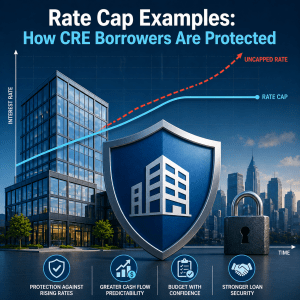
This is the core problem that rate caps solve at the DSCR level. The cap limits the increase in debt service by capping the floating rate component. It doesn’t eliminate debt service sensitivity — the property’s DSCR still responds to interest rates — but it puts a ceiling on how far debt service can rise, and therefore a floor on how low DSCR can fall due to rate increases alone.
Before stress-testing your deal manually, run your cap parameters through the Waldev interest rate cap calculator. It gives you the capped rate at different SOFR levels — the exact input you need for your DSCR sensitivity table.
How Rate Caps Protect DSCR Compliance
The connection between rate caps and DSCR is not abstract — it is contractually embedded in almost every floating-rate CRE loan commitment letter. Lenders require caps specifically because uncapped floating-rate debt creates unbounded DSCR risk. Without a cap, SOFR rising 300 basis points can turn a DSCR-compliant loan into a default in under 18 months, with no structural protection for either the borrower or the lender.
The three ways a cap protects DSCR
1. Caps debt service growth
Once SOFR exceeds the cap strike, the cap’s settlement payments offset the borrower’s interest expense. The effective all-in rate is bounded at strike + spread. Debt service cannot grow beyond the level implied by the strike rate, regardless of where SOFR goes.
2. Stabilises DSCR floor
Because the cap prevents debt service from growing beyond a defined level, the DSCR denominator is effectively bounded. A property with a stable or growing NOI and a capped interest rate has a predictable minimum DSCR — the lender can underwrite the covenant risk with confidence.
3. Protects during vulnerable phases
Value-add properties often have suppressed NOI during renovation or lease-up. A rate spike during this period would normally be catastrophic for DSCR. The cap delivers settlement income precisely when the property’s own income is lowest and the protection is most valuable.
The DSCR equation with and without a cap
Consider a $12M bridge loan at SOFR + 3.25% on a property with $900,000 NOI. Here is how DSCR changes as SOFR rises, with and without a 5.00% cap:
| SOFR Level | All-In Rate (No Cap) | Annual Debt Service (No Cap) | DSCR (No Cap) | All-In Rate (5% Cap) | Annual Debt Service (Capped) | DSCR (Capped) |
|---|---|---|---|---|---|---|
| 4.00% | 7.25% | $870,000 | 1.03x | 7.25% | $870,000 | 1.03x |
| 4.75% | 8.00% | $960,000 | 0.94x ⚠ | 8.00% | $960,000 | 0.94x ⚠ |
| 5.00% (strike) | 8.25% | $990,000 | 0.91x ✗ | 8.25% | $990,000 | 0.91x ✗ |
| 5.50% | 8.75% | $1,050,000 | 0.86x ✗ | 8.25% (capped) | $990,000 | 0.91x ✗ |
| 6.25% | 9.50% | $1,140,000 | 0.79x ✗ | 8.25% (capped) | $990,000 | 0.91x ✗ |
This example illustrates a critical point: when the cap strike is set near or below current SOFR levels, the cap alone may not keep the property DSCR-compliant. The table shows DSCR breaching 1.00x even with the cap. This property would need a tighter strike — or the lender would need to set the minimum DSCR covenant at a level that accounts for the realistic stabilised NOI trajectory, not just in-place income.
⚠ Important: A rate cap guarantees that interest expense won’t rise above a certain level. It does not guarantee DSCR compliance. DSCR compliance also depends on NOI. If NOI falls — because of vacancy, operating expense increases, or below-market rents — a DSCR breach can occur even when SOFR is well below the cap strike.
How Lenders Derive the Cap Strike from DSCR
When a lender’s commitment letter specifies a maximum allowable cap strike — say, “borrower shall purchase an interest rate cap with a strike not to exceed 5.25% on SOFR” — that number was not chosen arbitrarily. It was calculated backwards from a DSCR stress test. Understanding this calculation gives you leverage in negotiations and helps you evaluate whether the lender’s required strike is appropriate for your deal.
The backward derivation process
The lender’s underwriter calculates the property’s stabilised NOI — the income the property would generate at full market occupancy with typical operating expenses. For a value-add deal, this is the projected NOI at the end of the business plan, not at acquisition.
The lender has a policy minimum DSCR — often 1.15x to 1.25x for bridge loans. They solve for the maximum allowable debt service: Maximum Debt Service = Stabilised NOI ÷ Minimum DSCR. If stabilised NOI is $1,200,000 and the minimum DSCR is 1.20x, the maximum allowable annual debt service is $1,000,000.
Given the loan balance and the maximum allowable debt service, the lender solves for the interest rate that produces exactly that payment. For a $12M interest-only loan: Maximum Rate = $1,000,000 ÷ $12,000,000 = 8.33%. This is the all-in rate — SOFR + spread — at which DSCR exactly equals the minimum threshold.
The loan spread is fixed. The lender subtracts it: Maximum SOFR = 8.33% − 3.00% spread = 5.33%. This is the SOFR level at which the property’s stabilised DSCR equals the minimum threshold. The cap strike must be at or below this level.
Lenders typically round to the nearest 0.25% increment and document the maximum strike in the commitment letter and loan agreement. In this example, the maximum strike might be set at 5.25% (rounded down from 5.33% for a small additional buffer).
Step 1:  Max Annual Debt Service  = Stabilised NOI ÷ Min DSCR
Step 2:  Max All-In Rate          = Max Annual Debt Service ÷ Loan Balance
Step 3:  Max SOFR (= Cap Strike)  = Max All-In Rate − Loan Spread

Example:
  Stabilised NOI  = $1,200,000
  Min DSCR        = 1.20x
  Loan Balance    = $12,000,000
  Loan Spread     = 3.00%

  Step 1:  $1,200,000 ÷ 1.20  = $1,000,000 max debt service
  Step 2:  $1,000,000 ÷ $12M  = 8.33% max all-in rate
  Step 3:  8.33% − 3.00%      = 5.33% → rounded to 5.25% cap strike
What changes the output
Higher NOI → higher allowable strike
A property with stronger stabilised NOI can sustain more debt service before breaching the DSCR floor. The result is a higher maximum allowable cap strike, which is cheaper to purchase. Strong NOI gives the borrower more room on the strike and therefore lower hedge cost.
Higher loan balance → lower allowable strike
A larger loan relative to NOI means a given interest rate increase translates into more absolute debt service growth. The maximum rate — and therefore the cap strike — must be set lower to protect DSCR. Highly leveraged deals face the most restrictive (expensive) cap requirements.
Tighter minimum DSCR → lower allowable strike
A lender with a 1.25x minimum DSCR allows less room for interest rate increases than one with a 1.10x minimum. The more conservative the DSCR floor, the tighter the required cap strike.
Wider loan spread → lower allowable strike
A higher spread means more of the interest rate is already fixed. The remaining SOFR “budget” before breaching the DSCR floor is smaller, resulting in a lower maximum cap strike. Bridge loans in stressed markets face both wider spreads and tighter cap strike requirements.
Run the rate cap calculator at the lender’s maximum strike and at 25bp tighter. The premium difference tells you the cost of buying a buffer against DSCR covenant risk. In volatile markets, that buffer is worth it.
The DSCR Coverage Spectrum
Not all DSCR levels carry the same risk profile. Lenders think in zones — and you should too. The spectrum below shows how the typical bridge lender views different DSCR levels on a floating-rate value-add deal, and how the cap interacts with each zone.
The cap’s protective function is most visible in the caution and stress zones. A property sitting at 1.18x DSCR on in-place income is only 30–50 basis points of SOFR away from a technical covenant breach if uncapped. With a properly structured cap, SOFR rising beyond the strike generates settlement payments that offset the interest cost increase — holding the DSCR in place even as the benchmark rate moves against the borrower.
How the cap’s settlement payments interact with DSCR testing
This is a nuance that many borrowers miss: cap settlement payments are typically credited against interest expense in the period they are received. When SOFR exceeds the strike, the servicer receives the settlement from the cap counterparty and applies it to offset the borrower’s interest payment. The net interest expense — the amount actually hitting the income statement — is effectively capped. The DSCR calculation uses net interest expense, so the cap’s settlements directly support DSCR compliance in real time.
Practical note: Some lenders test DSCR on gross interest expense (before cap settlements) and some test on net. Understand which approach your lender uses before closing — it affects how much covenant protection your cap actually provides at each SOFR level.
Worked Example: Full DSCR Stress Test on a Value-Add Multifamily Deal
The following example traces a complete DSCR stress test for a real-world style bridge loan, showing how the cap strike is derived, how the cap performs across rate scenarios, and what happens to DSCR in each case.
Deal parameters
Deriving the cap strike
The lender’s underwriter runs the DSCR backward derivation using stabilised NOI:
Max Debt Service  = $1,680,000 ÷ 1.15  = $1,460,870 per year
Max All-In Rate   = $1,460,870 ÷ $16,800,000 = 8.70%
Max SOFR (Strike) = 8.70% − 3.15% spread    = 5.55% → rounded to 5.50%

Lender's required maximum cap strike: 5.50% on 1M Term SOFR
The lender requires the borrower to purchase a cap at a maximum 5.50% strike for the full 3-year loan term (28-month initial + 8-month extension). At closing, 1M Term SOFR is 4.65%. The borrower receives quotes for a $16.8M notional, 3-year, 5.50% cap and selects the most competitive dealer at $218,000.
DSCR stress test across three rate scenarios
The lender’s credit committee also runs three rate scenarios to understand the range of possible DSCR outcomes during the loan term. The cap’s performance in each scenario is shown below, along with the resulting DSCR based on in-place NOI (the conservative, transitional number):
Interest rate: 4.65% + 3.15% = 7.80% all-in
Annual debt service: $16.8M × 7.80% = $1,310,400
DSCR (in-place NOI): $1,040,000 ÷ $1,310,400 = 0.79x — below covenant minimum
DSCR (stabilised NOI): $1,680,000 ÷ $1,310,400 = 1.28x — compliant
This illustrates why lenders test DSCR on stabilised NOI for value-add deals. The property does not cover its debt on in-place income — the business plan must succeed. The cap is dormant in this scenario, meaning no settlement income, but the rate environment is benign and the property has time to execute the renovation and lease-up without rate pressure.
SOFR above strike by: 5.75% − 5.50% = 0.25%
Annual cap settlement: $16.8M × 0.25% = $42,000 per year
Effective all-in rate: 5.50% + 3.15% = 8.65% (capped)
Annual debt service (net of cap): $16.8M × 8.65% = $1,453,200
DSCR (stabilised NOI): $1,680,000 ÷ $1,453,200 = 1.16x — barely compliant
DSCR without cap: $1,680,000 ÷ ($16.8M × 8.90%) = $1,495,200 denominator → 1.12x — below 1.15x minimum
The cap makes the difference between covenant compliance and a technical default. The $42,000 in annual cap settlements reduces the effective debt service by $42,000 — moving the DSCR from 1.12x to 1.16x, exactly across the 1.15x threshold. This is the real-world value of the cap at a SOFR level modestly above the strike.
SOFR above strike by: 7.00% − 5.50% = 1.50%
Annual cap settlement: $16.8M × 1.50% = $252,000 per year
Effective all-in rate: 5.50% + 3.15% = 8.65% (capped — same as Scenario B)
Annual debt service (net of cap): $16.8M × 8.65% = $1,453,200
DSCR (stabilised NOI): $1,680,000 ÷ $1,453,200 = 1.16x — compliant
DSCR without cap: $1,680,000 ÷ ($16.8M × 10.15%) = $1,705,200 denominator → 0.99x ✗ BREACH
Without the cap, a 7.00% SOFR environment produces a DSCR below 1.00x — the property cannot service its debt from operations. The cap transforms a scenario that would produce a default into one that maintains covenant compliance. The $252,000 in annual settlements received in this scenario also significantly reduces the effective hedge cost: if the cap was purchased for $218,000 and generates $252,000 in year one alone, the hedge has already paid for itself.
Use the Waldev cap calculator to price the cap at the lender’s maximum strike, then at 25bp and 50bp tighter. Compare the premium difference to the DSCR buffer each strike provides. In high-volatility environments, a tighter strike can be worth significantly more than its premium cost.
When In-Place DSCR Is Thin — The Hidden Risk Layer
The worked example above exposed an important reality: on a value-add deal, in-place DSCR can be significantly below the covenant minimum at acquisition. The lender may be testing covenant compliance on projected stabilised NOI — and the cap’s required strike is derived from that projected number. But if the business plan runs behind schedule, stabilised NOI arrives later than expected. And during that gap, the property is doubly exposed: lower NOI than projected and a rate environment that may have moved against the borrower.
The double jeopardy scenario
Imagine the 148-unit deal from the worked example runs 6 months behind schedule on lease-up. At month 18 — when the lender originally projected 92% occupancy and near-stabilised NOI — actual occupancy is 78%. NOI at that point is approximately $1,280,000 rather than the projected $1,550,000. Simultaneously, SOFR is at 5.60%, above the 5.50% strike.
| Metric | Original Projection (Month 18) | Actual Result (Month 18) | Impact |
|---|---|---|---|
| Occupancy | 92% | 78% | −14% below plan |
| NOI | $1,550,000 | $1,280,000 | −$270,000 |
| SOFR | 4.65% (assumed flat) | 5.60% | +95bps above plan |
| Cap settlement (annualised) | $0 | $16,800 (5.60%−5.50% × $16.8M) | +$16,800 offset |
| Effective annual debt service | $1,310,400 | $1,453,200 (capped) | +$142,800 |
| DSCR | 1.18x (projected) | 0.88x (actual) ✗ | Covenant breach |
| DSCR without cap | — | 0.86x (worse) ✗ | Cap helps, but not enough |
The cap is helping — it reduces debt service by $16,800 per year and prevents DSCR from falling to 0.86x instead of 0.88x. But neither number is covenant-compliant. The root cause is the NOI shortfall, not the rate environment. This is the scenario where the cap’s role as covenant protection has limits.
How borrowers should respond to this risk
If your business plan takes 18 months to stabilise, stress-test DSCR at 24 months — assuming your plan runs 6 months behind and rates are 100 basis points higher than today. If the DSCR in that scenario threatens a covenant breach, address it at closing rather than mid-loan.
If your in-place DSCR is thin, buying a cap at the lender’s maximum strike gives you the minimum required protection. Buying 25–50 basis points tighter gives you a wider buffer during the vulnerable lease-up phase. Model the incremental premium cost against the probability of needing that buffer.
Know exactly what happens if you breach the DSCR covenant — the cure window, the required equity injection or reserve funding, and the lender’s rights during the cure period. Lenders vary significantly on this. A 30-day cure window with a moderate equity injection requirement is manageable. A 10-day window with an accelerated maturity trigger is not.
If your lender tests DSCR on gross interest expense (before cap settlements), you lose the benefit of the cap in the DSCR calculation at exactly the moment you need it most. Push to have DSCR tested on net interest expense — gross expense minus cap settlements — during loan negotiations.
Agency Programs and DSCR Cap Requirements
Bridge lenders have discretion in setting cap requirements — they can negotiate strike levels, evaluate collateral quality, and exercise judgment. Agency lenders — Fannie Mae and Freddie Mac — do not. Their floating-rate programs are governed by standardised guides that specify DSCR thresholds and cap requirements in detail. For borrowers using agency floating-rate execution, the cap requirement is non-negotiable.
Fannie Mae floating-rate requirements
Fannie Mae’s DUS floating-rate multifamily programs require interest rate caps on all floating-rate loans. The DUS Guide specifies that the cap must ensure the property maintains a minimum DSCR of 1.25x at the cap’s strike rate, using underwritten stabilised NOI. This is a higher minimum DSCR threshold than most bridge lenders — reflecting the permanent nature of agency financing and the agency’s credit exposure.
The cap must be from an approved counterparty (rated A- or better by S&P or A3 by Moody’s), must cover the full loan term, and must be assigned to the lender as a condition of closing. Fannie Mae also requires that the cap be purchased from a dealer with sufficient financial strength — the agency does not accept caps from all market participants, and borrowers cannot use a cap from a counterparty that doesn’t meet minimum rating requirements.
Freddie Mac floating-rate requirements
Freddie Mac’s floating-rate programs have similar cap requirements, with DSCR thresholds specified in the Freddie Mac Multifamily Seller/Servicer Guide. The minimum DSCR at the cap’s strike rate is typically 1.20x to 1.25x depending on property type and loan characteristics. Freddie Mac also requires an assignment of the cap to the lender and has approved counterparty requirements.
Why agency DSCR thresholds are higher
Agency loans carry implicit government backing. The agencies’ capital rules and guarantee structures require more conservative underwriting. A 1.25x DSCR minimum means the property must generate 25% more income than its debt service — leaving more room for economic stress before reaching default territory. Bridge lenders can accept 1.05x because the loan is expected to be temporary and the business plan creates value quickly.
Permanent vs. bridge cap cost differences
Agency floating-rate loans typically have longer terms (5–10 years) than bridge loans (2–3 years). A longer cap term significantly increases the premium. A 7-year cap on a $20M agency loan in a normal market environment can cost $400,000–$900,000 depending on strike and vol. This is a meaningful closing cost that borrowers often underestimate when comparing agency floating rates to fixed-rate alternatives.
Agency cap requirements are disclosed in the commitment letter but the cost isn’t always estimated accurately at term sheet. Use the Waldev interest rate cap calculator to estimate the cap cost using the agency’s required strike, your loan balance, and the full loan term — before you execute the agency commitment and lock in the rate.
DSCR Cure Provisions and the Cap’s Role
Even with a properly structured rate cap, DSCR covenant breaches can occur — primarily when NOI falls short of projections. Understanding how cure provisions work, and how the cap interacts with the cure process, is essential knowledge for any floating-rate CRE borrower.
What a DSCR cure provision typically says
A standard DSCR cure provision in a bridge loan agreement gives the borrower a defined period (often 30–90 days) to cure a covenant breach after receiving written notice from the lender. Common cure mechanisms include:
| Cure Mechanism | How It Works | Typical Use Case |
|---|---|---|
| Cash equity injection | Borrower deposits funds into a lender-controlled reserve account sufficient to bring DSCR into compliance if applied to reduce the loan balance or fund shortfalls | Most common — borrower funds a partial paydown or cash reserve |
| Principal paydown | Borrower reduces the outstanding loan balance, lowering debt service and increasing DSCR | Used when borrower has liquidity and wants to permanently reduce leverage |
| Guaranty increase | Additional guarantor steps up with a partial guaranty of debt service for the cure period | Used when borrower has creditworthy guarantors but limited liquid capital |
| Escrow funding | Borrower funds an escrow account held by lender equivalent to 3–6 months of projected shortfall | Common in transitional deals where the shortfall is expected to be temporary |
| NOI improvement plan | Borrower provides lender with a documented plan for NOI recovery, with milestones and lender approval rights | Rarely accepted as a standalone cure — typically combined with cash contribution |
How the cap reduces cure amounts
If a DSCR breach occurs while SOFR is above the cap strike, the cap is generating settlement payments. These settlements reduce the monthly interest shortfall. In a scenario where the property needs $15,000/month in additional income to cure a DSCR deficiency, a cap generating $8,000/month in settlements reduces the effective cure requirement to $7,000/month — meaningfully lowering the equity injection or escrow amount the lender requires.
This is the cap’s secondary protective function that most borrowers never think about at closing: it doesn’t just protect you from DSCR breaches — it also reduces the cost of curing a breach when one does occur.
⚠ Critical timing issue: If your cap expires before the lender’s DSCR cure period ends, you may lose cap settlement income precisely when you need it most during the cure. Ensure your cap term covers all loan extensions, not just the initial term. A cap that expires at month 24 on a loan with a 6-month extension option leaves you unhedged during exactly the period when a cure might be required.
Planning Your Cap Around DSCR Projections
The most sophisticated borrowers don’t think about the cap as a compliance item — they integrate it into their DSCR projection model from day one. Here is a practical framework for doing that.
Build a DSCR sensitivity table before closing
Before finalising your cap structure, build a simple DSCR sensitivity table that shows your projected DSCR at multiple SOFR levels, both with and without the cap. The table should cover:
| SOFR Level | Cap Settlement (Annual) | Net Debt Service | DSCR (In-Place NOI) | DSCR (Stabilised NOI) | Covenant Status |
|---|---|---|---|---|---|
| 3.50% | $0 (below strike) | $1,117,200 | 0.93x | 1.50x ✓ | Compliant |
| 4.50% | $0 (below strike) | $1,285,200 | 0.81x | 1.31x ✓ | Compliant |
| 5.00% (strike) | $0 | $1,369,200 | 0.76x | 1.23x ✓ | Compliant |
| 5.50% | $84,000 | $1,369,200 (capped) | 0.76x | 1.23x ✓ | Compliant |
| 6.50% | $252,000 | $1,369,200 (capped) | 0.76x | 1.23x ✓ | Compliant |
| 7.00% | $336,000 | $1,369,200 (capped) | 0.76x | 1.23x ✓ | Compliant |
Based on: $16.8M loan, SOFR + 3.15% spread, 5.00% cap strike, in-place NOI $1,040,000, stabilised NOI $1,680,000, lender minimum DSCR 1.15x. Cap settlement = (SOFR − 5.00%) × $16.8M when SOFR > 5.00%.
This table immediately shows that with stabilised NOI, the cap holds DSCR compliant at all SOFR levels. The risk period is during the transition from in-place to stabilised — where no rate level produces covenant compliance on in-place income alone. This tells you the lender is underwriting to stabilised projections and the borrower needs to execute the business plan successfully to avoid a cure event.
Six questions to answer before your cap closing
In-place, stabilised, or a blended transition schedule? The answer determines how conservative the covenant is during your business plan execution period.
Net testing (after cap settlements) gives you full benefit of the cap in the DSCR calculation. Gross testing means the cap helps your actual cash flow but not your covenant compliance number — a critical difference.
If this number is below 1.00x, your in-place property cannot cover debt service at the capped rate. You are entirely dependent on NOI growth to avoid covenant breach — understand this exposure before closing.
A cap that expires at the initial loan maturity leaves you unhedged if you exercise extension options. Lenders typically require the cap to cover extensions — confirm this is in your loan documents.
Calculate the cure equity or reserve requirement at two or three adverse DSCR scenarios before closing. Know what the number is and confirm you have the liquidity to fund it if needed.
Many bridge loans require the property to meet a minimum DSCR — often 1.10x or higher on in-place NOI — to qualify for extension options. Know this threshold and model whether your property will pass it under base, stress, and severe stress rate scenarios.
Frequently Asked Questions
What is DSCR and why does it matter for rate cap requirements?
DSCR — debt service coverage ratio — measures a property’s net operating income divided by its annual debt service. Lenders set minimum DSCR thresholds (typically 1.05x–1.35x) as loan covenants and use a DSCR stress test to determine the maximum cap strike they will accept. The cap strike is derived by finding the SOFR level at which debt service would push DSCR to exactly the minimum threshold. This ties the cap directly to the property’s financial capacity to service its debt.
How does a lender calculate the maximum cap strike from DSCR?
The lender uses a three-step backwards derivation: (1) Maximum allowable debt service = Stabilised NOI ÷ Minimum DSCR. (2) Maximum all-in rate = Max debt service ÷ Loan balance. (3) Maximum SOFR (cap strike) = Max all-in rate − Loan spread. A property with strong NOI, a moderate loan balance, and a generous lender DSCR floor will get a higher maximum strike (and therefore a cheaper cap) than a highly leveraged property with thin NOI and a conservative lender.
Can a DSCR covenant be breached even with a cap in place?
Yes. The cap protects against interest rate increases above the strike — it does not protect against NOI decline. If vacancy rises, a major tenant vacates, or operating expenses spike, DSCR can fall below the covenant minimum even when SOFR is below the cap strike and the cap is completely dormant. The cap addresses only the interest rate component of DSCR risk. NOI risk must be managed through the business plan, occupancy, and lease structure.
What happens to my DSCR covenant when SOFR drops below my cap strike?
When SOFR is below the cap strike, the cap is dormant and pays nothing. Your effective interest rate is SOFR + spread — lower than the capped rate. This means your actual debt service is lower than the capped scenario, and your DSCR is higher than the stressed level used to derive the cap strike. The covenant is easiest to comply with when SOFR is below the strike. The risk increases as SOFR approaches and then exceeds the strike, which is exactly when the cap begins generating settlement payments to offset the higher cost.
Should I buy a tighter cap than my lender requires to improve DSCR protection?
Sometimes yes — particularly if your in-place NOI is significantly below stabilised, your business plan execution is in a volatile phase, or the lender’s required strike is already near current SOFR levels. A tighter strike provides a wider buffer between the capped rate and the DSCR covenant threshold, reducing the probability of a technical default during the most vulnerable phase of your hold. The trade-off is a higher premium. Compare the incremental cost of a tighter strike to the cost of funding a cure if a covenant breach occurs — in many deals, the tighter cap is the better insurance.
Do agency lenders use DSCR to set cap requirements on floating-rate programs?
Yes. Both Fannie Mae and Freddie Mac require interest rate caps on their floating-rate multifamily programs and use DSCR stress tests to set cap parameters. Fannie Mae typically requires a minimum 1.25x DSCR at the cap’s strike rate using underwritten stabilised NOI. Freddie Mac’s requirements are similar. Agency cap requirements are non-negotiable at the individual loan level — they are specified in the DUS Guide and Seller/Servicer Guide and cannot be waived or negotiated away on a deal-by-deal basis.
How do cap settlement payments interact with DSCR testing?
Cap settlement payments are typically credited against interest expense in the period received. When SOFR exceeds the strike, the servicer applies the cap settlement to offset the borrower’s interest payment, reducing net interest expense. If the lender tests DSCR on net interest expense — after applying cap settlements — the cap’s payments directly support covenant compliance in real time. If the lender tests on gross interest expense (before settlements), the cap helps actual cash flow but not the covenant calculation. Negotiate for net-of-cap DSCR testing before closing — it’s a meaningful difference in how much covenant protection your cap actually provides.
Ready to Run Your Own DSCR Cap Analysis?
The concepts in this guide come to life when you plug in your actual deal numbers. Before your next loan commitment, run your cap structure through the calculator — it only takes a few minutes and gives you the capped rate estimate you need for your DSCR stress table.
Use the Free Interest Rate Cap Calculator →Related Guides on Waldev
How to Choose the Right Cap Strike Rate
A strategic deep-dive into strike selection methodology — including how to balance premium cost against DSCR protection across different deal types.
Bridge Loan Rate Cap Requirements
What bridge lenders actually require in the commitment letter — strike, term, counterparty rating, and Assignment Agreement — explained field by field.
Interest Rate Cap for Multifamily Loans
A complete borrower guide covering multifamily bridge and agency floating-rate caps, from lender requirements through the cap’s full lifecycle.
Interest Rate Cap for CRE — Complete Guide
The master reference covering rate caps across all CRE asset types — multifamily, office, retail, industrial, hotel, and construction.