Every basis point you move the strike changes the premium, non-linearly, and sometimes dramatically. Choosing the right strike is not just about accepting the lender’s maximum. It involves understanding the premium cost curve, your DSCR math, the forward rate environment, your deal’s sensitivity to rate increases, and the risk-adjusted value of tighter protection. This guide walks through each of those dimensions systematically.
In This Guide
Jump to any section.
What the Strike Rate Actually Controls
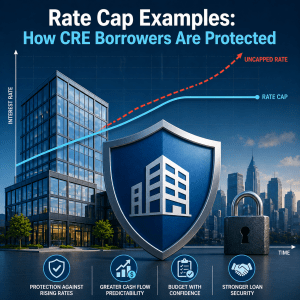
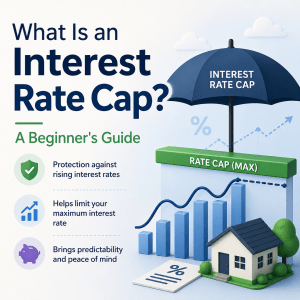
The strike rate on an interest rate cap is deceptively simple to define and surprisingly nuanced to select correctly. In plain terms, the strike is the threshold above which the cap provides protection. When the reference rate (Term SOFR) exceeds the strike, the cap generates payments. When it stays below the strike, the cap sits dormant and generates nothing.
But what the strike actually controls, beyond this basic on/off function, is the effective maximum borrowing cost on the floating-rate portion of your loan, the cost of the premium you pay upfront, and the probability that the cap will ever produce a payment. Those three dimensions are tightly linked and they all move together as you adjust the strike.
What gets tighter as you lower the strike
More protection. A lower strike caps your rate at a lower ceiling, your maximum effective interest rate is lower, and the cap begins generating payments sooner when SOFR rises.
Higher premium. A lower strike is worth more to the market because it is more likely to produce settlements, and produces larger ones when it does. You pay more upfront.
Higher intrinsic value. If your strike is already below the current forward rate, the cap has intrinsic value at inception. You are buying something that is already producing protection.
What gets cheaper as you raise the strike
Less protection. A higher strike caps your rate at a higher ceiling. You absorb more rate pain before the cap activates.
Lower premium. A higher strike is less likely to be breached and produces smaller payments when it is. The market prices that lower expected value into a lower upfront cost.
More out-of-the-money. The further the strike is above current forward rates, the more rates need to rise before any protection kicks in at all. In the limit, a very high strike cap is almost worthless.
💡 The fundamental trade-off: Every basis point you lower the strike costs you more premium today. Every basis point you raise the strike saves you premium today but moves more risk back onto your balance sheet. The optimal strike sits at the point where the marginal cost of additional protection is justified by the marginal risk it removes, and that point is different for every deal.
The Strike Spectrum: Five Zones to Understand
It is useful to think of strike selection not as choosing a single number, but as choosing a position on a spectrum that runs from deep-in-the-money to deep-out-of-the-money. Each zone has a different premium profile, protection profile, and strategic use case. The illustrative example below assumes a current 1-Month Term SOFR of 4.80% and a flat forward curve for simplicity.
The zone where most lender-required caps land is the Near ATM range, the zone of maximum premium sensitivity. A 25bps strike change in this zone can shift the premium by 15–25% on a standard cap structure. This is exactly why the strike selection question matters most for borrowers in this range: the decisions being made are expensive in both directions.
How Lenders Set the Maximum Permitted Strike
Understanding how your lender calculates their maximum permitted strike rate is essential context for the strike selection decision. It tells you what the floor of lender acceptability looks like and why. Most institutional lenders and debt funds use a variant of the same analytical framework, centred on the DSCR covenant.
The lender’s stress test logic
The lender’s underwriting model contains a stress test that asks: at what SOFR level does the property’s DSCR fall to our covenant minimum? The answer to that question becomes the maximum permitted strike on the required cap. Here is the basic structure of that test:
Lender DSCR Stress Test, How the Maximum Strike Is Derived
          DSCR = Net Operating Income / Annual Debt Service


          Annual Debt Service = Loan Balance × (SOFR + Credit Spread) × Interest-Only Factor


          Solve for: Max SOFR where DSCR ≥ Covenant Minimum (e.g. 1.15x)


          Max SOFR = (NOI / (Loan Balance × 1.15)) − Credit Spread


          Maximum Permitted Strike = Max SOFR (rounded to nearest 25bps)
Example: NOI = $1,200,000 · Loan = $14,000,000 · Spread = 3.25% · Covenant = 1.15x
Max SOFR = ($1,200,000 / ($14,000,000 × 1.15)) − 3.25% = 7.46% − 3.25% = 4.21% → Lender requires strike ≤ 4.25%
Notice what this reveals: the maximum permitted strike is a function of the property’s income level relative to the loan balance and the credit spread. A property with higher NOI relative to its loan balance can support a higher maximum strike (cheaper cap). A property with thin income coverage relative to its debt must have a tighter, more expensive strike to keep the lender’s DSCR protected.
What happens if you want to push back on the lender’s maximum strike
In some cases, the lender’s maximum strike is more conservative than necessary because it uses a stressed or discounted NOI figure. If you believe their NOI assumption understates the property’s actual income, for example, because it excludes signed leases that haven’t yet commenced rent, you can present updated income documentation to support a revised stress test. The lender may adjust their maximum strike upward, reducing your required premium. This is not always possible, but it is worth exploring when the lender’s stress test appears to use below-market NOI assumptions.
Working the DSCR Backwards: Finding Your Own Optimal Strike
The lender sets a maximum. But within that maximum, borrowers should also run their own DSCR analysis to understand at what strike level the cap genuinely protects their deal economics, not just the lender’s covenant, but the equity return profile, the debt service reserve adequacy, and the cash flow cushion needed to fund ongoing operations.
The borrower’s own DSCR analysis uses a different threshold than the lender’s. While the lender cares about the covenant minimum (typically 1.05x–1.25x), the borrower cares about operational viability. Most deals begin to feel genuine cash flow stress somewhere between 1.10x and 1.20x DSCR, at those levels, even modest income shortfalls can create situations where debt service is being funded from reserves rather than operations.
        Borrower's Strike Target = Rate level at which DSCR = "Operational Comfort Floor" (e.g. 1.20x)


        Borrower Comfort Strike = (NOI / (Loan × 1.20)) − Credit Spread


        Compare this to Lender's Maximum Strike:

        If Comfort Strike < Lender Maximum → Consider buying at Comfort Strike (tighter, more expensive)

        If Comfort Strike ≥ Lender Maximum → Lender's constraint is binding; buy at or below their maximum
When the borrower’s comfort threshold produces a lower strike than the lender’s maximum, it means the lender’s covenant is looser than the borrower’s own operational tolerance. In this case, buying at the lender’s maximum (the cheapest permissible cap) would leave the property in a zone where it is technically covenant-compliant but operationally stressed, exactly the scenario where you need a lender conversation while simultaneously managing a distressed asset.
The three-zone DSCR framework for strike selection
At these SOFR levels, the deal has adequate cash flow coverage. Operations are funded from income, reserves are not being drawn, and the lender relationship is smooth.
Strike target: Choose a strike at the top of this zone to maintain operational comfort as a minimum floor.
Coverage is thin. Debt service is still being met but cash flow after debt service is minimal. Business plan execution is under pressure. Small income shortfalls require reserve draws.
Strike target: Protect the lower boundary of this zone. Don’t allow SOFR increases to push into the red zone.
Covenant breach risk is elevated. Lender notices likely. Equity may need to fund debt service from outside the deal. Business plan execution severely constrained.
Strike target: The cap must prevent entry into this zone. Any strike that allows this zone to be reached under a reasonable rate scenario is too high.
Reading the Forward Rate Curve When Selecting a Strike
The SOFR forward curve is the market’s current best estimate of where SOFR will be at each future date. It is derived from SOFR futures contracts and swap market pricing and is updated continuously during trading hours. Understanding what the forward curve is telling you, and how your strike relates to it, is a critical input to an informed strike decision.
Why the forward curve matters for strike selection
If you set your strike at 5.50% and the entire forward curve sits above 5.50% for most of your cap term, your cap is in-the-money from the start. You are virtually certain to receive settlements throughout the period. You pay a higher premium upfront, but you are buying something with near-certain cash flows, not just optionality.
If you set your strike at 6.50% and the forward curve peaks at 5.80%, your cap will almost certainly never be triggered under base-case market expectations. You pay a small premium for tail-risk protection, protection against a scenario that the market currently considers unlikely but not impossible. Whether that is worth buying depends entirely on how your deal performs if rates reach 6.50%.
| Strike Relative to Forward Curve | Expected Settlement Probability | Premium Profile | Best Strategic Use |
|---|---|---|---|
| Well below forward curve (ITM) | High, near certain | High premium, mostly intrinsic value | Very thin DSCR coverage; income-critical assets |
| Near the forward curve (ATM) | Moderate, ~50% probability | High premium sensitivity zone | Standard bridge loans; lender-required strikes often here |
| Moderately above forward curve (OTM) | Lower, requires rate increase to activate | Moderate premium, mostly time value | Deals with adequate cash flow buffer; cost-sensitive borrowers |
| Well above forward curve (Deep OTM) | Low, tail scenario only | Low premium, thin time value | Tail-risk protection; deals already performing at high rates |
Upward-sloping vs. inverted forward curves
The shape of the forward curve also matters. In a normal (upward-sloping) curve, the market expects rates to rise over time, later caplets price in higher expected rates and cost more. In an inverted curve, the market expects rates to fall, later caplets are priced with lower expected rates, reducing the premium for longer-term caps relative to what you’d expect. Understanding curve shape helps you evaluate whether a longer cap term is disproportionately cheap or expensive relative to a shorter one in the current environment.
Strike Strategy by Deal Type
The optimal approach to strike selection differs across commercial real estate asset types and business plan profiles. Here is how the strategic priorities shift.
| Deal Type | Typical DSCR Sensitivity | Strike Strategy | Key Consideration |
|---|---|---|---|
| Value-add multifamily (renovation) | High, income suppressed during renovation | Buy at or near lender’s maximum; consider 25bps tighter if DSCR math shows stress risk | Renovation period is when the cap matters most, income is lowest and rate impact is proportionally highest |
| Stabilised multifamily (light bridge) | Moderate, income in place but thin margin | Lender’s maximum often sufficient; test the extra cost of 25–50bps tighter | Stable income provides buffer; deeper protection may not be economically justified unless NOI margin is very tight |
| Office repositioning / conversion | Very high, leasing risk compounds rate risk | Tighter strike often justified; consider buying below lender maximum if DSCR analysis supports it | Office has both income uncertainty AND rate risk, the interaction amplifies stress; tighter protection more valuable |
| Industrial / logistics stabilised | Low-moderate, strong in-place income | Lender’s maximum typically appropriate; premium savings from loose strike can be meaningful | Strong NOI coverage means the deal can absorb rate moves before approaching covenant stress, deeper OTM caps reasonable |
| Ground-up construction | Maximum, zero income during build | Tight strike required; cap protects the interest reserve, not operating income | No operating income exists to offset rate increases, the cap directly protects the construction interest reserve from depletion |
| Retail repositioning | High, leasing timeline uncertain | Tight strike; high rate sensitivity during anchor tenant search | Retail leasing can take longer than projected, ensure cap term and strike are conservative given timeline uncertainty |
A Six-Step Strike Selection Framework
Putting all the above together, here is a systematic process for selecting the strike rate on any commercial real estate cap purchase. Work through each step in order.
Identify the lender’s maximum permitted strike
Your starting constraint is always the lender’s cap requirement. Read the commitment letter carefully, the maximum strike is specified there and is not negotiable without lender approval. This is your ceiling, not your target. Everything else is evaluated within this constraint.
Run your own DSCR analysis at multiple SOFR levels
Using your in-place or projected NOI, calculate DSCR at SOFR levels from current through to 200bps above current rates. Identify the SOFR level at which DSCR falls to your operational comfort floor (typically 1.20x–1.25x). That SOFR level is your target strike. Compare it to the lender’s maximum, if it is lower, consider buying there rather than at the lender’s maximum.
Price the premium at three different strike levels
Using the Waldev cap calculator, price the cap at: (a) your DSCR-derived comfort strike, (b) the lender’s maximum strike, and (c) a midpoint between the two. This gives you three data points on the premium cost curve specific to your loan. Calculate the incremental premium for each step of additional protection.
Compare incremental premium against incremental protection value
For each 25–50bp tightening of the strike below the lender’s maximum, ask: how much annual NOI at risk does this protect, and what is the present value of that protection over the cap term? If the additional premium is less than the present value of NOI protected, the tighter strike has positive expected value. If the additional premium significantly exceeds the NOI at risk in a realistic scenario, the extra cost is harder to justify.
Evaluate the forward curve environment
Check where the SOFR forward curve sits relative to your candidate strike options. If the forward curve is above the lender’s maximum strike, buying at that strike gives you near-certain cap payments and the premium reflects high intrinsic value. You are buying protection you will almost certainly use. If the forward curve is well below all candidate strikes, you are buying out-of-the-money protection at time value only, adjust your premium expectations and protection probability accordingly.
Make a final decision, and document the rationale
Select the strike that optimally balances premium cost against protection level given your deal’s specific risk profile. Document the rationale in your deal file, specifically, the DSCR analysis at different SOFR levels and the premium differential between strike options. This documentation is useful if the strike decision is later reviewed by investors, partners, or in a workout scenario. It also creates institutional memory for future deals.
Worked Example: Full Strike Analysis on a $19M Bridge Loan
Deal parameters
Bridge loan on 210-unit multifamily in the Sunbelt, interest-only
Loan pricing; current 1M Term SOFR = 4.65%
In-place NOI at acquisition (68% occupied)
The lender requires a cap for the full 2-year initial term. The commitment letter specifies a maximum strike of 5.25%. Let’s run the full framework.
Step 1, Lender’s maximum strike: 5.25%
This is the hard ceiling from the commitment letter. The DSCR test at 5.25% SOFR: Annual debt service = $19M × (5.25% + 3.15%) = $19M × 8.40% = $1,596,000. DSCR = $1,540,000 / $1,596,000 = 0.96x. Wait. That is below 1.0x. That means the lender’s maximum strike still results in a sub-1x DSCR on in-place income. How can the lender accept this?
The answer: lenders often set the maximum strike based on projected stabilised NOI, not in-place NOI at acquisition. The deal’s business plan projects NOI growing to $2,180,000 at stabilisation. The lender’s stress test uses that stabilised figure, which produces: DSCR = $2,180,000 / $1,596,000 = 1.37x, comfortably above the 1.15x covenant minimum.
⚠️ Critical insight: The lender’s maximum strike is based on stabilised NOI. But during the first 12–18 months, before stabilisation, in-place NOI is $1,540,000 and the cap at 5.25% still doesn’t prevent debt service exceeding income at current occupancy. This is why the borrower’s own strike analysis often produces a tighter result than the lender’s requirement.
Step 2, Borrower’s DSCR analysis (using in-place NOI)
| SOFR Level | All-In Rate | Annual Debt Service | DSCR (In-Place NOI) | DSCR (Stabilised NOI) | Status |
|---|---|---|---|---|---|
| 4.65% (current) | 7.80% | $1,482,000 | 1.04x | 1.47x | Tight but OK |
| 5.00% | 8.15% | $1,548,500 | 1.00x | 1.41x | Break-even in-place |
| 5.25% (lender max) | 8.40% | $1,596,000 | 0.96x | 1.37x | Sub-1x in-place |
| 5.75% | 8.90% | $1,691,000 | 0.91x | 1.29x | Stress territory |
| 6.50% | 9.65% | $1,833,500 | 0.84x | 1.19x | Near lender covenant |
The analysis reveals something important: even at current rates (4.65%), the in-place DSCR is only 1.04x, meaning the property already relies on rent growth to comfortably service its debt. Any rate increase compounds this. The borrower’s comfort floor at 1.20x DSCR on in-place NOI requires SOFR to stay below approximately 4.40%, already below current rates. There is no strike available that keeps in-place DSCR above 1.20x from current rate levels.
This means the real question for strike selection is not “what keeps me above 1.20x DSCR”. It is “what prevents an acceleration of already-existing income stress as rates move against me.” With that framing, the tightest practical strike available (the lender’s 5.25% maximum) is clearly the right choice, and the borrower should also actively monitor the asset’s leasing progress to reach stabilisation as quickly as possible.
Step 3, Premium curve for this loan
| Strike | Est. Premium (2yr, $19M) | Incremental Cost vs. Next | Protection Added |
|---|---|---|---|
| 4.75% | ~$388,000 | — | Activates immediately, full protection |
| 5.00% | ~$284,000 | +$104K tighter | Activates 35bps above current SOFR |
| 5.25% (lender max) | ~$198,000 | +$86K tighter | Activates 60bps above current SOFR |
| 5.75% | ~$108,000 | +$90K tighter from here | Activates 110bps above current SOFR |
Given the DSCR analysis showing the deal is already thin on in-place NOI, the borrower in this example decides to buy at the lender’s maximum of 5.25% rather than tighter, not because they don’t see value in tighter protection, but because the DSCR analysis shows the deal’s risk during the stabilisation phase is primarily a leasing execution risk, not a rate risk. Paying an extra $86,000 to move to a 5.00% strike would not materially change the stabilisation outcome. It would only modestly reduce the rate at which existing income stress accumulates. The equity is better deployed toward leasing incentives than toward a tighter cap.
Strike selected: 5.25% (lender’s maximum)
Premium: ~$198,000. Rationale documented: deal risk is primarily leasing execution during stabilisation period; rate risk is secondary and already thin DSCR provides limited room for premium optimisation. The lender’s maximum strike is the most cost-efficient choice given the deal’s actual risk profile.
Advanced Considerations for Sophisticated Borrowers
Beyond the core strike selection framework, several advanced considerations affect the strike decision for more complex deals or more experienced borrowers.
Strike and implied volatility interaction
High implied volatility inflates premiums across all strikes, but it inflates them disproportionately for at-the-money and near-the-money strikes. In a high-vol environment, the cost of moving from OTM to ATM is larger than in a low-vol environment. During high-vol periods, it can be worth considering a slightly higher (cheaper) strike and accepting more tail risk, because the cost of tighter protection is being amplified by market conditions rather than by the fundamental risk of your deal.
Strike selection for phased business plans
Some deals have phased business plans where income grows materially at specific dates, for example, a large anchor lease commencing in month 14. For these deals, the optimal strike for months 1–13 (thin income) may be different from the optimal strike for months 14–24 (stronger income). Some derivatives advisors structure this as a “step-down strike” cap, tighter protection early in the term, wider later, though these are non-standard and require lender approval.
Multiple tranches and blended strikes
For large loans with multiple debt tranches, senior plus mezzanine, for example, the cap should be sized and struck to the senior tranche’s covenant requirements, since the mezzanine covenant is typically less restrictive. Purchasing a cap sized to the total loan at a strike derived from the senior covenant is more conservative than necessary, while purchasing one sized to the total loan at a looser strike may not fully protect the senior lender.
Timing the strike execution
The strike is locked at the time of cap execution, not at the time the loan is committed. If you lock the cap early and rates move against you before closing, your strike (and therefore your protection) is fixed at the originally agreed level. If rates move in your favour before execution, your cap is effectively tighter than originally modelled. Timing execution is a separate decision from strike selection, but the two interact, and monitoring the forward curve during the pre-closing period informs both.
Frequently Asked Questions
What is a strike rate on an interest rate cap?
The strike rate is the threshold above which the cap seller begins making payments to the borrower. When SOFR exceeds the strike, the cap pays the difference on the outstanding notional for that period. Below the strike, the cap is dormant. The strike determines both the strength of protection and the cost of the premium, lower strike means stronger protection and higher upfront cost.
How does the lender decide on the maximum permitted strike?
Lenders derive the maximum permitted strike from a DSCR stress test. They calculate the SOFR level at which the property’s debt service coverage ratio falls to their covenant minimum (typically 1.05x–1.25x) based on stabilised or projected NOI. That SOFR level becomes the maximum allowable strike. It is the threshold above which the lender’s coverage covenant could be threatened by rate increases alone, if the cap did not exist. Different lenders use different NOI assumptions in this test, which is why the permitted maximum can vary between lenders on similar assets.
Should I always buy the cap at the lender’s maximum strike?
Not necessarily. The lender’s maximum protects the lender’s covenant. It does not automatically protect the borrower’s operational comfort level. For deals with thin in-place income coverage, or where the business plan involves a long period of income suppression before stabilisation, buying at a strike tighter than the lender’s maximum may be economically justified. Run your own DSCR analysis at multiple SOFR levels to identify the rate level at which your deal experiences genuine operational stress, and evaluate whether the additional premium cost of protecting that level is justified by the magnitude of risk.
What does in-the-money mean for a cap strike?
A cap is in-the-money when the current floating reference rate (or the relevant forward rate) is already above the strike. In this case, the cap would generate settlement payments if observed today. In-the-money caps have higher premiums because they incorporate intrinsic value, the current value of the immediate protection, in addition to time value from potential future rate movements. An out-of-the-money cap has a strike above current rates and only activates if rates rise further.
How much does a 50bps strike change typically affect the premium?
The impact depends heavily on where the strike sits relative to the forward rate. Near the at-the-money level, a 50bps tighter strike can increase the premium by 30–60% of the original cost. Deep out-of-the-money, the same 50bps move produces a proportionally smaller premium change. The cost curve is convex. It accelerates near and through the forward rate level. This is why generating a premium at three different strike levels before making a decision is more informative than relying on a single quote.
Can I negotiate the maximum strike with my lender?
The maximum strike is typically driven by the lender’s DSCR stress test model, not by arbitrary conservatism. However, if the lender’s stress test uses understated NOI assumptions, for example, excluding signed leases not yet in occupancy, or using below-market rent assumptions, presenting updated income documentation can support a revised stress test and potentially a higher maximum permitted strike. Whether this is worth pursuing depends on how much premium reduction it would produce and whether the additional lender conversation time is worth it given your closing timeline.
What is the break-even strike concept?
The break-even strike is the rate level at which the expected cap settlements over the term exactly equal the upfront premium paid. A strike set at or below the forward rate curve is likely to produce settlements that recover the premium, meaning the cap pays for itself under market-expected rate scenarios. A strike well above the forward curve requires a larger-than-expected rate move before it generates value. Understanding the relationship between your strike, the forward curve, and the break-even threshold helps evaluate whether a given strike-premium combination represents good risk-adjusted protection value for your specific deal.
Apply the Framework to Your Deal
The six-step strike selection framework in this guide converges on one practical action: pricing the cap at multiple strike levels before making a decision. Until you have real premium numbers for three or four different strike options on your specific loan, the strike selection question is theoretical. Once you have those numbers, the decision usually becomes straightforward.
The Chatham-style interest rate cap calculator at Waldev makes it fast to run multiple strike scenarios. Enter your notional, term, forward rate, and implied volatility, then change only the strike rate to generate the premium curve for your deal. Three runs, three data points, two minutes. That is the foundation of a properly informed strike decision.
Price the cap at the lender’s maximum strike first
Price it at your DSCR-derived comfort strike
Calculate the premium delta between the two
Compare that delta against the NOI at risk in the protected range
Make the strike decision with documented rationale
For related commercial real estate finance tools, visit the Waldev finance tools category.
Disclaimer: This article is for educational and informational purposes only and does not constitute financial, legal, or derivatives advisory advice. All premium estimates, DSCR calculations, and deal scenarios are illustrative and hypothetical. Actual cap premiums depend on live market data including the SOFR forward curve, implied volatility surfaces, and dealer spreads that change daily. DSCR calculations depend on actual verified NOI, loan terms, and lender-specific covenant definitions. Always consult a qualified derivatives advisor, your lender, and legal counsel before making any strike rate selection or purchasing any interest rate hedging instrument.