Board Foot Calculator
Calculate board feet accurately using lumber thickness, width, length, quantity, and price per board foot. This calculator helps woodworkers, contractors, and buyers estimate lumber volume and total material cost quickly and clearly.
Enter your lumber details
Use the fields below to calculate board feet, total lumber volume, and estimated cost. This works well for hardwoods, softwoods, rough cut boards, and custom lumber buying where board foot pricing is commonly used.
Board feet per piece = (Thickness in inches × Width in inches × Length in feet) ÷ 12
Total board feet = board feet per piece × quantity
Adjusted total = total board feet × waste factor
Estimated cost = adjusted total board feet × price per board foot
Free Board Foot Calculator Guide: Estimating Wood Volume, Calculating Hardwood Costs, and Mastering Lumber Measurements
In the world of woodworking and construction, purchasing lumber requires a shift from standard measurements to volume-based metrics. A Board Foot is the specialized unit used to quantify hardwood and rough-sawn timber, representing a volume equivalent to 144 cubic inches. This Board Foot Calculator guide provides the technical framework needed to determine exactly how much lumber you need for your project, ensuring you order the right quantity for furniture, decks, or structural framing while staying within your material budget.
Success in any building project starts with data-driven material estimation. To explore a comprehensive suite of residential and project management tools, visit our home calculators category on waldev.com. Whether you are surfacing a project site with the Free Cubic Yard Calculator, estimating landscaping materials with the Free Dirt Calculator, or planning structural elements like the Free Stair Calculator, we provide the precision you need.
What Exactly is a Board Foot? Understanding the Volume Unit
A board foot (BF) is a unit of measurement for the volume of lumber in the United States and Canada. One board foot is defined as a piece of wood that is 12 inches long, 12 inches wide, and 1 inch thick (12″ x 12″ x 1″). It represents 144 cubic inches of wood. While softwood dimensional lumber is often sold by the “linear foot” or “piece,” hardwoods and high-end timber are almost always priced by the board foot because they vary in random widths and thicknesses.
Mastering this measurement is as critical for a builder as water chemistry is for a pool owner. Just as you use a Free Pool Salt Calculator to keep your water in balance, you use a Board Foot Calculator to keep your project finances in balance. By quantifying the volume, you can accurately compare the value of different wood species—from walnut and oak to cherry and maple.
The Mathematics of Wood Volume: The Core Formulas
The basic calculation for board feet depends on whether you are using feet or inches for your length measurement. Because thickness and width are almost always measured in inches, the division factor changes to normalize the units into cubic feet or square-inch equivalents.
1. (Thickness” × Width” × Length’) / 12 = Board Feet
2. (Thickness” × Width” × Length”) / 144 = Board Feet
Note: Lumber thickness is often expressed in “quarters.” 4/4 is 1 inch, 8/4 is 2 inches, etc.
This level of mathematical precision is found in all our home utilities, including the Ultimate Recessed Lighting Calculator and the Free Stair Calculator. Whether you are spacing out lights or stacking board feet, getting the unit-conversion right is the difference between a successful build and a costly error.
Nominal vs. Actual Dimensions: Calculating Rough vs. Surfaced Lumber
One of the most confusing aspects of lumber is the difference between “nominal” and “actual” sizes. A standard softwood 2×4 is nominally 2 inches by 4 inches, but its actual size is 1.5 inches by 3.5 inches. Board footage is typically calculated using the nominal thickness and width because it reflects the lumber’s original rough size before it was dried and surfaced.
This distinction is similar to managing land fill. When using the Free Dirt Calculator or Cubic Yard Calculator, you must account for the “volume” the material occupies versus how it settles. For hardwood, the “quarters” system (4/4, 5/4, 8/4) always refers to the rough-sawn thickness, ensuring a standard unit for pricing regardless of the final planed finish.
Step-by-Step Guide to Calculating Your Lumber Order
Hardwoods like walnut or oak are sold by the board foot. Softwoods (Pine/Cedar) are often sold by piece, but knowing the BF still helps compare total volume costs.
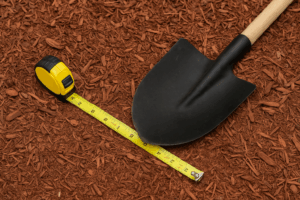
Measure the Thickness (in), Width (in), and Length (ft or in). If the board is irregular, use the average width.
Use the Free Board Foot Calculator to find your total volume. For large orders, calculate the total MBF (Thousand Board Feet).
Always add 15-25% to your order for waste (knots, grain matching, and cutting errors).
Lumber Pricing Trends in 2026: Cost per Thousand (MBF)
In 2026, the cost of framing lumber has stabilized after several years of volatility, currently hovering around $870 per MBF (thousand board feet). Hardwood prices remain higher and vary by species availability. When you check your Wood Cost Guide, remember that pricing is usually “tier-based”—larger quantities often earn a lower price per board foot.
If your project involves extensive site clearing, consider the Tree Removal Cost Calculator. If you are felling your own timber, you can use the BF formula to estimate the value of the “standing timber” before it ever reaches the mill.
Accounting for Spoil and Waste Factors in High-End Woodworking
In high-end furniture making, “yield” is rarely 100%. Knots, sapwood, and cracks often require cutting around portions of a board. A common standard is to add a 25% “waste factor” to your net project needs. If you need exactly 100 BF of cherry for a table, you should order 125 BF.
This level of contingency planning is as important as the “buffer” used in landscaping. When using the Topsoil Calculator or Free Dirt Calculator, you add extra to account for settling. In woodworking, the “waste” is the cost of ensuring the highest quality grain selection for your final piece.
Structural Projects: Stairs, Enclosures, and Masonry
When building structural features like stairs or decks, lumber volume must be perfectly balanced with engineering requirements. Use the Free Stair Calculator to determine your stringer and tread dimensions, then use the Board Foot Calculator to find the volume of cedar or pressure-treated wood needed.
Structural health is interconnected. If you are building a Pool Enclosure or repairing a Chimney, wood is often used for framing or scaffolding. Understanding your board footage ensures your material staging is efficient and your site remains clear for other contractors.
Outdoor Projects: Fencing, Decking, and Asphalt
Board footage is the standard for high-end exterior projects like ipe decks or cedar fencing. Coordinating these with your landscaping, such as using the Grow a Garden Calculator, ensures your outdoor space is cohesive. If your lumber delivery requires heavy trucks, keep an eye on your driveway; our Free Asphalt Calculator can help you estimate repair costs if heavy lifting causes surface wear.
For interior finish work that follows a structural build, don’t forget the aesthetic finish. Our Interior Painting Cost Calculator and Kitchen Cabinet Painting Calculator help you budget for the stains and paints that will protect your newly calculated board feet for decades.
Frequently Asked Questions About Board Foot Calculations
What is the difference between a board foot and a linear foot?
A linear foot measures only length (12 inches), regardless of width or thickness. A board foot measures total volume. For example, a 12″ long board that is 2×4 has much more volume than a 1×4, but they are both 1 linear foot.
How many board feet are in a 2x4x8?
Using the formula (2″ x 4″ x 8′) / 12, a standard 8-foot 2×4 contains approximately 5.33 board feet.
Why is hardwood sold by the board foot and not the piece?
Hardwood trees grow in irregular shapes. To maximize the yield, mills cut boards in “random widths.” Selling by volume (BF) ensures a fair price based on the amount of usable wood rather than forcing it into a standard dimensional piece.
What does 4/4 and 8/4 lumber mean?
This is the “quarters” system for thickness. 4/4 (four-quarter) is 1 inch thick. 8/4 (eight-quarter) is 2 inches thick. It represents the rough-sawn thickness of the lumber before it is planed.
Final Strategy
The Board Foot Calculator is the ultimate tool for banishing material uncertainty from your woodworking projects. By mastering the volume-based metrics of the timber industry, you can ensure a professional-grade result, minimize waste, and protect your project’s financial bottom line.
From planning your Driveway Paving to maintaining your Pool Chemistry, Waldev is dedicated to providing the technical data for your entire property. For more information on lumber grading and standards, we recommend visiting the National Hardwood Lumber Association (NHLA) for the latest in professional wood standards.